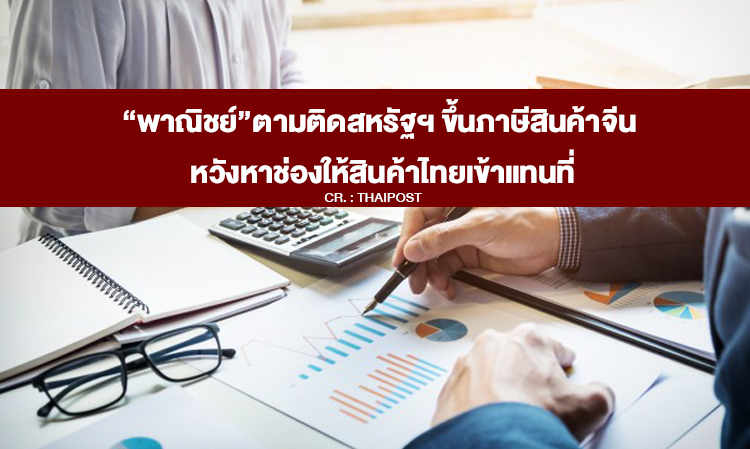
Commerce Ministry Follows U.S. Tax Hike on Chinese Goods, Aiming to Create Opportunities for Thai Products
On August 16, 2019, Ms. Pimchanok Wonkohporn, Director of the Office of Trade Policy and Strategy (OTPS), revealed updates on the U.S. announcement regarding the adjustment of tariffs on $300 billion worth of Chinese goods made on August 13, 2019. The U.S. has postponed some of the tariff increases, dividing them into two phases: the first phase on September 1, 2019, affecting over 3,000 items, including food such as meat, vegetables, fruits, nuts, butter, spices, beverages, tobacco, books and publications, clothing, footwear, household appliances, jewelry, and toys, as well as other products like minerals, chemicals, steel, aluminum, and motorcycles. The second phase on December 15, 2019, will affect around 500 items, mostly in the electrical and electronics sector, such as mobile phones, laptops, video game consoles, televisions, radios, computer monitors, and other products like watches, toys, footwear, and clothing.
The U.S. justified this tariff adjustment as a result of discussions and feedback from businesses and stakeholders in June 2019. The statement from the Office of the U.S. Trade Representative (USTR) also indicated that tariffs on health, safety, and national security-related products would be exempted. OTPS assessed that the delay in tariff increases is a positive sign that the U.S. and China may resume negotiations, with the next official talks scheduled for September 2019.
Ms. Pimchanok stated that Thailand has the opportunity to promote its potential products in the U.S. market to replace Chinese goods that will be subject to tariffs, particularly in processed agricultural products, food such as seasonings and beverages, clothing, and household items. However, Thailand must quickly implement measures to penetrate the U.S. market and other markets to compete with other countries that are also looking to enter the U.S. market. Thai products still have strengths in terms of quality and are trusted by consumers worldwide, which must be further promoted to enhance recognition.
Nevertheless, it is essential to monitor the progress of negotiations and the tariff increases that will take effect in the last quarter, as these may pressure the overall global trade landscape, including Thailand's exports towards the end of this year.
Deputy Prime Minister and Minister of Commerce Jurin Laksanawisit revealed after the ASEAN-U.S. Business Council (USABC) met with a delegation of U.S. business representatives on August 15, 2019, that the U.S. business delegation consisted of 46 companies and 108 individuals, marking the largest group to meet with representatives from various governments. They exchanged views on several issues and expressed a desire to enhance economic cooperation between the U.S. and Thailand in trade and investment.
He informed the U.S. business representatives that the government has policies to facilitate business operations to attract investment and business activities in Thailand. He also confirmed that Thailand protects intellectual property rights and supports a modern economy alongside social responsibility. At the same time, he urged U.S. investors in Thailand to use domestic raw materials for their products and services, emphasizing the importance of using contract farming systems to help stabilize agricultural prices for quality producers and to utilize rubber as a raw material in tire production.
Additionally, he provided updates on the progress of the Regional Comprehensive Economic Partnership (RCEP) negotiations, which are expected to conclude by the end of this year, and Thailand's stance on joining the Comprehensive and Progressive Agreement for Trans-Pacific Partnership (CPTPP), which the U.S. hopes to see progress on as it would benefit U.S. investors looking to expand their markets.
According to reports, the 46 U.S. companies that met with Mr. Jurin are major corporations, most of which have investments or business operations in Thailand, including 3M, Airbnb, Amazon, Bayer, Power Group Asia, Cargill, Chevron, Cigna, Cisco, Citibank, ConocoPhillips, Diageo, Dow, ExxonMobil, FedEx, Ford, Guardian Industries, Harley-Davidson, Herbalife, HP, Johnson & Johnson, Marriott, McLarty Associates, Netflix, Oracle, PayPal, PepsiCo, PMI, P&G, Seagate, TE Connectivity, Tyson, Apple, MSD, Expedia, Agoda, Google, Qualcomm, among others.
Ms. Siriporn Chaisut, Vice President of Strategy for Asia-Pacific at Chevron Asia Pacific Ltd., one of the U.S. companies that attended this meeting, stated that this was the largest gathering of U.S. business representatives meeting with government agencies in history over the past 35 years, with 46 companies participating, surpassing previous meetings in Malaysia, Vietnam, or anywhere else. The U.S. investment in Thailand is valued higher than investments in China and India, or both countries combined.
"The 46 companies, including those still in the U.S., are eager to learn about policies and partnerships with Thailand because U.S. investors already have a fondness for Thailand. With the new government following the elections, the political atmosphere has improved, encouraging them to come," Ms. Siriporn stated.
Thank you for the information from www.thaipost.net