Finance Ministry Cuts 2019 GDP Growth Forecast to 3.8% Due to External Factors Impacting Economic Engines
On April 29, 2019, Mr. Lawaron Sangsanit, Director of the Fiscal Policy Office (FPO) and spokesperson for the Ministry of Finance, announced that the Ministry has revised its economic forecast for Thailand in 2019. It is now expected that the Thai economy will grow at a rate of 3.8% this year, slightly down from the previously estimated 4.0% in January 2019. The main reasons for this adjustment include the slowdown in the economies of trading partners and global trade volumes, as well as the impacts of trade policies between the U.S. and China and retaliatory measures from various countries, which have led to a downward trend in Thai exports, now expected to grow at 3.4%, down from the previous estimate of 4.5%.

Mr. Lawaron Sangsanit, Director of the Fiscal Policy Office (FPO) (left)
However, the service exports are expected to continue growing, supported by an increase in tourist arrivals compared to the previous year, along with the extension of the Visa on Arrival (VOA) fee waiver, which is anticipated to lead to a 2.4% growth in goods and services exports (with a forecast range of 1.9% – 2.9%).
Meanwhile, public investment projects are expected to continue driving the economy, supported by an increasing budget for public investment in the fiscal year 2019. It is anticipated that public consumption and investment will grow at 2.0% (with a forecast range of 1.5% – 2.5%) and 4.6% (with a forecast range of 4.1% – 5.1%), respectively.
Additionally, it is expected that this year, public-private partnership (PPP) projects in infrastructure will further support private sector investment growth compared to the previous year, with private investment expected to grow at 4.1% (with a forecast range of 3.6% – 4.6%). Private consumption is also expected to continue growing at 4.2% (with a forecast range of 3.7% – 4.7%), supported by improving household income outside the agricultural sector due to increased employment. Imports of goods and services are expected to grow at 3.4% (with a forecast range of 2.9% – 3.9%), slowing down from the previous year due to a decline in exports and domestic consumption.
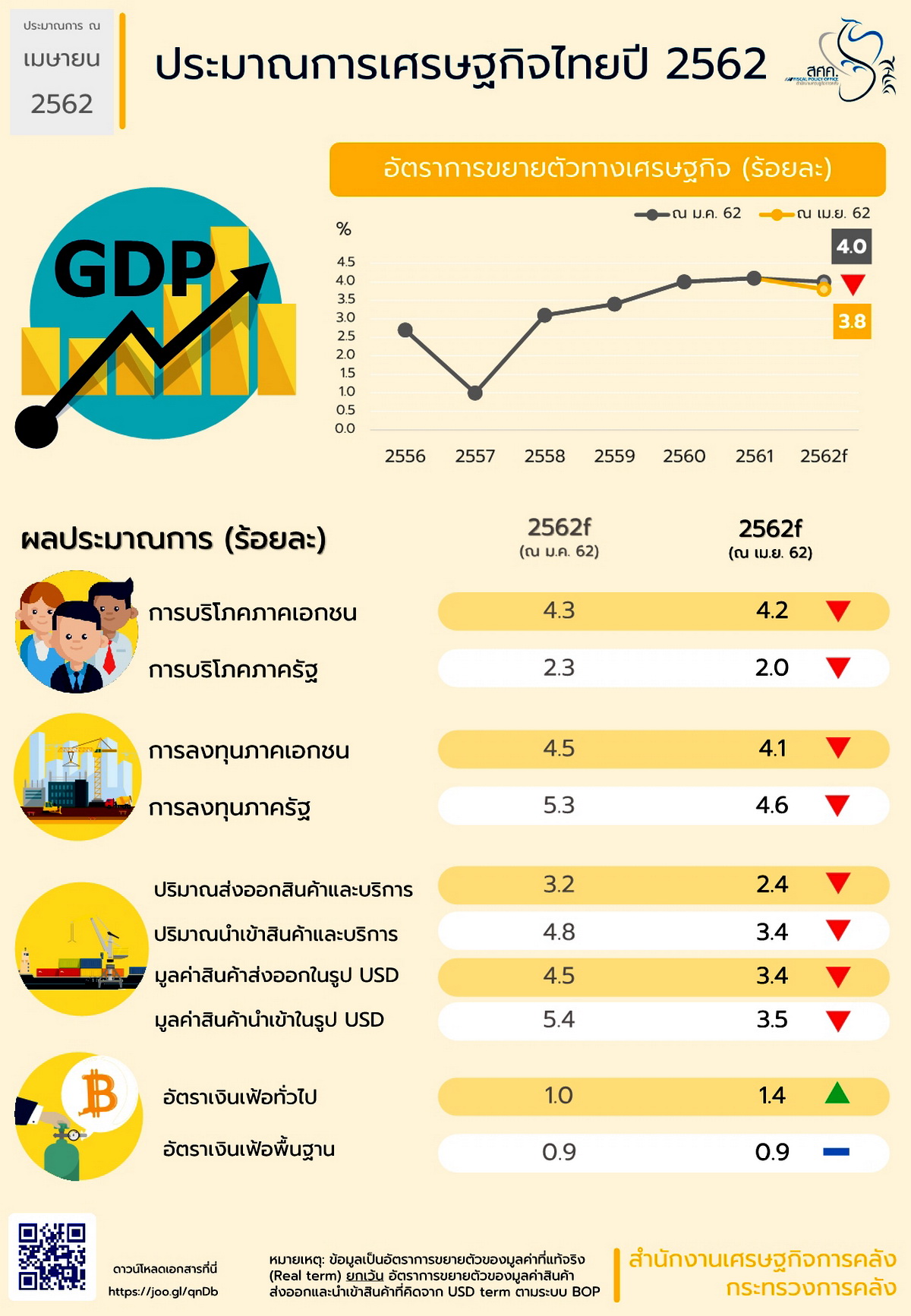
Regarding domestic economic stability, the general inflation rate in 2019 is expected to be at 1.4% (with a forecast range of 0.9% – 1.9%), increasing from the previous year due to rising costs from crude oil prices in the global market, partly due to the U.S. ending exemptions on sanctions against countries importing oil from Iran, which has resulted in a limited increase in global crude oil supply. For external stability, it is expected that the current account will have a surplus of $37.8 billion, or 6.8% of GDP (with a forecast range of 6.3% – 7.3% of GDP), due to a trade surplus expected at $24.3 billion, as the value of imports is anticipated to grow at a faster rate than that of exports. The value of imports is expected to grow at 3.5% (with a forecast range of 3.0% – 4.0%), while the value of exports is expected to grow at 3.4% (with a forecast range of 2.9% – 3.9%).
“The direction of the Thai economy moving forward must take into account the risk factors that need to be closely monitored, such as the impacts of trade barriers between the U.S. and China, as well as the volatility of global financial markets and exchange rates. Additionally, the government will play a role in sustaining the economy moving forward through domestic spending,” the spokesperson for the Ministry of Finance concluded.
Thank you for the information from thaipublica.org