
Men vs. Women: Who Truly Holds the Reins of Senior Management in Thailand?
It is undeniable that e-commerce is gaining immense popularity in Southeast Asia. However, whether it thrives or falters depends not only on the service model that effectively targets customers but also on the internal management of the company. The more visionary the executives are, the longer they can compete with rivals. In the past, senior executives in Thailand were predominantly male due to traditional cultural beliefs that men must always take the lead, resulting in a scarcity of female executives in organizations. However, as times have changed, gender equality has significantly improved, and since most e-commerce businesses in Thailand market internationally, iPrice conducted a study analyzing the gender diversity of executives in Thai e-commerce stores, revealing five interesting points:
Male Executives Dominate Thai E-commerce Stores
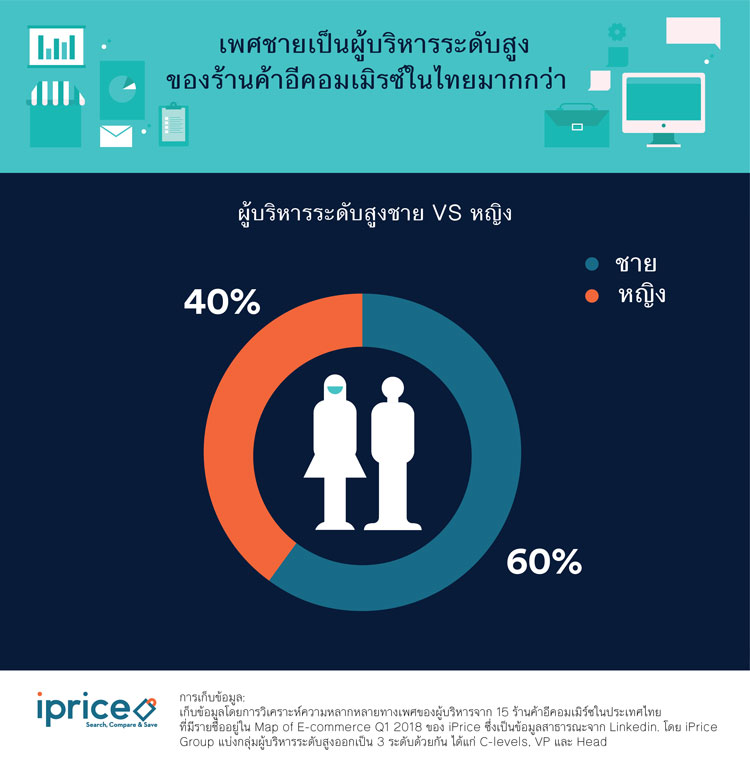
The results were as expected, with a higher ratio of male to female executives. However, the gender gap was not as wide as anticipated, with men making up 60% and women 40%. This data was collected from senior executives in Thai e-commerce stores, some of which are not directly Thai-owned. Additionally, since most e-commerce businesses operate in multiple countries, they tend to select their executive teams based on new criteria that do not involve gender differences. Nevertheless, certain types of e-commerce stores and specific positions still prefer male executives with more expertise, such as in electronics and IT.
Gender Differences Among Various Executive Levels in E-commerce
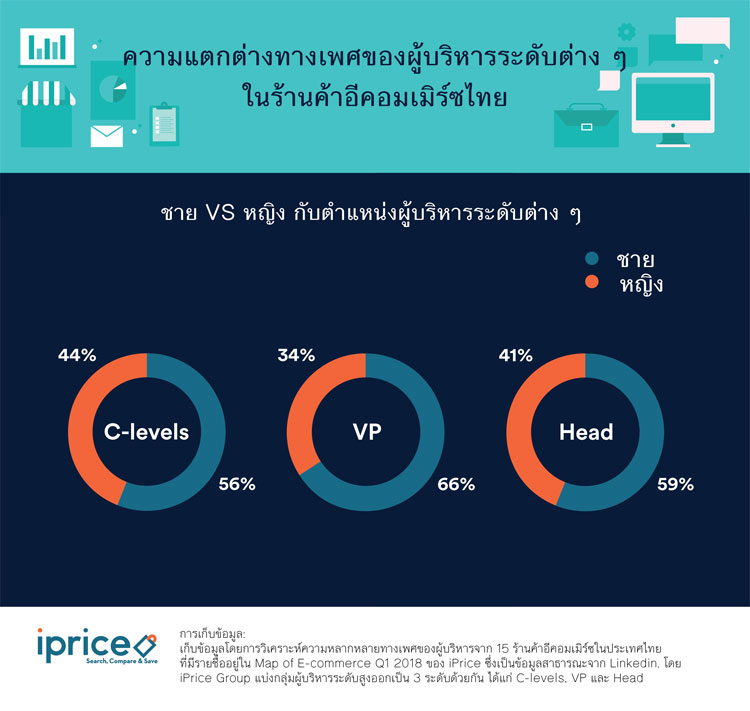
When analyzing the gender differences among senior executives in Thai e-commerce stores across three levels—C-Levels, VP, and Head—it was found that the gender disparity varies at each level. At the C-Level, including SVP, Founders, Co-founders, and Managing Directors, the gender ratio is 56% male to 44% female, which is relatively close. This supports the notion that Thailand is increasingly embracing foreign cultures and ideas regarding gender equality. At the VP level, women hold 34% of positions compared to 66% for men. Finally, at the Head level, which has the most data due to the numerous departments and management structures, the gender ratio is nearly equal at 59% male and 41% female. This may be because positions at this level often serve as stepping stones for advancement, leading to similar gender ratios at the Head and C-Level due to the motivation to produce results for higher positions.
Ethnic Diversity Among Senior Executives in Thai E-commerce
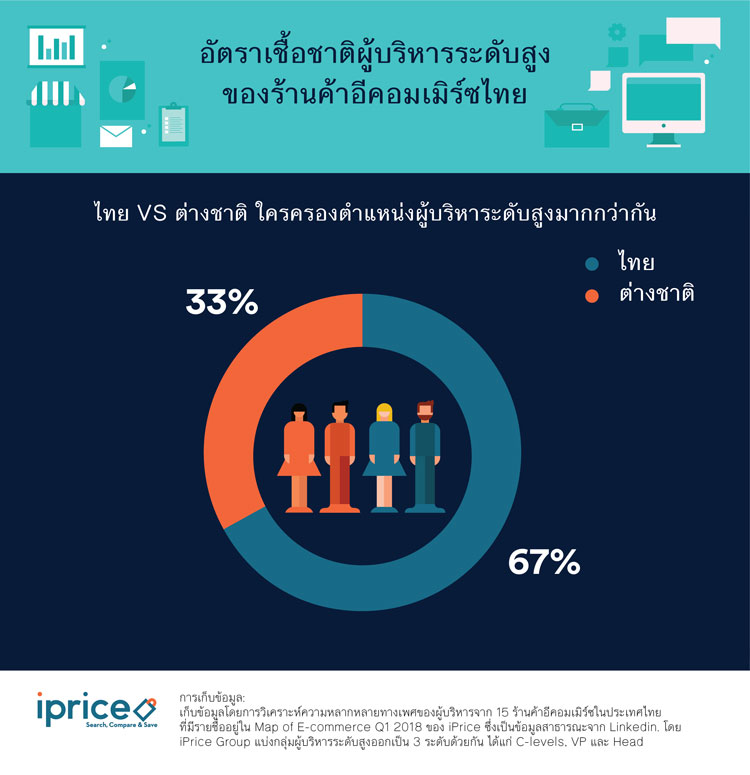
Given that most e-commerce businesses market in multiple countries, foreign executives represent a strategic approach to diverse management. The data shows that 33% of senior executives in Thai e-commerce stores are foreign, making up one-third of the total, while Thai executives account for 67%. Although the latter is double the former, the gap suggests that Thai e-commerce stores value the diverse perspectives of executives from different nationalities, providing opportunities for foreigners to lead and drive the business.
Gender and Ethnic Differences Among Senior Executives in Thai E-commerce
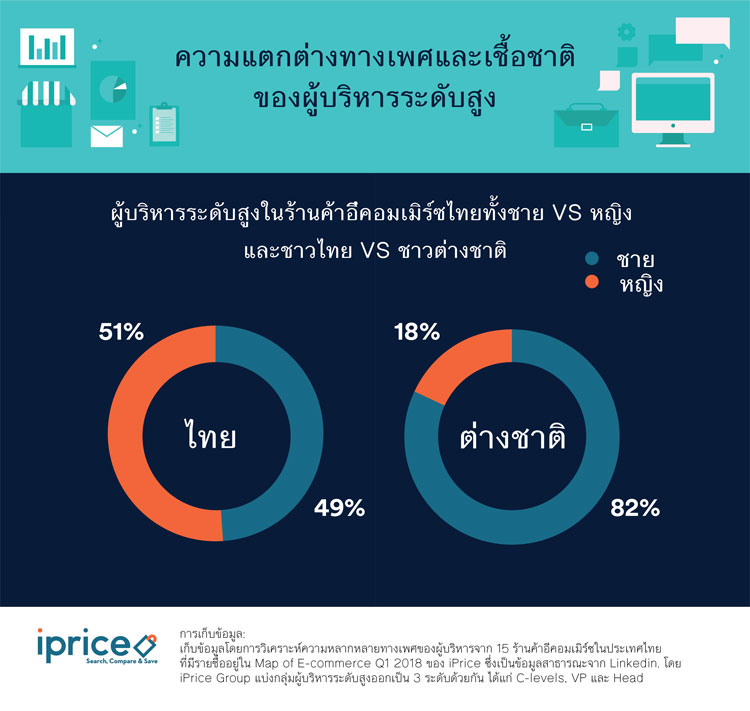
When categorizing the data by gender and ethnicity, it was found that among Thai executives, women hold 51% of positions compared to 49% for men. In contrast, among foreign executives, men dominate at 82% to 18%. This data further suggests that the criteria for selecting senior executives in Thai e-commerce stores focus primarily on capability, with gender differences being a minor consideration. As more online stores emphasize fashion, health, and beauty products, the demand for female executives is increasing, making it unsurprising that women play a significant role in managing Thai e-commerce stores.
Gender Differences Among Executives in Different Types of E-commerce
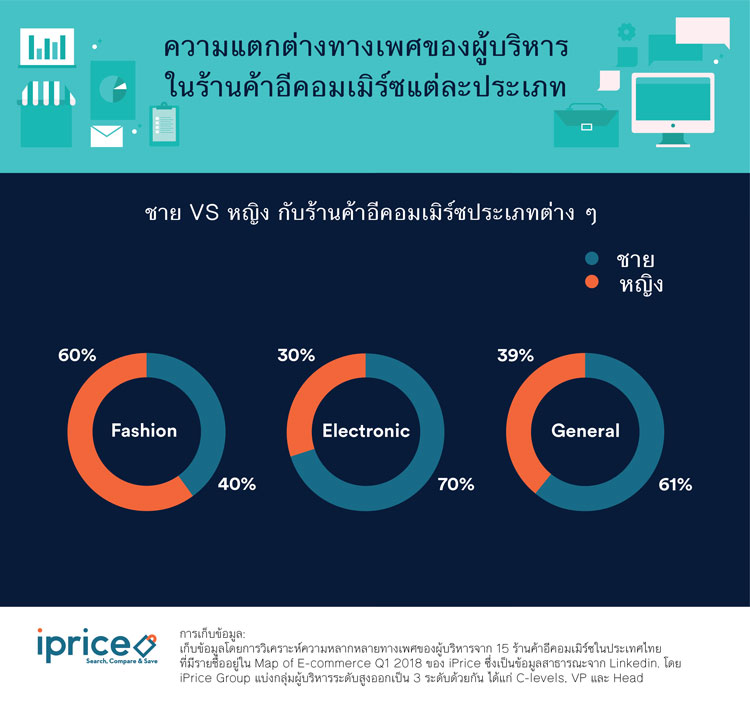
When categorizing the data into three business types: Fashion, Electronic, and General, it further supports the likelihood of an increase in e-commerce stores targeting women, such as in Fashion, where female executives are preferred to align with the target audience, resulting in a gender ratio of 60% female to 40% male. Next, in the Electronic category, which primarily targets men with a natural inclination towards IT devices, the ratio of male executives is significantly higher at 70% to 30%. Finally, in the General e-commerce category, which still dominates the Thai e-commerce market, the data shows that male executives account for 61% while female executives make up 39%, a figure that is not surprising.
Data Collection: Data was collected by analyzing the gender diversity of executives from 15 e-commerce stores in Thailand listed in the Map of E-commerce Q1 2018 by iPrice, which is publicly available data from LinkedIn. The iPrice Group categorized senior executives into three levels: C-levels, VP, and Head.
Written and analyzed by Kanitha Sasa-kul iPrice
Thanks to the information from ipricethailand.com