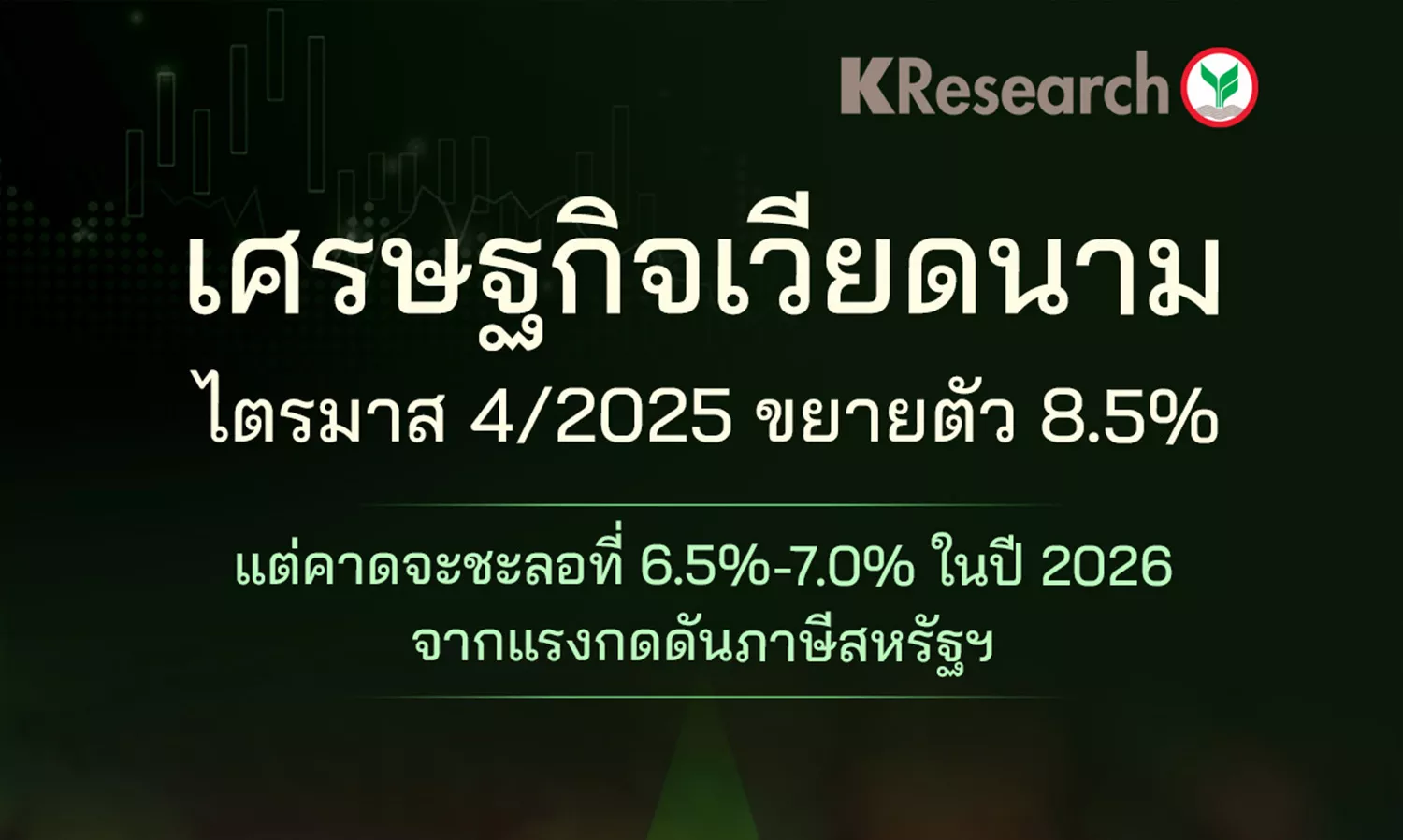
Vietnam's Economy Grows 8.5% in Q4/2025 but Expected to Slow to 6.5%–7.0% in 2026 Due to U.S. Tax Pressures
Vietnam's economy accelerated growth in Q4/2025 at 8.5% YoY, surpassing Bloomberg's survey average of 7.7%. The main driving factor was the continued strong growth in public investment at 24.4% YoY, spurred by the acceleration of infrastructure spending, particularly the Long Thanh International Airport, which opened on December 19.
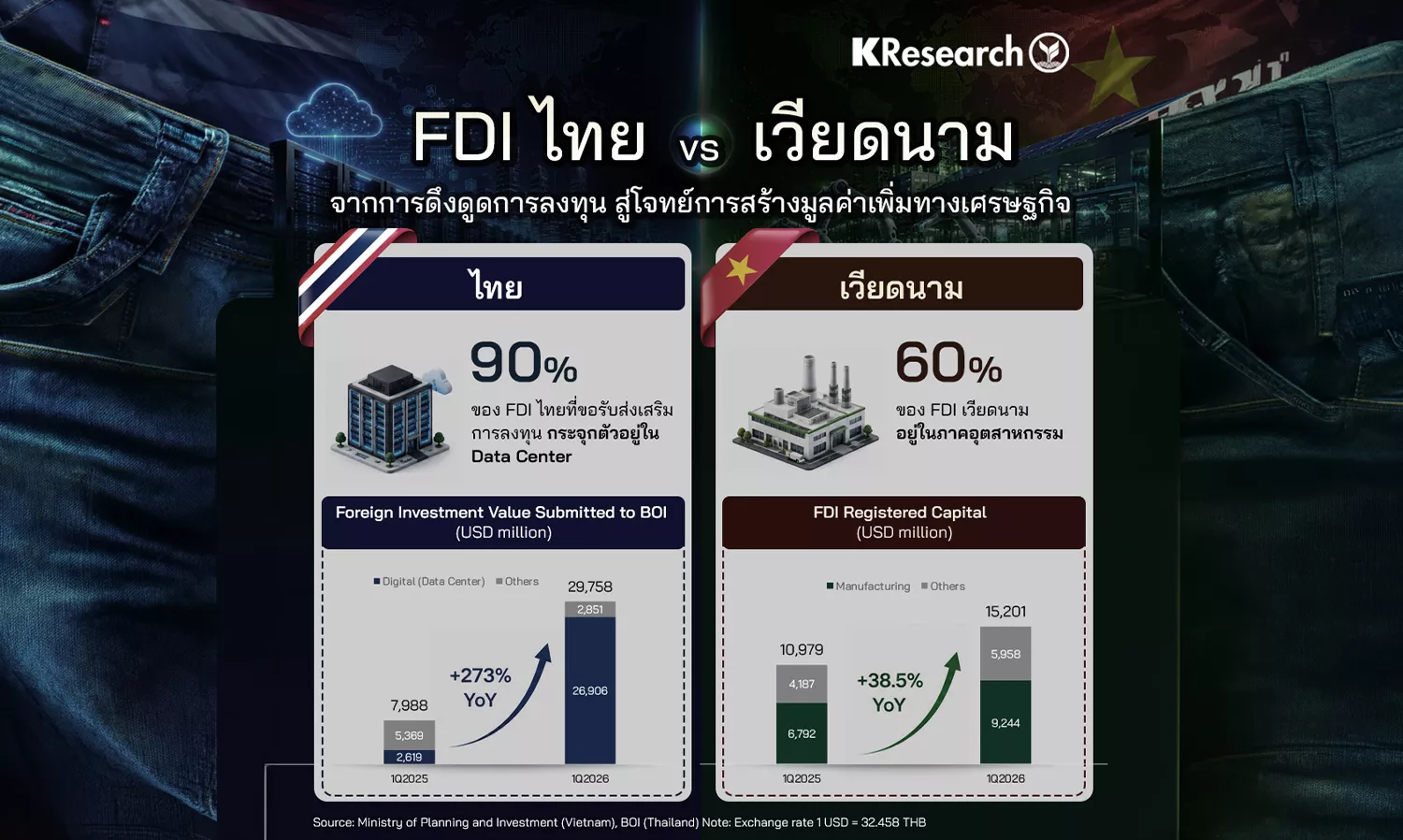
Foreign Direct Investment (FDI) also saw a significant increase of 10.0% YoY, with major new investment projects coming from China (48%), Singapore (15%), South Korea (12%), and Japan (8%). This reflects that Vietnam continues to benefit from the relocation of manufacturing under the Trump 2.0 policy.
Exports continued to grow at 18.9% YoY, close to the 18.2% YoY in Q3, with exports to the U.S. still showing strong growth at 28.8% YoY, despite a slowdown from Q2.
Vietnam's exports to the U.S. in Q4 remained robust, driven by the acceleration of electronic goods that have not yet been subject to U.S. import tariffs. However, President Trump announced plans to increase import tariffs on semiconductors by up to 100% in the future, resulting in a significant growth of 37.3% YoY in electronic goods exports in Q4.
Conversely, products heavily reliant on the U.S. market that are already subject to import tariffs, such as clothing and footwear, saw export growth slow to 0.9% YoY.
For the entire year of 2025, Vietnam's economy grew by 8.0%, higher than the 7.0% in the previous year, supported by:
-
Exports of goods and services (16.3%)
-
Total investment (8.7%)
-
Domestic consumption (8.0%)
For 2026, the Vietnamese economy is expected to slow to 6.5%–7.0% due to U.S. tax pressures, with exports likely contracting due to full-year import tariffs on a high base from the previous year, which saw accelerated exports.
Household consumption is expected to grow at a slower pace in line with industrial labor income focused on exports. However, investment in infrastructure is likely to accelerate due to the Doi Moi 2.0 policy, which enhances public sector efficiency, allowing for better budget allocation to support long-term growth.
Key Risks to Monitor:
Vietnam's economy still faces significant risks, including:
-
Potential additional U.S. import tariffs, particularly on semiconductors, and a 40% transshipment tax.
-
High levels of non-performing loans (NPL) in the banking system, with an NPL ratio of 4.91% as of March 2025, primarily stemming from the real estate sector, which has been struggling since late 2022, although the market is slowly starting to recover.
-
Trends of depreciation of the Vietnamese dong due to ongoing capital outflows from the stock and bond markets over the past three years.
Copyright and Usage Note:
This report is prepared by KASIKORN RESEARCH CENTER (KResearch) for general dissemination. Any use (in whole or in part) must credit the source of the information and cannot be used for commercial purposes, modified, or republished without written permission.