Thai Border Trade Expected to Grow Over 28% in 2021, Southern China Ranks First for the First Time (Kasikorn Research Center)
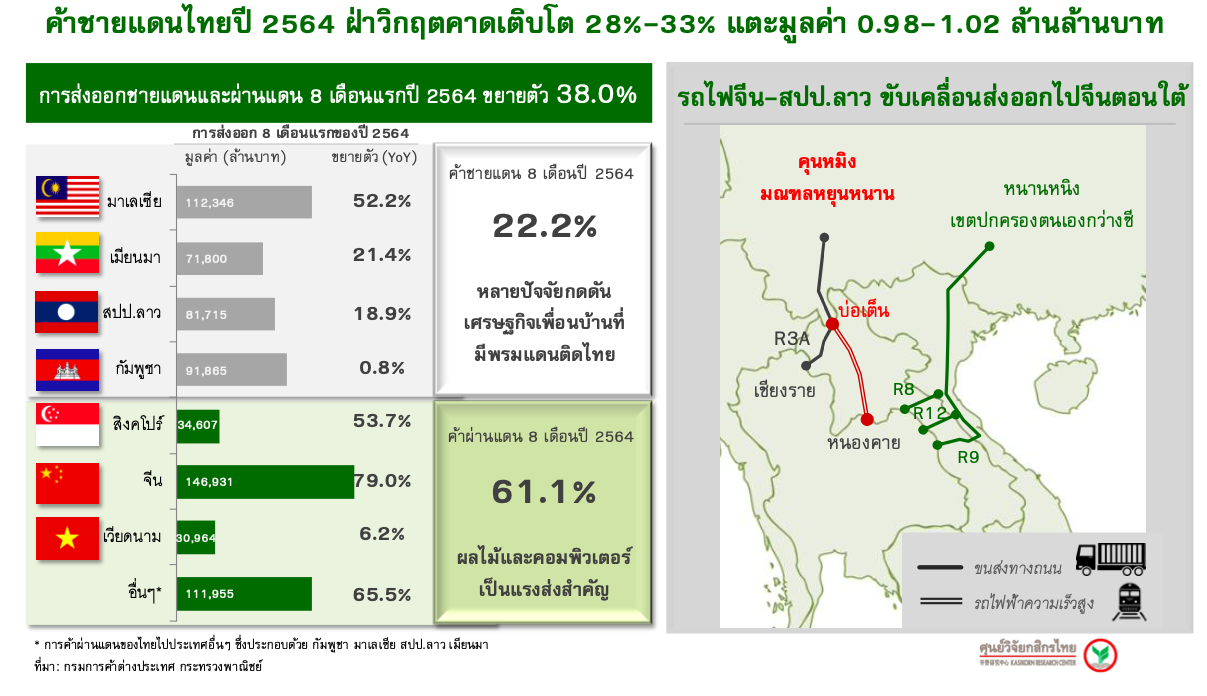
The export situation at Thailand's borders and through border trade during the first 8 months of 2021 has shown a progressively brighter outlook, benefiting from a low base in the previous year. Increased purchasing power and rising energy prices have led to a significant growth of 38% (YoY), with export values reaching 682,184 million baht. This growth is primarily driven by cross-border trade markets, which are increasingly appealing due to purchasing power and diverse product demands from Singapore, Southern China, Vietnam, and others, growing at 61.1% (YoY). In contrast, markets bordering Thailand, such as Malaysia, Myanmar, Laos, and Cambodia, where Thai products have limited market access, expanded by only 22.2% (YoY). The Kasikorn Research Center believes that exports are likely to continue growing, primarily fueled by exports to third countries as follows:
- The trade structure is shifting towards growth from cross-border trade to third countries, particularly with exports to Southern China showing remarkable growth. In August, exports to China surpassed those to Malaysia for the fifth consecutive month, resulting in a total of 146,930 million baht in exports to China over the first 8 months of 2021, marking a 79% increase (YoY). This growth is largely attributed to fruit exports such as durian, longan, and mangosteen, which expanded by 211.3% (YoY). Additionally, exports to Singapore and Vietnam continue to grow well at 53.7% and 6.2%, respectively. This interesting growth has shifted the structure of border trade towards cross-border markets, now accounting for 47.6% of total border and cross-border trade, a significant increase from 41.5% in 2020.
- Transporting fruits by road to China has become increasingly popular. It is now time for Thai operators to seriously consider the quality standards of fruit products, as Chinese authorities have tightened inspections at border checkpoints regarding good agricultural practices (GAP), good manufacturing practices (GMP), contamination control, and checking for residues on fruits. In July, China temporarily suspended imports of Thai durian due to some operators failing to meet GAP and GMP standards. Furthermore, Chinese authorities recently announced a ban on imports of wax apples and sugar apples from Taiwan starting September 20 due to the detection of mealybugs. Earlier, in March, Taiwan was also banned from exporting pineapples due to pest detection during transport. Thus, exporting Thai fruits via road to third countries has become increasingly important; during the first 8 months of 2021, Thailand's fruit exports to third countries reached 81,925 million baht, mostly to China, with only a small amount sent to Vietnam. This value represents a significant 62.1% of total Thai fruit exports to China and Vietnam across all channels (including land, water, and air), further emphasizing the growing importance of road transport for fruits, which was only 4.1% in 2017.
- Convenience in international transport is attracting increased use of road transport routes for exports to Southern China. Currently, road transport accounts for 18.9% of total exports from Thailand to China (with the remaining 81.1% transported by sea), up from 13.2% in 2020. In the first 8 months of 2021, total cross-border exports to Southern China were valued at 146,931 million baht, primarily passing through Thailand's northeastern region to the Guangxi Zhuang Autonomous Region, which has both large markets and multiple convenient transport routes. Exports to Yunnan Province accounted for about 18%, valued at only 27,502 million baht. The changes occurring during this period provide Thai operators with more options for transporting goods, as follows:
- The economies of trading partner countries and the pressures affecting border trade are beginning to ease, as strict COVID-19 measures at Thai border checkpoints are gradually being lifted. The Thai authorities plan to gradually reopen border checkpoints that were previously closed to prevent COVID-19. Out of 97 checkpoints, only 44 are currently operational. Although trading partner countries still maintain strict measures to control the COVID-19 situation in cross-border transport, it is believed that this will not adversely affect Thai exports for the remainder of the year. Additionally, the markets of Malaysia, Myanmar, Laos, and Cambodia, which share borders with Thailand, are beginning to ease lockdowns, reflecting effective control of the COVID-19 outbreak, which will support recovery for the remainder of the year in each country. However, the political situation in Myanmar continues to pose concerns for the economy, and Western nations' economic sanctions exacerbate domestic shortages of consumer goods. This has resulted in continued demand for Thai products, as evidenced by a 21.4% (YoY) growth in exports to Myanmar during the first 8 months of 2021, particularly for diesel, finished oil, beverages, herbs, and cosmetics.
- Operators have multiple channels for exporting to China, especially new routes to Yunnan Province, which will facilitate smoother transport of goods. This is due to Thai and Chinese authorities collaborating to open 7 additional quarantine checkpoints for inspecting fruit imports and exports at the beginning of September, including 1 checkpoint on the Thai side at Nong Khai, which is prepared to accommodate the China-Laos railway, and 6 checkpoints on the Chinese side, including those in Yunnan Province and Guangxi. This allows Thai operators to have a total of 16 land transport routes for fruits to China. Existing operational checkpoints include those in Yunnan Province at Mohan and in Guangxi at Youyi Guan, Dongxing, and Pingxiang railway checkpoints. On the Thai side, operational checkpoints include Chiang Khong (Chiang Rai), Mukdahan, Nakhon Phanom, Ban Pak Kad (Chanthaburi), and Bueng Kan.
- A new dimension of transport via the high-speed railway connecting China and Laos will commence operations on December 2, 2021, allowing goods to be transported from Vientiane directly to Yunnan Province in just 8 hours. The railway connects with Thailand at Nong Khai, which is already the main route for transporting goods into Laos. However, it has rarely been used for transporting goods to China due to the winding and steep R13 road, which takes over 15 hours to transport goods through Luang Prabang to Boten in Laos to enter Yunnan Province. The new railway route helps shorten the distance and reduce travel obstacles, and the railway's endpoint also connects with the Chinese border at Boten, similar to the R3A road that passes through Chiang Rai to Boten, which is currently the main road used by Thailand to transport goods to Yunnan Province. Therefore, this new railway line represents an interesting alternative transport route.
In summary, the Kasikorn Research Center believes that Thailand's border and cross-border exports may slow down in the remaining months of the year as the effects of the low base begin to dissipate. Meanwhile, economies in many countries are showing signs of recovery from the Delta variant of COVID-19, particularly in Southern China, which has more positive signals than other countries. This makes it a market that will drive Thailand's overall border and cross-border exports throughout 2021, leading to an expected growth of no less than 28%, reaching a record high value of 980,000 million baht. In a favorable scenario, if the COVID-19 situation improves progressively and purchasing power of trading partners recovers rapidly, along with smooth fruit exports to China for the remainder of the year, there is a possibility that export values could expand by 33%, reaching 1,020,000 million baht for the first time in history, surpassing the 1,000,000 million baht mark for border exports.
In the future, the Southern China market will become increasingly important as Thailand's number one border export market, reflected by export values surpassing Malaysia for the first time in history in 2021. The opening of the high-speed railway route connecting China and Laos will elevate transportation between Vientiane, Luang Prabang, Luang Namtha, and Kunming, transforming a challenging mountainous transport route into a convenient and fast one. Thai operators can use this as an additional option for exporting to Yunnan Province, which has traditionally relied on the R3A route. Thus, there is a chance that exports to Yunnan Province will become a driving force for increased exports to Southern China in the future, as the primary growth has typically come from exports to the Guangxi Zhuang Autonomous Region, which accounts for 82% of Thailand's border exports to Southern China.