India's Economy and Investment Growth Boosts Thai Exports to India in 2021 by 40%
Analysis from Kasikorn Research Center
- India is not only an attractive country due to its high economic growth rate, ranking among the top in the world, but in 2020, it also attracted significant FDI inflows, becoming the fifth largest recipient globally. The Kasikorn Research Center believes that the new wave of investments, particularly in digital services, e-commerce, and ICT, as well as the production of technology products like smartphones, electrical/electronic appliances, and electric vehicles, will play a crucial role in transforming India's production structure to integrate into the global supply chain. This will benefit exporting countries, including Thailand, which is a key producer of electronic components, providing opportunities for growth alongside India's manufacturing sector.
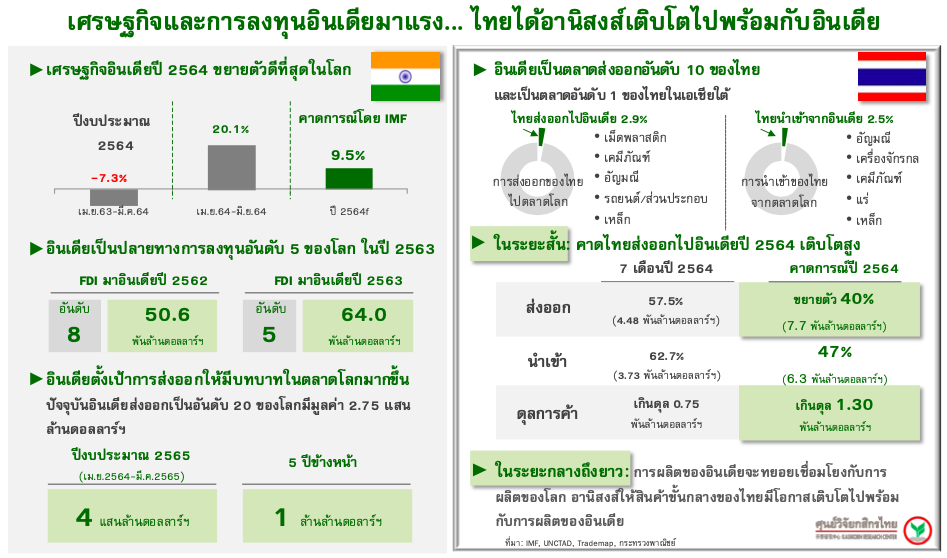
- The Kasikorn Research Center anticipates that in the short term, Thai exports to India in 2021 will benefit from the economic recovery, expanding by approximately 40% YoY, reaching a record high value of $7.7 billion. In the medium to long term, if FDI continues to flow into India, enabling significant production and export of technology products, Thailand could become an interesting supplier of intermediate goods to South Asian countries, particularly in electrical and electronic components and automotive parts.
Despite facing a severe outbreak of the Delta variant of COVID-19, India's economy in Q2 2021 managed to achieve a record growth rate of 20.1% (YoY), partly due to recovery from the previous year's significant contraction of 24.4%. Additionally, India's exports reached a new monthly record of $35.2 billion in July 2021, driven by the economic recovery of its trading partners. The UNCTAD's World Investment Report 2021 indicates that India has moved up to become the fifth largest destination for FDI inflows in 2020 (from eighth place in 2019). The Kasikorn Research Center views the increasing trend of investment in India as a reflection of its emerging role in global manufacturing. This trend not only supports India's economy but also necessitates increased imports of production factors, particularly intermediate goods, benefiting exporting countries, including Thailand, for several reasons:
- The structure of India's manufacturing has begun to change since the introduction of the Make in India policy in 2014, which has facilitated investment, attracted capital, and enhanced domestic production capabilities. However, the incoming investments have primarily focused on less complex manufacturing. In 2015, following the policy's implementation, new investment (Greenfield FDI) in India surged to first place, surpassing the US and China for the first time, mainly in natural resources and energy sectors such as coal, oil, natural gas, and renewable energy. In 2017, India made significant improvements to its Goods and Services Tax (GST) structure, reducing redundancy in tax collection and lowering the tax burden on businesses. These government efforts have made India a more attractive investment destination, moving up to 63rd in the world (according to the Ease of Doing Business 2020 report) from 100th in 2017.
- The COVID-19 pandemic and trade wars have also been pivotal in increasing India's role in global manufacturing. FDI into India has jumped significantly within just one year, highlighting India's emergence as a standout option in South Asia. This trend is expected to continue over the next decade, as the investments that have flowed in over the past 1-2 years are largely due to global investors' plans to diversify their investments to mitigate risks from trade wars, natural disasters, and pandemics. In 2020, FDI into India grew by 27%, reaching a record high of $64.0 billion, while global FDI contracted by 35%, placing India fifth globally (up from eighth in 2019), trailing only the US, China, Hong Kong, and Singapore. This indicates that India has a unique appeal that is difficult for other countries to replicate, being a large market with over 1.3 billion people and suitable for labor-intensive manufacturing, with a workforce of 472 million and low labor costs of just $2.8 per day (lower than Thailand, China, and Vietnam).
- The influx of FDI is enhancing India's manufacturing capabilities in technology products that cater to daily life needs. Nearly half of the new FDI entering India last year was in the ICT sector, focusing on computer software and hardware, responding to the booming digital technology trend during the COVID-19 crisis. This includes significant investments from major US e-commerce companies driving digital business across various sectors, such as integrating technology into agriculture and modernizing healthcare systems. The production of these products is expected to drive future investments, building on India's existing strengths as the third-largest producer of pharmaceuticals globally, supplying 50% of the world's vaccine needs, and producing generic drugs at affordable prices for developing countries' healthcare systems. Additionally, India has the potential to expand its automotive production, with a capacity of 26.36 million vehicles annually, particularly motorcycles, which accounted for 80% of India's automotive production in 2020.
- Investment in technology is increasingly linking India's production to the global supply chain, as currently, India has minimal involvement in global manufacturing due to its lack of capacity to produce complex export goods. India's role in the global market is as the 20th largest exporter, with exports valued at $275 billion, primarily consisting of raw materials and products where India has competitive advantages, such as oil, commodities, minerals, chemicals, pharmaceuticals, rice, and cotton. However, there are signs that India's production chain will gradually strengthen, driven by additional investments from Korean smartphone manufacturers last year, which will significantly influence the production of related products in India. India has been assembling mobile phones since 2014, importing components for domestic sales and increasing exports, which reached $3.9 billion, but accounted for only 0.7% of global exports. In 2021, investors are also expanding production and R&D in the semiconductor industry for electrical appliances and automotive sectors, as well as investing in the supply chain for electric vehicle (EV) production.
It is evident that India is becoming a focal point for global investment interest. Despite existing production limitations, the gradual influx of investment will encourage India's production structure to integrate more into the global supply chain. Previously, India withdrew from the RCEP free trade agreement, missing out on joining a significant Asian supply chain. Although India has FTAs with several countries, such as ASEAN, Chile, Afghanistan, Bhutan, Nepal, Singapore, and Sri Lanka, these countries do not possess upstream production technology to connect India's manufacturing with international markets. Attention should be paid to the economic developments of the Quadrilateral Security Dialogue (Quad), which brings together countries that own production technology, such as the US and Japan, with Australia possessing critical mineral production factors, and India as a low-cost production hub. If the informal meeting of Quad leaders in September 2021 leads to trade/investment liberalization or clear economic cooperation, it could position India as a significant player in global manufacturing moving forward.
Currently, India ranks as Thailand's 10th largest market and is the most important market for Thailand in South Asia. Thai exports to India in the first seven months of 2021 grew by 57.5% (YoY), valued at $4.486 billion. Despite a long-standing FTA between the two countries, the export relationship remains relatively small, accounting for only 2.9% of Thailand's total exports to the world, primarily driven by growth in raw materials such as copper, plastic pellets, and chemicals to meet India's increasing production and consumption needs. The Kasikorn Research Center believes that with the global market's support for India's economic recovery, coupled with Thailand's raw materials being essential for domestic production in India, India is likely to be another market that returns to pre-COVID-19 levels. In the remaining months of the year, exports may grow slowly from the previous year's elevated base, but throughout 2021, the export value to India is expected to reach a record high of no less than $7.7 billion, expanding by 40%. Looking ahead, if India continues to develop its investment landscape attractively, it will likely drive demand for intermediate goods from Thailand, expanding beyond the current limited value in automotive parts to include electrical and electronic components, opening new markets in South Asia.