EIC Deep Dive Analysis of the Bangkok and Perimeter Residential Market in 2021: Solutions for Operators Amid Challenges from the COVID-19 Crisis
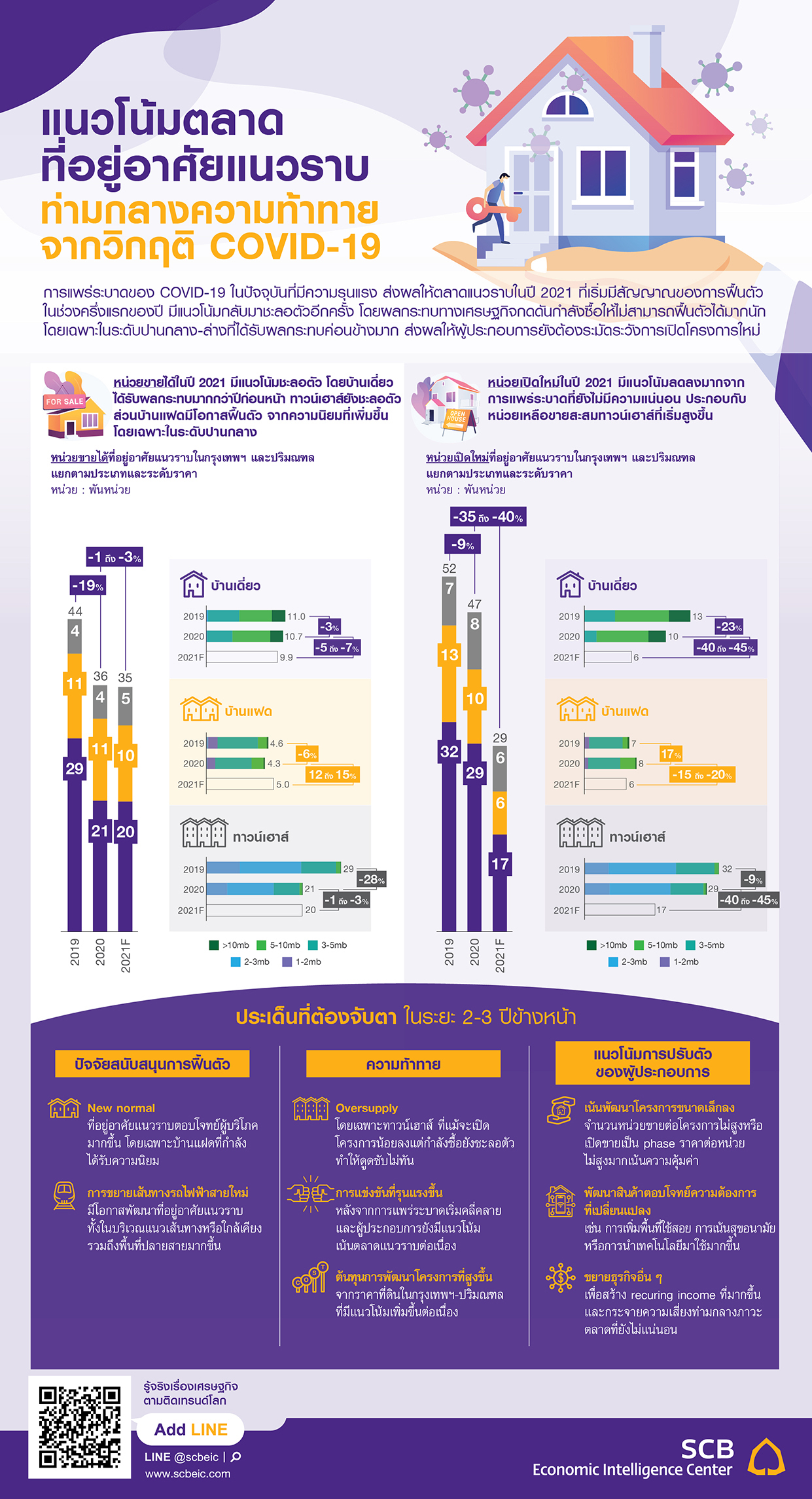
- The severity of the new wave of COVID-19 has caused the previously recovering low-rise residential market in the first half of 2021 to slow down again, particularly for townhouses, which are primarily in the mid to lower market segments that have been significantly affected by the economic slowdown. As a result, operators must continue to focus on ongoing promotions to attract the remaining real demand.
- Although there are supportive factors from measures to reduce transfer and mortgage fees, these are limited to residential properties priced below 3 million baht, which may stimulate the market to some extent. Overall, EIC views that the low-rise residential market is still on a downward trend from the first half of the year, which showed initial signs of recovery. It is expected that the sales units of low-rise residential properties in Bangkok and its vicinity in 2021 will be around 35,000 units, a decrease of -1% to -3% YoY from last year, remaining below pre-COVID-19 levels.
- Regarding supply, operators remain cautious or are delaying the launch of new projects for the remainder of 2021, especially for townhouses, due to the impact of the new wave of COVID-19 on the recovery of purchasing power in the mid to lower segments. Additionally, the accumulated unsold units are trending upward, while the launch of single-house projects is expected to grow more slowly due to land constraints. EIC predicts that the overall new launches of low-rise residential properties in 2021 will decrease by approximately -36% to -39% YoY, totaling only 29,000-30,000 units, which is below the average of new low-rise residential launches during 2017-2019 (before COVID-19), which was around 50,000 units per year.
- In the next 2-3 years, as the pandemic situation begins to ease, the low-rise residential market is expected to gradually recover with supportive factors, including:
1. The new lifestyle trends are making low-rise residential properties more appealing to consumers today, especially twin houses, which are likely to gain popularity among the mid to upper purchasing power segments due to their value in terms of price, function, and usable space.
2. The expansion of the electric train routes will make low-rise residential projects along the routes and at the end of the lines more attractive. - However, the low-rise residential market still faces several significant challenges, including:
1) Excess supply, particularly in townhouses, where even though new project launches have decreased, the returning purchasing power is still sluggish, leading to a prolonged absorption period for townhouses in the market. Additionally, the launch of projects along new electric train routes may intensify competition in those areas.
2) Increased competition in promotions has limited the price increases for certain residential segments, especially townhouses.
3) The rising development costs due to increasing land prices in central Bangkok and surrounding areas, as well as construction costs from rising prices of certain construction materials, particularly steel, which has seen significant increases. - In a market that is still recovering slowly, operators are focusing on adaptive strategies, including:
1) Developing smaller projects, reducing the number of units per project, gradually launching projects phase by phase, and focusing on projects with lower overall values while emphasizing value.
2) Developing projects that meet the changing lifestyles of consumers, including work-from-home arrangements and prioritizing cleanliness and hygiene.
3) Expanding into other businesses and creating more recurring income, such as hotel rentals, industrial estates, hospitals, engineering services, electricity generation, transportation, and warehousing.
The COVID-19 crisis has significantly impacted the overall residential market. While low-rise residential properties have been less affected compared to condominiums, they still cater to real demand. Additionally, the mid to upper purchasing power segments, which have been less economically impacted than the mid to lower segments, have helped support the low-rise residential market in the past year. However, the economy contracted significantly last year, coupled with the ongoing new wave of COVID-19, will limit the recovery of purchasing power in 2021. EIC believes that the economic impact on the low-rise residential market and the recovery trends of each segment in 2021 will differ, with townhouses being the most affected due to their focus on the mid to lower purchasing power segments. In contrast, single houses will face increased impacts from rising development costs and the already absorbed mid to upper purchasing power from last year, while twin houses are expected to stabilize or recover slightly due to their ongoing popularity, especially among the mid purchasing power segment.
1. The state of the low-rise residential market in Bangkok and its vicinity has seen a significant contraction in demand due to the COVID-19 pandemic, particularly for townhouses.
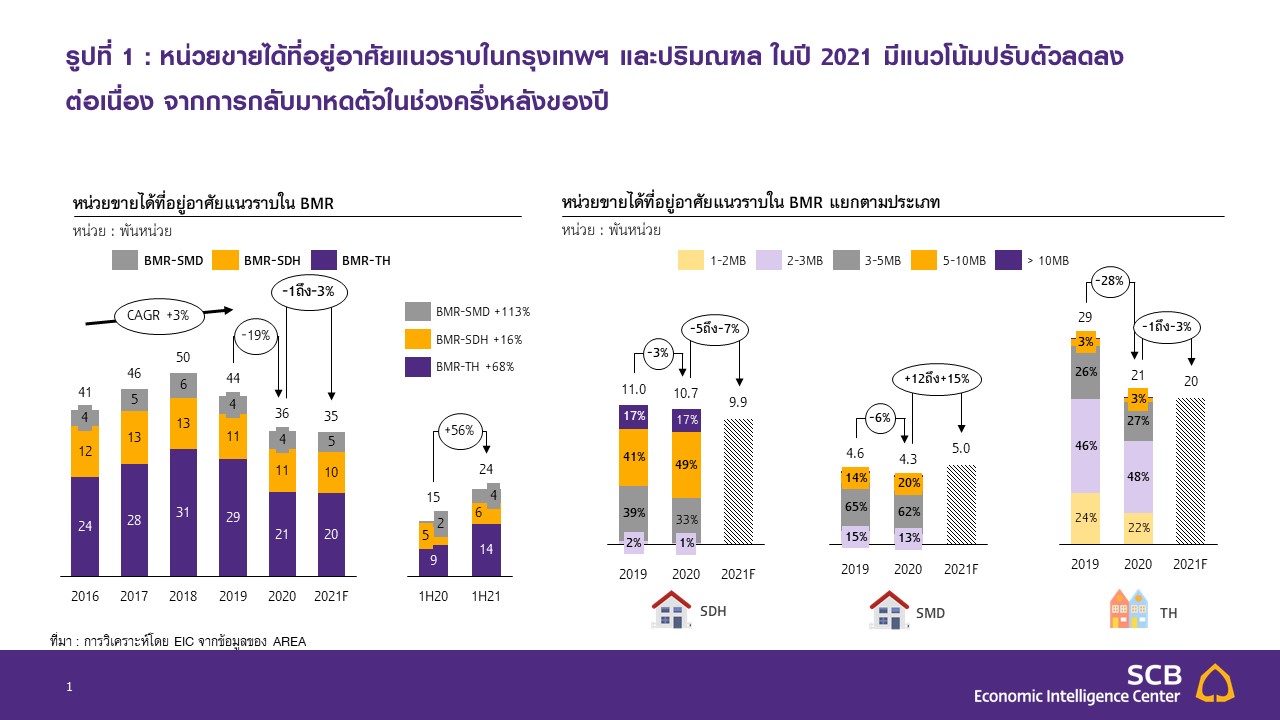
The vulnerability of consumer purchasing power has impacted demand for residential properties, especially townhouses, which have been more affected than single houses and twin houses, as they primarily target the mid to lower purchasing power segments. The sales units of low-rise residential properties in Bangkok and its vicinity in the first half of 2021 increased by 56% YoY from a low base during the same period last year when there was a strict lockdown. However, it is expected that the figures for 2021 will still decrease by around -1% to -3% YoY, continuing from the -19% YoY contraction in 2020, totaling 35,589 units, with townhouse sales decreasing by -28% YoY. Approximately 70% of townhouse sales are priced between 1-3 million baht, reflecting that most buyers belong to the mid to lower purchasing power segments, which have been economically impacted and have faced difficulties accessing credit since last year, resulting in a more significant decline in townhouse sales compared to single houses and twin houses (Figure 1). Nevertheless, even though townhouse sales in the first half of 2021 increased by 68% YoY due to market recovery from late last year continuing into early this year, partly due to a low base during the same period last year, the new wave of severe outbreaks is likely to economically impact purchasing power in the townhouse market, potentially leading to a severe contraction in the market during the second half of the year. The transfer of townhouse ownership in Bangkok and its vicinity in the first five months of 2021 also contracted by -5.9% YoY.
Twin houses are an option for mid-level purchasing power groups who want the functionality of a single house but have limited purchasing power or are uncertain about their future income stability. The sales units of twin houses in Bangkok and its vicinity in the first half of 2021 increased by 113% YoY to 3,639 units, compared to a -6% YoY decrease in 2020, partly due to a low base during the same period last year. Additionally, the transfer of ownership of twin houses in Bangkok and its vicinity in the first five months of 2021 increased by about 14% YoY, reflecting that twin houses are gaining popularity continuously. When considering the sales units of twin houses in Bangkok and its vicinity in 2020, although there was a -6% YoY decrease, the sales units in the price range of 5-10 million baht increased to about 20% from 14% in the previous year. The sales units of new twin house projects, when considering only the sales from projects launched in 2020, increased by 3% YoY, and the average sales rate in the first month of new twin house units in 2020 increased to 20% from 18% in the previous year (the figures for the first seven months of 2021 are at 19%). Currently, twin houses, which have land sizes not exceeding 50 square wah, are being developed to resemble single houses more closely by constructing only the underground beams or the upper beams to connect, creating open space around the house on all four sides, giving a feeling similar to a single house. Although the area of twin houses may not be as spacious as single houses, the internal space can be adjusted to be similar to that of a single house. Furthermore, twin houses are priced lower than single houses while having comparable usable space in the same location. For example, in the area of Mahajetsadabodin Bridge in Nonthaburi, a twin house project launched in 2020 has a usable area of 173 square meters, land area of 42.3 square wah, priced at around 7 million baht, while a single house project launched in the same year and location has a usable area of 180 square meters, land area of 52.8 square wah, priced at around 8 million baht. The price difference of 1 million baht between the twin house and single house may make twin houses an attractive option for mid-level purchasing power groups who want the functionality of a single house but have limited purchasing power or are uncertain about their future income stability.
Demand for single houses in 2020 contracted the least among the low-rise residential segments, as the mid to upper purchasing power groups were less economically impacted. However, demand in the first half of 2021 has also recovered the least among the low-rise segments, as the demand was significantly absorbed in the previous year. The sales units of single houses in Bangkok and its vicinity in 2020 contracted by -3% YoY, marking the lowest contraction rate among low-rise residential segments last year (twin houses -6%, townhouses -28% YoY). Most sales units were priced between 5 million and 10 million baht and above, which belong to the mid to upper purchasing power groups that were less economically impacted than the mid to lower purchasing power groups. Continuous promotions from operators have led to an increase in sales units of single houses priced between 5-10 million baht by 16% YoY, and the market share of houses in the 5-10 million baht price range increased from 41% in 2019 to 49% in 2020 and 46% in the first half of 2021. The sales units of single houses in Bangkok and its vicinity in the first half of 2021 increased the least among low-rise segments at 16% YoY (twin houses 113%, townhouses 68% YoY) due to the significant absorption of demand in 2020. The average sales rate in the first month of new single house units in the first seven months of 2021 was 21%, continuing from 18% in 2020 and 16% in 2019, partly due to the continuous decline in the launch of single house projects due to cost and land size constraints.
EIC believes that the demand for single houses from the mid to upper purchasing power groups remains a potential market with opportunities for recovery if the economic situation and consumer confidence begin to improve. The transfer of ownership of single houses in Bangkok and its vicinity in the first five months of 2021 still expanded by about 7% YoY, in contrast to the overall contraction in residential ownership transfers. However, the single house market still faces limitations from the trend of more challenging project development due to limited large land areas and rising development costs, which affect selling prices.
Figure 1: Sales units of low-rise residential properties in Bangkok and its vicinity in 2021 are expected to continue to decline, with a return to contraction in the second half of the year.
Source: Analysis by EIC from AREA data
The economic impact and increased competition from new homes have significantly affected the second-hand residential market.
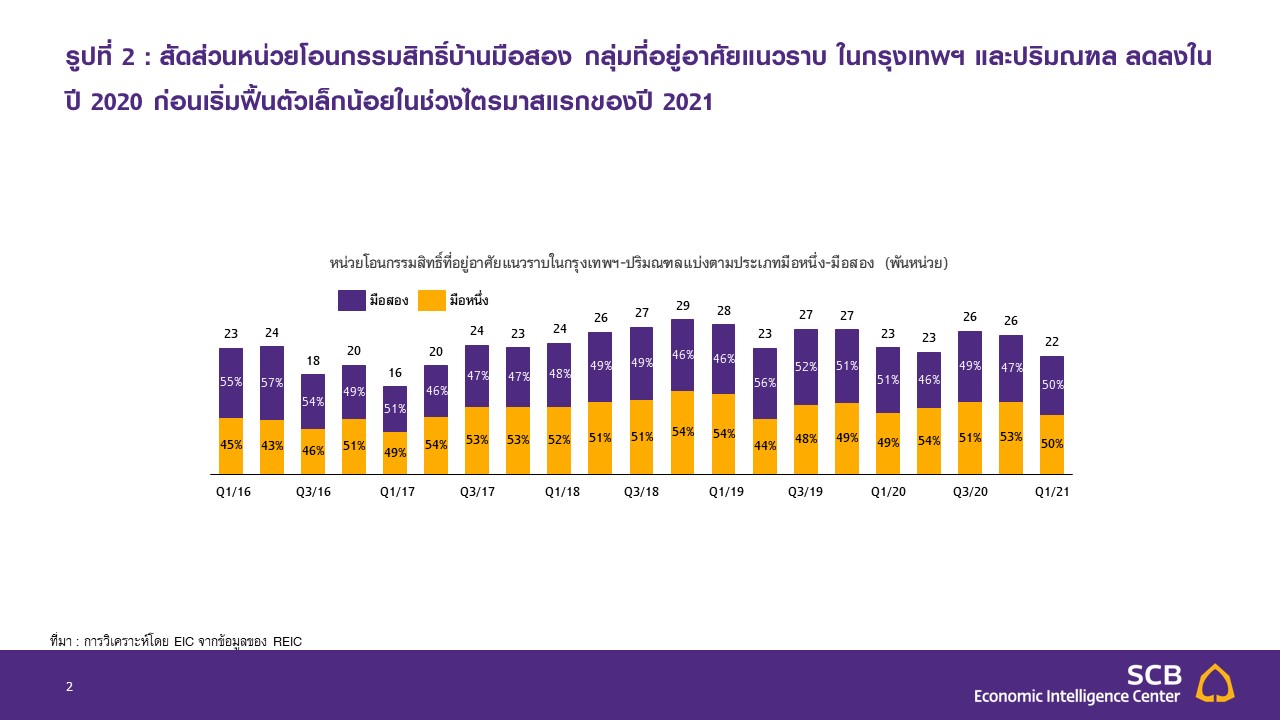
Although in the first five months of 2021, the transfer of ownership of second-hand low-rise residential properties in Bangkok and its vicinity showed a slight increase of 1.0% YoY compared to the same period last year when second-hand ownership transfers dropped significantly during the first outbreak, when examining the transfer figures for second-hand low-rise residential properties in Bangkok and its vicinity in 2020, it contracted by -12.5% YoY, particularly in townhouses which contracted by -12% YoY. This reflects that the economic impact has significantly affected the second-hand residential market, as buyers of second-hand properties tend to be from the lower purchasing power segments. Additionally, increased competition from new homes, where operators have been continuously promoting, has reduced the price gap between new and second-hand homes.
EIC believes that the supply of second-hand homes will likely increase due to the economic impact affecting consumers' ability to repay debts. The increasing trend of non-performing loans will lead to an increase in second-hand homes as non-performing assets, which will intensify competition in both the new and second-hand home markets.
Figure 2: The proportion of second-hand ownership transfers in the low-rise residential segment in Bangkok and its vicinity decreased in 2020 before showing a slight recovery in the first quarter of 2021.
Source: Analysis by EIC from REIC data
2. Trends in the low-rise residential market in Bangkok and its vicinity in 2021
EIC views that the low-rise residential market in 2021 will continue to slow down due to the impact of the new wave of COVID-19, which is severely pressuring purchasing power and consumer confidence after the market had shown continuous recovery in the first half of the year. This will result in a longer recovery period for the market. It is expected that the sales units of low-rise residential properties in Bangkok and its vicinity in 2021 will continue to slow down by around -1% to -3% YoY, totaling around 35,000 units, which remains below pre-COVID-19 levels. The recovery of the low-rise residential market will come from properties in the mid-price segment, with single houses and twin houses priced between 5-10 million baht, while townhouses will be priced between 3-5 million baht. Twin houses are expected to gain more popularity among the mid to upper purchasing power segments due to their value in terms of price, function, and usable space.
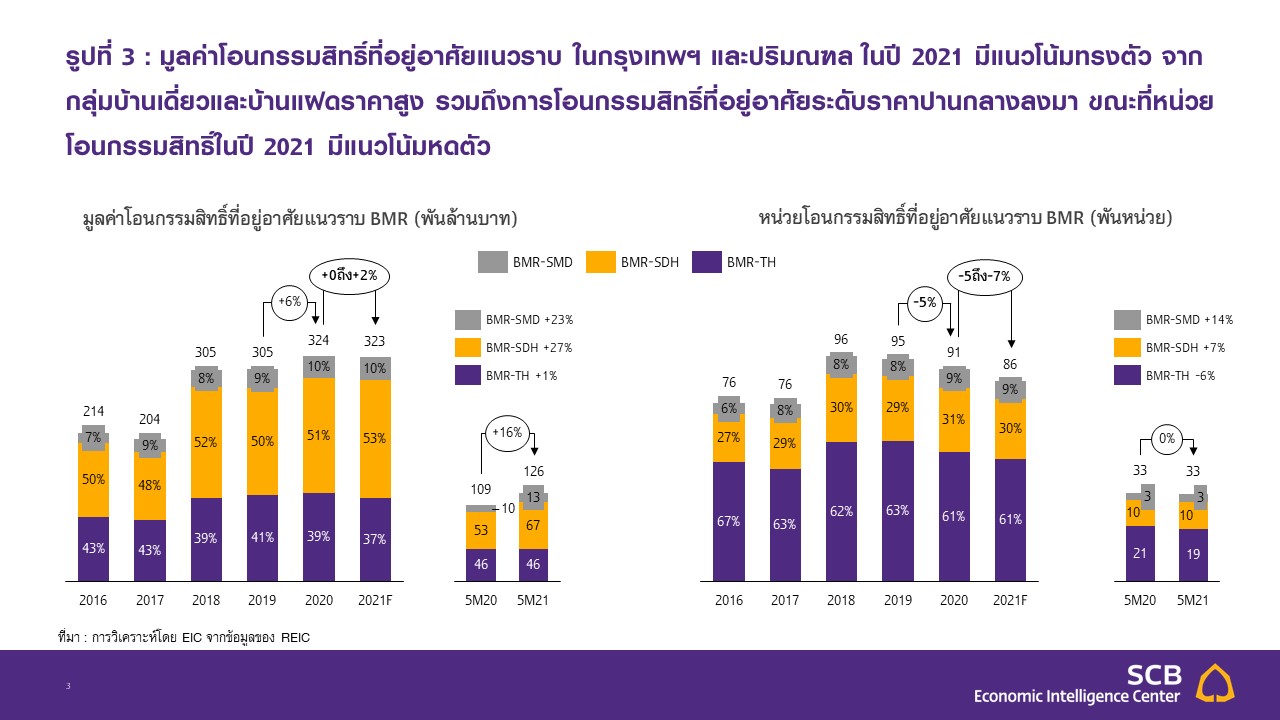
As for the value of ownership transfers of low-rise residential properties in 2021, it is expected to remain stable at 0% to 2% YoY due to the continued transfer of high-priced single houses and twin houses from last year and early this year, as well as the transfer of mid-priced residential properties. However, it is expected that the impact from the current outbreak will lead to a decrease in ownership transfers in the second half of 2021, resulting in an overall annual contraction of -5% to -7% YoY (Figure 3). Similarly, the transfer of ownership of second-hand residential properties is also expected to continue to slow down in 2021 due to increased competition from new homes, where operators have been continuously promoting since last year, along with an influx of second-hand homes as non-performing assets into the market. The second-hand residential market is expected to begin recovering in the future, following the overall recovery of the residential market.
Negative Factors
- The new wave of COVID-19 outbreaks, which are still severe, will impact purchasing power and consumer confidence.
- Unemployment and household debt remain high.
- Concerns about political stability are increasing.
- Financial institutions remain cautious in lending.
- Non-performing assets may enter the market more, intensifying competition in both new and second-hand home markets.
- Large land areas for developing low-rise residential projects are limited, while land prices continue to rise, making it more challenging to develop affordable residential projects priced below 3 million baht.
Positive Factors
- Operators are likely to continue promotions to stimulate sales and clear stock.
- Interest rates remain low.
- Government measures to reduce transfer and mortgage fees for residential properties priced below 3 million baht will help stimulate the market to some extent, especially for townhouses.
- The expansion of electric train routes that are progressing and becoming clearer will support urban expansion, making low-rise residential projects along the routes and at the end of the lines more attractive.
- The new normal lifestyle, such as working from home and spending more time at home, makes low-rise residential properties more appealing to consumers today compared to condominiums.
Figure 3: The value of ownership transfers of low-rise residential properties in Bangkok and its vicinity in 2021 is expected to remain stable, with high-priced single houses and twin houses continuing to transfer, while overall ownership transfers are expected to contract.
Source: Analysis by EIC from REIC data
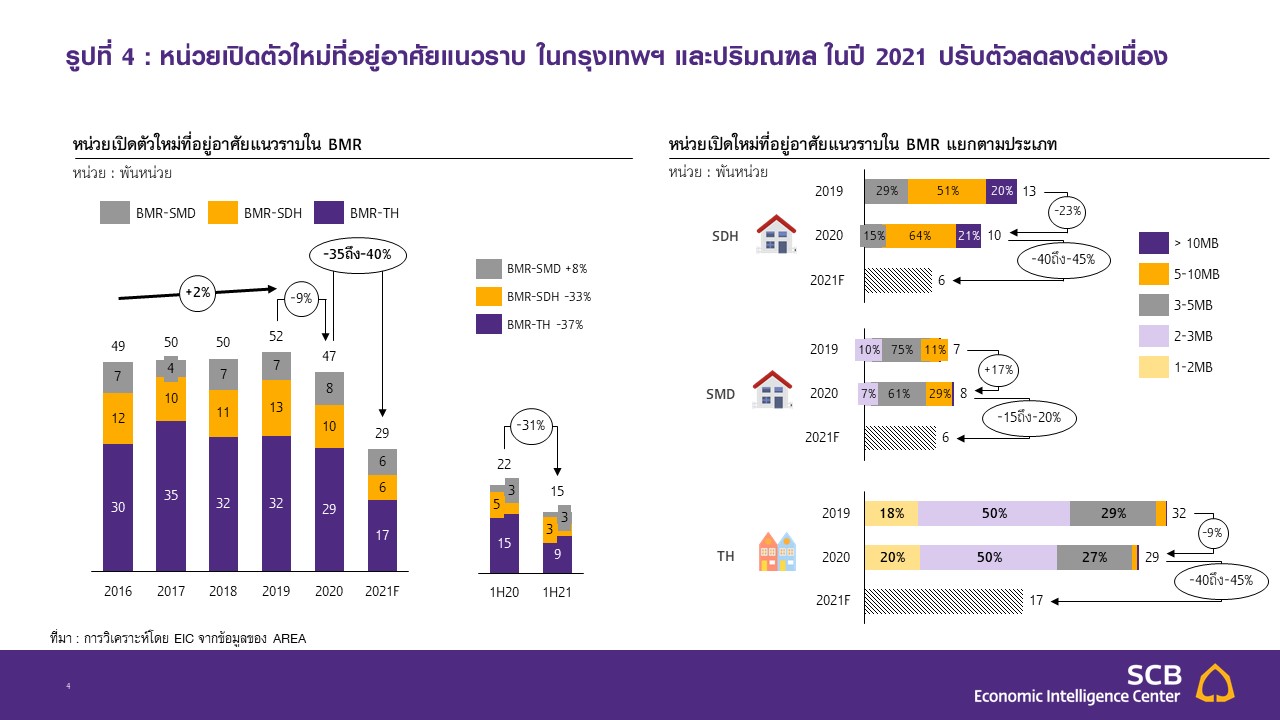
Operators remain cautious in launching new projects for the remainder of 2021, especially for townhouses, as the severe new wave of COVID-19 impacts the recovery of purchasing power. Additionally, the accumulated unsold units are trending upward, while the launch of single house projects is expected to decline due to land constraints and restrictions from construction worker camp control measures in Bangkok and its vicinity. EIC predicts that the overall new launches of low-rise residential properties in 2021 may decrease by -35% to -40% YoY, with new low-rise residential units in Bangkok and its vicinity in 2020 decreasing by -9% YoY to 46,846 units, valued at 213,493 million baht, down approximately -6% YoY. In the first six months of 2021, the decline was as much as -31% YoY. The market conditions are expected to slow down significantly for the remainder of the year, leading most operators to delay or postpone the launch of new projects. However, there has been a continuous increase in the launch of twin house projects due to growing consumer popularity in recent times, especially for affordable mid-range projects. Although the proportion of new twin house units remains relatively small, at around 14% of total low-rise residential launches, there has been a 17% YoY increase in launches.
In 2020, there was a significant decrease in the launch of single house projects by -23% YoY, the largest decline among low-rise segments, and this trend continued in the first half of 2021 with a -33% YoY decrease (Figure 4). EIC believes that the new launches of single houses will continue to slow down in the future, as operators are likely to develop twin house projects that resemble single houses more, due to the need for large land areas for single house developments. Currently, not only is it challenging to find large land areas with potential, but some plots are also priced so high that they may make marketing difficult, except for high-end single houses priced from 20 million baht and above, which are expected to be launched in limited numbers to meet the demand of high-end buyers only.
EIC predicts that the new launches of low-rise residential properties in Bangkok and its vicinity in 2021 will decrease by around -35% to -40% YoY, totaling 29,000-30,000 units. Among these, the launches of single houses and townhouses will contract at a similar level of around -40% to -45% YoY, while the launches of twin houses will decrease by around -15% to -20% YoY. Although operators are shifting to launch low-rise projects like townhouses instead of condominiums, especially in the mid to lower price segments that can sell quickly and are not large projects, the new wave of COVID-19 outbreaks impacting the recovery of purchasing power, along with the increasing trend of accumulated unsold units for townhouses, has led operators to postpone most new project launches that were originally planned for the third and fourth quarters of this year.
Figure 4: New launches of low-rise residential properties in Bangkok and its vicinity in 2021 are expected to continue to decline.
Source: Analysis by EIC from AREA data
3. Supply challenges in the low-rise residential market in Bangkok and its vicinity in the future
The severity of the current COVID-19 outbreak has caused the recovery of the low-rise residential market to slow down again, and it also faces challenges, including:
1) Excess supply from operators increasingly launching low-rise projects along various electric train routes and at the end of the lines.
2) Increased competition, which continues to limit price adjustments for certain residential segments.
3) Rising development costs due to increasing land prices and construction costs from rising prices of certain construction materials, particularly steel, which has seen significant increases.
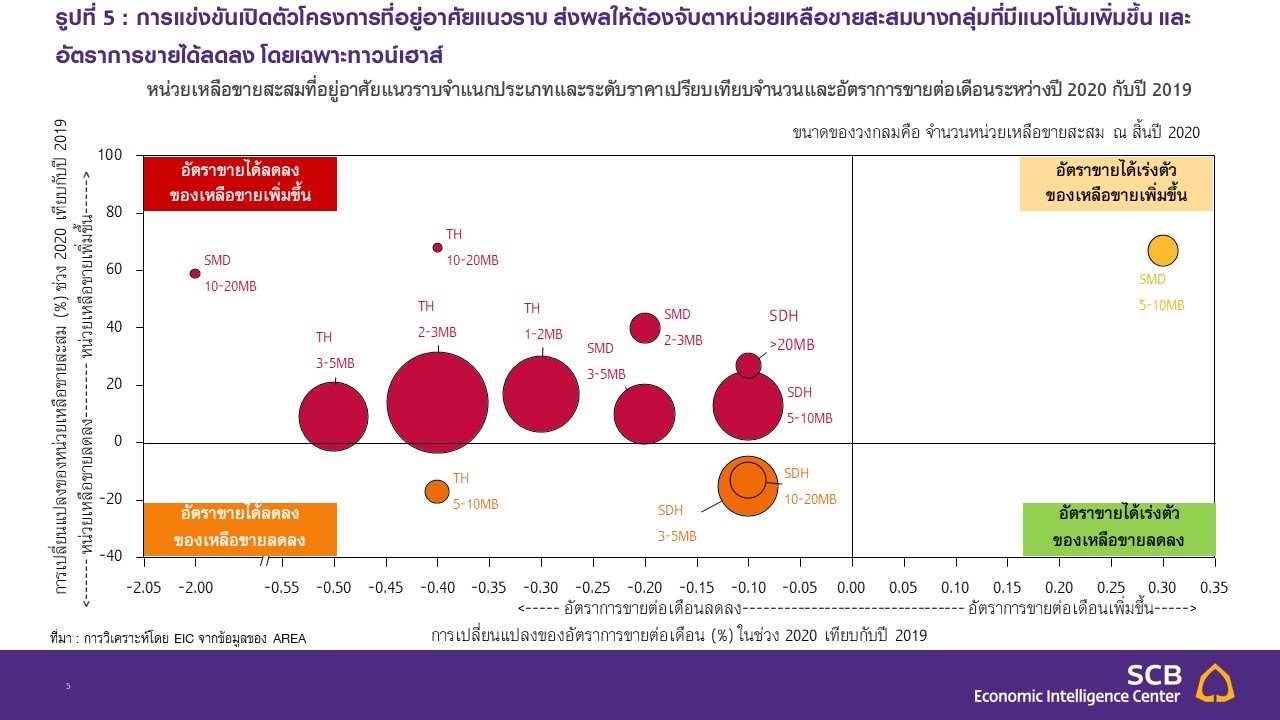
The accumulated unsold units of low-rise residential properties in 2021 are expected to remain stable, as new project launches decrease, but purchasing power is also expected to continue to slow down, making it difficult for the market to recover significantly. This will prolong the absorption period for units in the market. Although most operators have shifted to launch more low-rise projects, particularly twin houses and townhouses in recent times, due to the anticipated slow recovery of the condominium market in the next 1-2 years, the impact from the current new outbreak has forced most operators to adjust their short-term plans by postponing some project launches in the second half of this year. Additionally, the purchasing power is expected to slow down again, leading to the possibility that the accumulated unsold units in the low-rise segment will remain stable in 2021. The segment that needs to be cautious is townhouses priced at 2-3 million baht, which account for up to 50% of the total unsold townhouse units currently, as this segment has seen an increase in accumulated unsold units and a decrease in sales rates compared to the previous year (Figure 5).
For the accumulated unsold units of single houses and twin houses, they are expected to remain stable and decrease slowly, as the new launches of single houses are not expected to increase each year. Additionally, purchasing power in the mid to upper segments is still experiencing low economic impacts, leading to a continuous absorption of single houses and twin houses from the market.
Figure 5: The competition in launching low-rise residential projects has resulted in increased attention to accumulated unsold units in certain segments, particularly townhouses.
Source: Analysis by EIC from AREA data
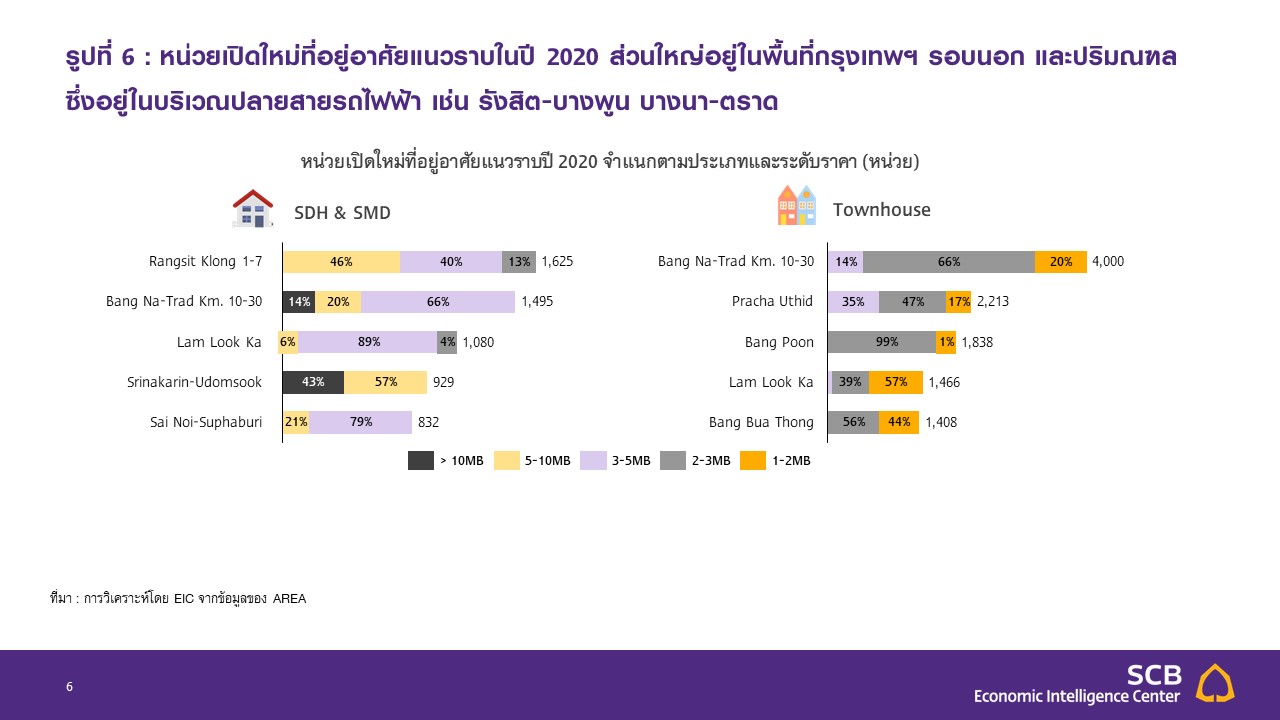
Operators are launching projects in areas along the new electric train routes that are expected to be operational in the next 1-4 years, which may lead to increased competition in those areas. In the past year, areas at the end of various electric train lines have become more popular for residential project development by operators, as these locations are mostly in the periphery, where land prices are still relatively low, suitable for developing mid-range projects at affordable prices, aligning with the current residential buyer market. In the next 1-3 years, areas like Rangsit, Bang Phun at the end of the dark red line, Lat Krabang, Bang Na-Trad at the end of the yellow line, and the light red line areas around Phutthamonthon, Taveewattana, and Salaya are expected to see more residential projects launched (Figure 6).
Figure 6: New low-rise residential units launched in 2020 are mostly located in the outskirts of Bangkok and its vicinity, particularly at the ends of electric train lines, such as Rangsit-Bang Phun and Bang Na-Trad.
Source: Analysis by EIC from AREA data
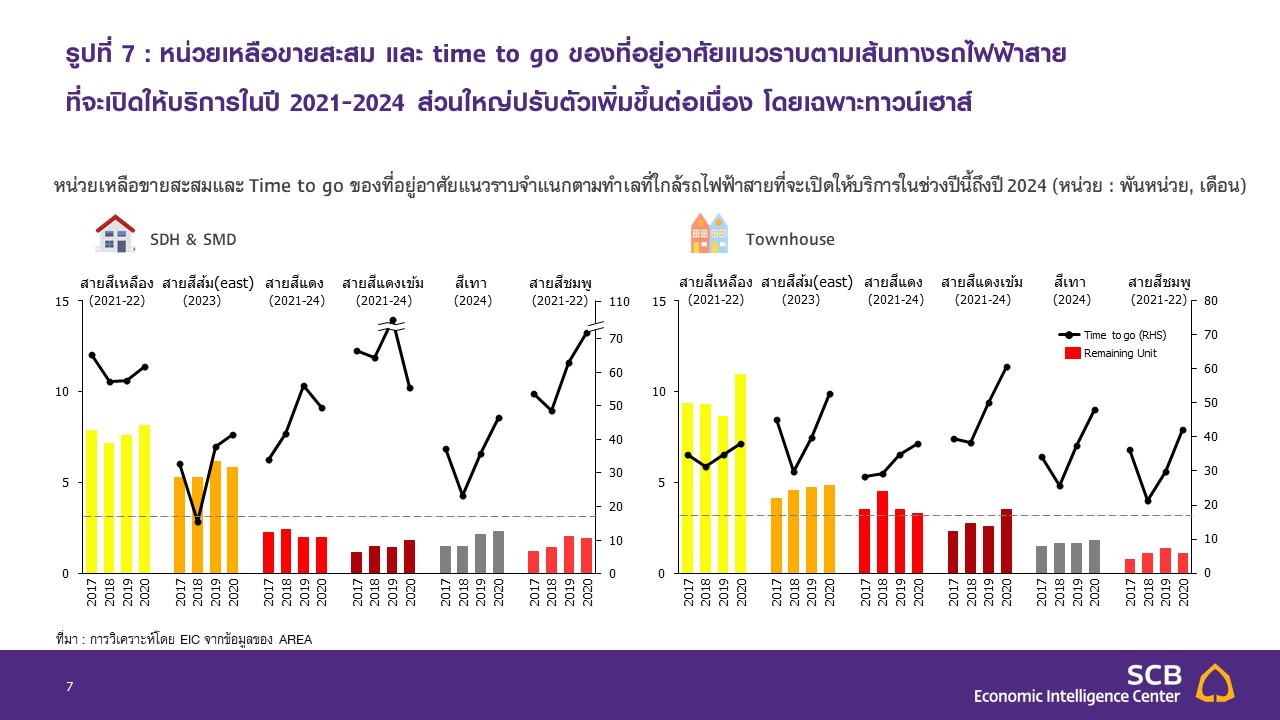
The new electric train lines planned to be operational between 2021 and 2024 include the red line, dark red line, pink line, yellow line, gray line, and orange line (eastern side). When examining the accumulated unsold units and the time to go for low-rise residential properties in each area along the various electric train routes (Figure 7), it is observed that most have continued to increase, particularly townhouses in various areas, such as along the yellow electric train line in Bang Na-Trad and Srinakarin. Additionally, twin houses and townhouses along Bang Na-Trad Road between kilometers 10-30 are among the locations with the most new low-rise residential projects launched last year, as well as areas overlapping with the pink and gray electric train lines, such as Watcharapol and Khubon, which have seen a continuous increase in accumulated unsold units of single houses and twin houses over the past two years, necessitating ongoing monitoring of the accumulated unsold units in these areas in the future.
Figure 7: The accumulated unsold units and time to go for low-rise residential properties along the electric train routes expected to be operational between 2021-2024 have mostly continued to increase, particularly for townhouses.
Source: Analysis by EIC from AREA data
The competition among operators focusing on low-rise residential projects has led to intensified promotional activities, which continues to limit price adjustments for certain residential segments, especially townhouses with a large number of accumulated unsold units. However, low-rise residential properties in the mid to upper price segments are expected to see price increases, as reflected in the sales units of townhouses priced over 10 million baht, which increased by 27% YoY in 2020. Similarly, the average prices in 2020 for townhouses priced between 5-10 million baht and single houses priced between 5-10 million baht saw slight decreases of around -1.2% and -0.9% YoY, respectively. Additionally, the accumulated unsold units in this market segment are still relatively low, resulting in less intense promotional competition in the mid to upper price segments of the low-rise residential market.
The development costs for low-rise residential projects have increased due to rising land prices and prices of certain construction materials, such as steel, which has seen significant increases. Although the low-rise residential market is trending downwards, land prices continue to rise steadily in both central Bangkok and surrounding areas, which are suitable for developing low-rise residential projects, especially along the routes of electric train projects currently in operation and those expected to open in the next 1-5 years. This affects the costs of developing residential properties. Currently, the assessed land prices in central Bangkok and many outer areas popular for developing low-rise residential projects have increased significantly. For example, land prices in the Prawet and Suan Luang areas, suitable for developing mid to upper townhouses, increased by about 6.7% compared to assessed prices in 2019, with an average price of around 300,000 baht per square wah. Meanwhile, the assessed prices in the Bangkok Noi-Bang Phlat-Taling Chan-Taveewattana areas, suitable for developing mid to upper single houses or twin houses, increased by only 0.3% from 2019.
However, the average prices in some areas are currently at levels of 100,000-200,000 baht per square wah, such as along Borommaratchachonnani Road and Sirindhorn Road, leading operators to adjust their project management strategies more efficiently. EIC believes that the development of mid-priced single houses priced between 5-10 million baht may start to decrease, while the development of mid-priced twin houses is likely to increase instead. Meanwhile, all types of low-rise residential projects in the high-end segment will see significantly higher average prices due to increased costs, which are expected to be launched in limited numbers to meet the demand of high-end buyers only. Additionally, construction costs are expected to continue rising due to the ongoing increase in steel prices, which rose by about 36% in July 2021 compared to the end of the third quarter of 2020.
Analysis by SCB EIC >>> https://www.scbeic.com/th/detail/product/7765
Author of the analysis: Chetthawat Songprasert ([email protected])
Analyst
Economic Intelligence Center (EIC)
Siam Commercial Bank Public Company Limited
EIC Online: www.scbeic.com
Line: @scbeic