
Severe COVID Outbreak Disrupts Online Shipping Temporarily, but Revenue Expected to Grow by 19.0% in 2021
• KASIKORN Research Center observes that the worsening COVID outbreak has led to some online shipping employees in certain areas contracting the virus. Coupled with the extension of lockdown measures for at least another 14 days in August, this has temporarily impacted product deliveries, especially for perishable goods such as fresh food, vegetables, and fruits. However, non-food items, such as personal care products and dry goods (which are less prone to spoilage), may experience less impact.
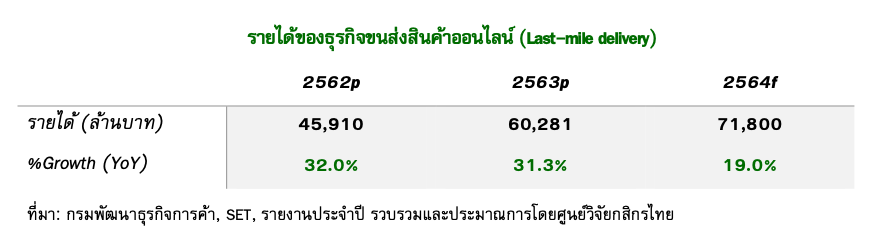
• KASIKORN Research Center believes that the overall online shipping business in 2021 is expected to grow by approximately 19.0%, with a value of around 71.8 billion baht. However, this growth is slower than the previous year's 31.3% increase due to the impact of COVID, as well as the effect of lower shipping costs. Considering the management costs, particularly those related to COVID, it is expected that these will rise. Meanwhile, operators may not be able to increase shipping prices, leading to the possibility that overall revenue growth at double-digit rates may not reflect improved performance for all operators. Given the ongoing situation, the risk of managing costs remains, and some operators may face losses, while others that are still profitable may see a slowdown due to increased competition.
Online shipping business or Last-mile delivery has expanded alongside the growth of E-commerce, especially during the COVID outbreak, as consumers are concerned about safety and refrain from outdoor activities. This has led to a shift in consumer spending behavior towards online shopping, boosting the growth of online shipping.
However, due to the severe COVID outbreak, many online shipping employees from various companies in several areas have contracted the virus, particularly in high-risk zones such as Bangkok, Nonthaburi, Ayutthaya, and Chonburi. The extension of lockdown measures for at least another 14 days in August 2021 (which may be reviewed and adjusted) has resulted in some key distribution centers and certain branches for receiving and delivering goods, both in and out of shopping malls, having to temporarily close. Meanwhile, some branches that remain open are also affected due to longer delivery times to destination areas compared to normal periods, leading to temporary disruptions in online shipping. Additionally, the intensified competition in the business, particularly regarding shipping prices, may make it difficult for the overall shipping business this year, even though revenue is still expected to grow.
• Online food deliveries are likely to be more affected than non-food items due to the perishability of the products. KASIKORN Research Center believes that when the delivery system of the Last-mile delivery business, which is crucial for E-commerce, faces issues, it inevitably impacts online sales, especially for food items, whether fresh, dry, vegetables, or fruits. These are essential goods that consumers are expected to continue planning to purchase online during the COVID outbreak. However, when deliveries cannot be made or take longer than usual, and the vehicles used for delivering these goods are mostly not suitable for long-term storage or quality control, the products can spoil easily, leading to significant impacts. Consequently, some operators in certain areas may have to temporarily stop accepting deliveries of these items.
In contrast, non-food items or luxury goods, such as fashion products, cosmetics, and home decor, have seen sales affected by consumers' reduced purchasing power and cautious spending habits. Therefore, this situation may impact the delivery of these goods to a lesser extent, or if there are orders, some consumers may be willing to wait for the products. Nonetheless, this issue is expected to be temporary, and due to the rapid problem-solving and adaptation of operators, some branches that temporarily closed are beginning to reopen, although they still face longer wait times for products compared to normal.
• The overall revenue of the online shipping business (Last-mile delivery) in 2021 is still expected to grow due to the ongoing COVID outbreak encouraging consumers to shop online more. However, growth is anticipated to slow down from the previous year due to price competition in shipping costs, as well as facing higher operational costs. Although the severe COVID outbreak has temporarily disrupted the shipping system in some areas, consumers remain concerned about going out to spend or engage in outdoor activities. The government's lockdown announcement, along with continuous promotions from E-commerce operators, has led consumers to continue spending through online platforms to avoid various risks.
Nevertheless, the online shipping business currently faces intense competition from numerous market players, especially regarding shipping prices from major operators, which forces other operators to adapt. Ultimately, if any operator cannot manage or bear the costs, they may face increasingly difficult competition. Therefore, KASIKORN Research Center predicts that while the revenue of the online shipping business (Last-mile delivery) in 2021 is expected to be around 71.8 billion baht, growing by 19.0%, this represents a slowdown from the previous year's growth of 31.3%. However, considering management costs, these are also expected to rise, particularly costs related to COVID management to ensure safety and confidence for consumers and employees, costs from hiring additional staff (to replace those who contracted COVID and to handle increased online orders), and costs for managing new delivery routes to avoid problematic areas, while needing to lower shipping prices to remain competitive. Thus, it is possible that some operators may still face losses.
Revenue of the Online Shipping Business (Last-mile delivery)
Therefore, KASIKORN Research Center believes that the growth of online shipping business revenue at double-digit rates may not reflect improved net performance for all operators. Looking ahead, with the ongoing outbreak situation, various risks may still arise, which could lead to continued COVID management costs for operators, whether in terms of hygiene and safety management, distributing distribution centers to new potential areas to mitigate risks, incorporating technology to enhance operational efficiency, and providing comprehensive product services. If consumers remain concerned and uncertain about safety, leading to increased stockpiling to reduce the frequency of orders, this could result in decreased delivery volumes and subsequently impact business performance, especially for operators with limitations in cost management, capital, and adaptability who cannot respond to the situation and consumer behavior promptly, which may continue to face difficulties in competition.