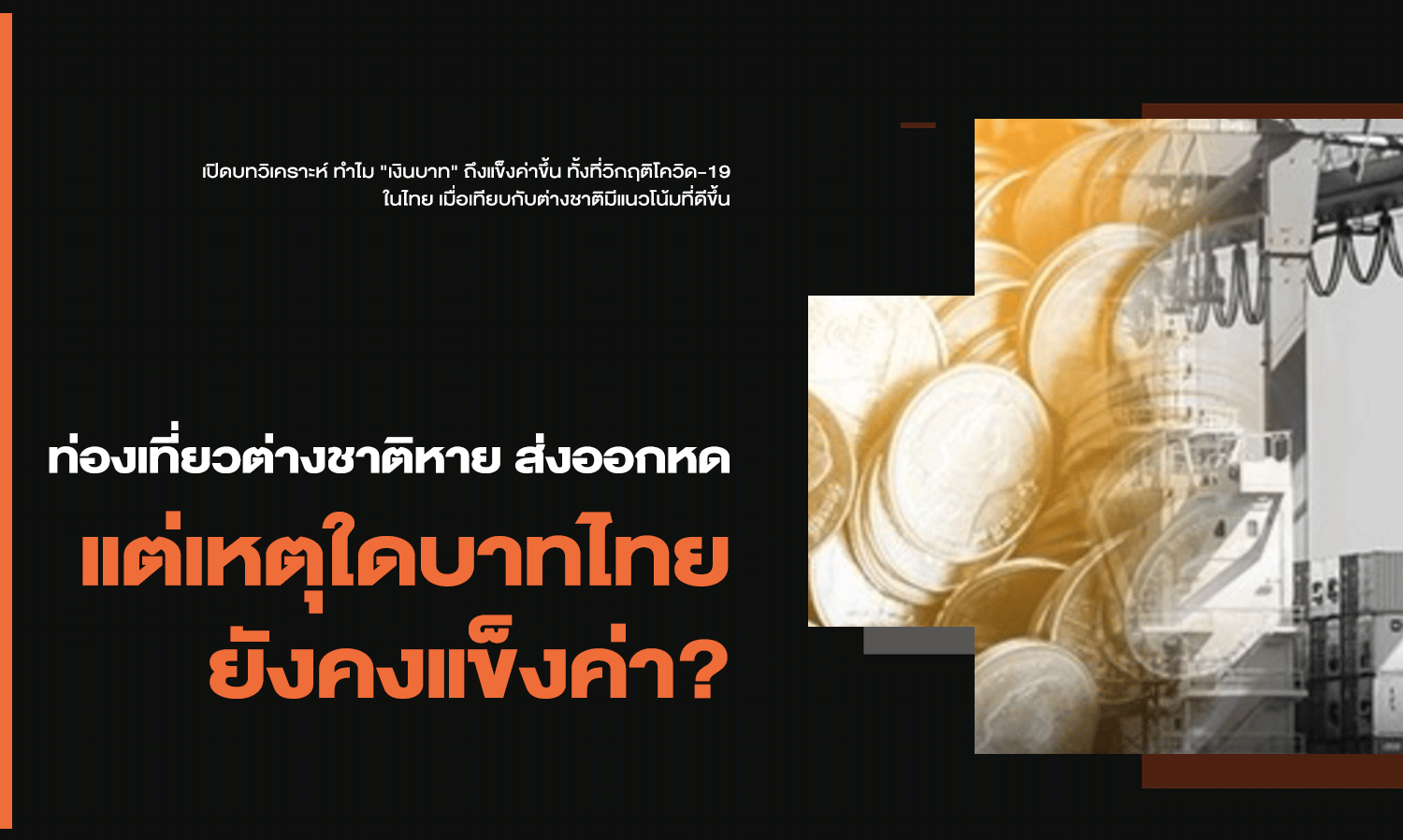
International Tourism Declines, Exports Shrink, Yet Why is the Thai Baht Still Strengthening?
An Analysis of Why the "Thai Baht" is Appreciating Despite the COVID-19 Crisis in Thailand, with Improving Trends Compared to Abroad. What Internal and External Factors are Influencing This? And What Steps Should be Taken to Mitigate the Strengthening of the Baht Going Forward?
Data on Thailand's economic situation from the National Economic and Social Development Council's report for the second quarter of this year clearly shows that the impact of COVID-19 has severely affected both the domestic and external economies.
For example, domestic consumption has contracted by over 6.6%, marking the most severe contraction since the Tom Yum Kung crisis. The tourism and export sectors, which have long relied on foreign demand, are experiencing unprecedented contractions. Exports in the first seven months of this year have shrunk by over 12.4%, leading to the most significant decline in exports in two decades, resulting in widespread impacts on businesses in the tourism and export sectors.
Although the business outlook for the second half of the year is improving compared to the second quarter, the ongoing issue pressuring Thailand's economic growth is the strengthening of the Thai Baht following the COVID-19 outbreak, which has negatively impacted export revenues.
The appreciation of the Thai Baht may come as a surprise to some readers, as typically, the strengthening of the Baht is driven by increased demand for the currency, whether from tourists needing to exchange Baht for travel or from foreign investors wanting to invest in Thailand's stock market. This increased demand for the Baht has led to its appreciation.
However, under the current economic conditions, many readers may also observe that after the closure of airspace since April, Thailand has not seen foreign tourists for nearly five months. So why does the Baht continue to appreciate?
In this regard, I must explain that the appreciation of the Thai Baht results from both internal and external factors. The significant external factor is the weakening of the US dollar, which has not only caused the Baht to strengthen but has also affected other currencies in the Asian region.
The weakening of the US dollar is due to the increased supply of dollars in the system from the US Federal Reserve's quantitative easing measures aimed at providing liquidity in the US capital markets during the COVID-19 crisis. While the short-term increase in dollars is beneficial and crucial for the US economy, in the long run, the increased supply of dollars leads to a decrease in its value, resulting in a long-term weakening trend for the dollar.
Regarding domestic factors, the COVID-19 outbreak has indeed reduced the demand for Baht from foreign tourists, leading to a negative balance in the services account, a component of Thailand's balance of payments, for the first time in five years in the second quarter.
However, overall, Thailand's balance of payments in the second quarter showed a growing surplus, primarily due to a surplus in the capital account of over $11 billion, the largest surplus since the first quarter of 2008 during the global financial crisis. The main reason for this surplus is the influx of foreign capital as businesses and financial institutions reduce their investment risks abroad by net selling bonds and withdrawing deposits from overseas, along with repayments of trade credits from foreign debtors, resulting in a capital influx into Thailand, similar to the situation in the first quarter of 2008 during the global financial crisis.
It is noteworthy that both the weakening of the US dollar and the influx of foreign capital stem from the COVID-19 outbreak, which has severely impacted the global economy, putting pressure on the Baht to appreciate. Therefore, to support the export and tourism sectors in regaining strong growth in the future, addressing the strengthening of the Baht is a crucial issue that we should collectively seek solutions for.
SOURCE: www.bangkokbiznews.com