Signs of Economic Recession
A few days ago, I started driving my car again to meet with a group of VI investor friends for an evening gathering, after having paused this quarterly activity for over a decade due to the COVID-19 pandemic that hit about 5-6 months ago.
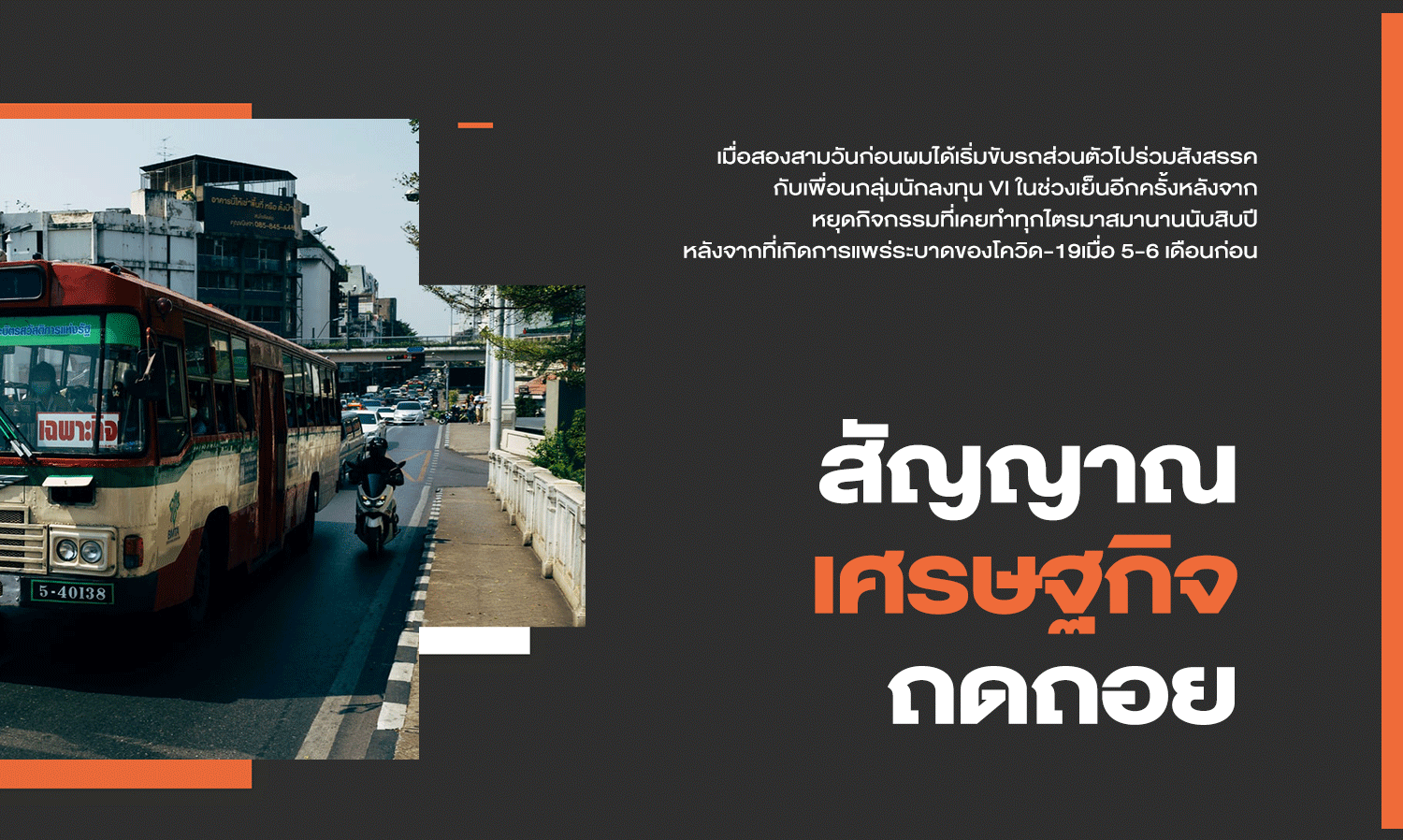
It's been a long time since I drove during this evening rush hour, but I remember that in the past, the route I took was the expressway that exits onto Rama 4 Road near Klong Toey, which was usually heavily congested. However, this time, the traffic was surprisingly light, even though there were still many cars on the road. I feel that after COVID-19 calmed down in Thailand and we reopened almost all businesses, daily commuting activities have noticeably decreased, as reflected in the traffic. While some may complain that traffic has returned to being 'as congested as before,' that might only apply to certain areas or roads at specific times, such as during long holidays when people travel to provinces or on roads like Srinakarin, where a new sky train is being constructed. But on routes that haven't changed, like those in the central Bangkok area, I believe there are clearly fewer cars. A daily example is the Rangsit Road in front of my house, which used to be a hub for Chinese tourists, and is now 'always empty.' This is a significant sign indicating that Thailand's economy is 'strongly' declining.
The number of shoppers in malls is another sign that the economy is sluggish. Many might argue that large malls, especially those on the 'outskirts of Bangkok' that they frequent, are 'back to normal,' with no parking available and 'crowded as if giving things away for free.' However, this could just be a 'feeling' that arises after the malls were quiet for so long, and it may only be true on weekends. On weekdays, when they are not going, the malls might be quite empty. I personally shop at a luxury mall in Siam, a key area for international tourists, almost every week, and I can confirm that the mall is still quite empty, with significantly fewer people than before. The supermarket where I buy my daily groceries used to have long checkout lines, but now on some days, there are hardly any lines at all. This indicates that Thais are likely spending significantly less, especially on non-essential items and/or items typically purchased by foreign tourists.
Interestingly, I noticed that luxury and high-priced items, such as those sold in 'super brand' clothing stores, still have people 'lining up' to enter and purchase, just like before COVID-19. The prices of these items have not seen 'massive discounts' to attract customers; in fact, some stores have even 'raised prices' on items they used to sell. This leads me to conclude that the wealthy in Thai society have not been significantly affected and continue to spend as usual. Now, since they cannot travel abroad, they are spending within Thailand instead. This trend is also observed internationally; for instance, in China, there are reports that super brand items are selling better than before COVID-19.
In addition to luxury clothing, high-end homes seem to be selling better post-COVID-19 compared to homes targeted at the general public. In fact, even during the lockdown, there were signs that more people were looking at and purchasing luxury homes. This indicates that the 'super-rich' or affluent individuals have not been heavily impacted by the crisis and continue to buy luxury and expensive items as before. This is evident from the performance of real estate companies selling luxury homes, which outperformed those focusing on lower or mid-range homes that were severely affected.
While community homes may be selling less, many businesses in construction materials claim their sales did not drop during the COVID-19 lockdown. This may be true, but one must be cautious as these products have a lag time; when the economy is in crisis, the demand for these products remains steady because homes that have already started construction must continue until completion if the owners still have the means. I am also currently building and have found that construction work never stopped during COVID-19; in fact, it seems to have accelerated because there were no labor shortages like in normal times. What needs to be watched is that once the work starts to finish and new projects do not come in due to decreased demand for homes or buildings, the construction business may see a significant drop in sales.
I believe the downturn in the economy primarily stems from the halt of the tourism industry, travel, and activities requiring people to be in close proximity, which has led millions to lose their jobs immediately. They have to cut back on consumption. This all peaked during the second quarter, and we all thought that after that, the economy would improve rapidly. The second quarter was expected to be the lowest point, and the pain should lessen from there. However, I was quite surprised to hear that a friend's daughter, who worked as a flight attendant for a top global airline, was suddenly laid off after being unable to work for several months and hoping to return as the airline started flying again on some routes. This incident made me think that during the second quarter, some companies were still trying to retain their workers, but now they can no longer bear the costs and have to let people go. At the same time, the government was providing financial assistance of 5,000 baht per month to many people until the end of August. On the other hand, the central bank allowed many borrowers to defer payments until September. If none of this is renewed, what will happen? I think the economy may not worsen compared to the second quarter, but I still doubt it will improve rapidly.
Returning to the topic of investment, during our VI friends' gathering, we always have a 'stock pick' session to identify stocks expected to perform well in the next three months, where everyone must choose stocks they like, usually 2-3 each. When we meet again in the next quarter, we review who achieved what returns. This is a light-hearted activity that is not serious or competitive, but everyone tends to choose stocks they are genuinely investing in. The results of this selection have noticeably changed from previous times; for the past 2-3 years, this group often chose Vietnamese stocks over Thai ones, with Thai stocks being selected much less. This is partly because they have shifted their investments to the Vietnamese stock market, and some, especially foreigners, have stopped investing in the Thai stock market altogether. However, this time, the majority of selected stocks turned out to be Thai stocks. This indicates that COVID-19 has likely made certain Thai stocks or groups more attractive, prompting some VIs who had previously abandoned the market to return to investing more.
I believe that interest in stocks among Thais has also increased, as evidenced by the significant rise in new investors during COVID-19. This is quite peculiar. I think the reasons are twofold: first, those with good financial standing and ample cash have not been affected by COVID-19; they see the downturn in the stock market as a great opportunity to profit easily compared to the very low returns from savings. Secondly, they believe that the impacts on listed companies will be one-time events, and after the crisis, everything will return to normal within 1-2 years, or at most 3 years. The idea that companies will 'collapse' or go bankrupt seems unlikely. Above all, the liquidity in Thailand's financial system remains abundant, with many still seeking bonds. Once COVID-19 passes and customers return, companies' revenues and profits will return to 'normal.' Lastly, international stock markets, such as in the United States, have already rebounded to previous levels and even higher, with the performance of companies, especially in the tech sector, significantly increasing. Therefore, they believe that eventually, Thai companies and stocks will follow suit.
In conclusion, I think the economic situation and the performance of listed companies will still be quite challenging moving forward. The recovery is likely to be slow, but stocks that have dropped significantly may rebound quickly due to the funds from Thais and Thai investors who still have substantial cash and have not been heavily impacted by the economic situation. However, as reality begins to unfold, there may be a risk that investors will start to realize and withdraw their funds, and that day could be when the stock market adjusts to align with the true fundamentals of the Thai stock market.
SOURCE : www.bangkokbiznews.com