Consolidating Economic Recovery Departments: The Last Breath... Fight On or Surrender?
The Finance, Banking, Financial Institutions, and Financial Markets Committee of the House of Representatives, along with the Faculty of Economics at Thammasat University, held a seminar titled "The Changing World, Thailand Adjusts to the Pandemic Crisis"
Although the COVID-19 crisis has eased in Thailand, the situation abroad remains concerning. This means that Thailand is being surrounded by a pandemic that brings various changes, particularly deep structural economic changes.
Banyong Pongpanit, Chairman of the Executive Board of Kiatnakin Bank Public Company Limited, stated that the COVID-19 crisis this time is severe and has impacted the entire world. He believes that the 1.9 trillion baht injected to support the economy is insufficient and should be increased by another trillion baht. The government should not worry about public debt, even if it reaches the ceiling of 60-70%, as it will help rescue Thailand's economy.
There must be a clear revenue generation plan. The government should expedite three actions: 1. Increase corporate income tax from the current 20% to 25%, which would generate an additional 200 billion baht per year. This tax increase will not affect the public as it will be collected from profitable businesses. 2. Increase property taxes, which will not impact the poor since they own little property. 3. Privatize state enterprises, which are valued at over 16 trillion baht. Particularly, just two state enterprises under the Ministry of Energy could generate up to 2 trillion baht in revenue.
Additionally, the government should liberalize in all areas, especially regarding land ownership, allowing foreigners to hold land titles. This will foster competition in land use for maximum benefit. The previous restrictions have resulted in only a few wealthy families owning large amounts of land due to the lack of foreign competition. The government need not worry, as foreigners cannot take land out of Thailand; it will remain in the country. The positive outcome will lead to increased investment in various businesses, and the government will collect more taxes.
“In Thailand's past, there were many policies that did not require a budget but had a tremendous positive impact on the economy, such as during the Chotichai Choonhavan era, which opened up investment liberalization and the Eastern Seaboard project, where the government implemented measures to attract investment, leading to rapid economic growth.”
The financial liberalization measures have allowed Thailand's economy to grow among the top in the world for five consecutive years, doubling in size. However, some flawed policies led to the 1997 crisis. The liberalization of aviation reduced airfare significantly, resulting in the emergence of low-cost airlines, which expanded Thailand's tourism from 10 million to nearly 40 million visitors in 2019, contributing significantly to the economy, accounting for 20% of GDP.
Regarding support for SMEs, the government should compensate businesses affected by lockdowns based on their VAT payments. Those paying more should receive more compensation, with the condition that these businesses maintain employment at no less than 75%. This will also help bring SMEs into the proper tax system, along with allocating a budget of 100 billion baht to local areas to benefit their communities, prioritizing provinces with lower per capita income over those with higher income.
Moreover, the government should abolish the 20-year national strategy, which is outdated and resembles a forced dream into law. According to the national strategy, 56 new agencies must be established, which contradicts the global trend of reducing the role of the state. The government should also reduce the number of civil servants. For comparison, Japan has 500,000 civil servants for a population of 127 million, Singapore has 120,000 for 5.5 million, while Thailand has 2.2 million for 66 million. This clearly shows an excess of civil servants with low efficiency. Reducing their number and increasing efficiency could significantly lower budget burdens.
Suwit Masinthree, former Minister of Higher Education, Science, Research and Innovation, stated that before COVID-19, the government set a policy for 12 target industries. However, after the pandemic, everything must change, reducing the target industries and focusing on those where Thailand is strong and beneficial to the nation. Thus, the BCG policy was pushed forward, reducing the target industries to five groups: Agriculture and Biotechnology, Food Processing, Biofuels and Biochemicals, Comprehensive Medical Care, and Tourism, integrated together. COVID-19 will elevate Thailand in two industries: food and medicine, strengthening the foundation of the Thai economy from existing resources.
The government must urgently act to mitigate the impact of COVID-19 by creating jobs. National Statistical Office data shows that there are 500,000 graduates unemployed. Last year, a budget was pushed for the Youth Nation project to create 100,000 jobs, but only about 50,000 jobs were funded. During COVID-19, the Ministry of Higher Education suggested hiring at least 300,000 people. Previously, 70% of graduates would find jobs, while 30% would take 1-3 years to find work.
“However, due to COVID-19, the situation has reversed, with 70-80% of graduates now unemployed. This is very concerning, compounded by the existing backlog of 500,000, leading to a total of over a million unemployed graduates.”
Nevertheless, the project has not yet reached the Cabinet. The government must first create jobs for these individuals, as they are the nation's assets. A budget of 400 billion baht should be allocated to employ these graduates for 12 months, alongside reskilling and upskilling efforts. It should not just be about distributing jobs; universities nationwide should employ graduates by addressing community issues, allowing them to work in their own areas. Within these 12 months, there should be two months of training in necessary skills for the new world, addressing both short-term and long-term needs.
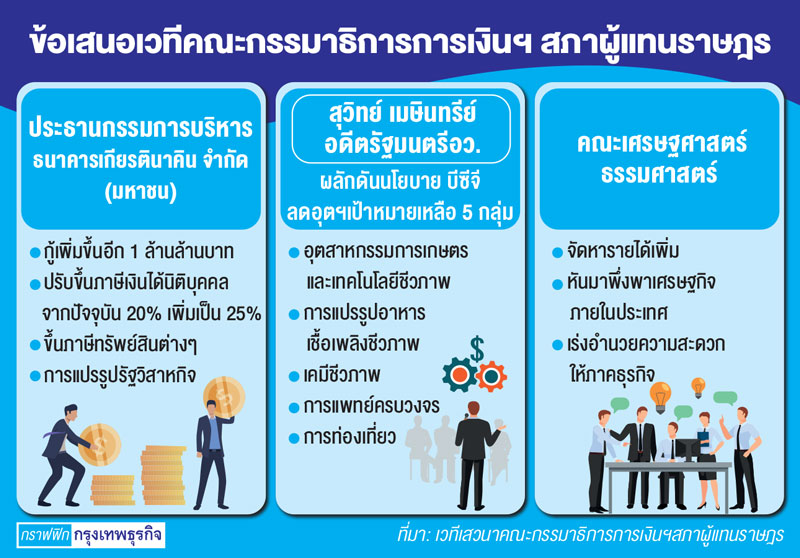
Suwit Masinthree, former Minister of Higher Education, Science, Research and Innovation, reiterated that before COVID-19, the government had set a policy for 12 target industries, but everything must change post-pandemic. The focus should shift to industries where Thailand is strong and beneficial to the nation. Thus, the BCG policy was pushed forward, reducing the target industries to five groups: Agriculture and Biotechnology, Food Processing, Biofuels and Biochemicals, Comprehensive Medical Care, and Tourism, integrated together. COVID-19 will elevate Thailand in two industries: food and medicine, strengthening the foundation of the Thai economy from existing resources.
The government must urgently act to mitigate the impact of COVID-19 by creating jobs. National Statistical Office data shows that there are 500,000 graduates unemployed. Last year, a budget was pushed for the Youth Nation project to create 100,000 jobs, but only about 50,000 jobs were funded. During COVID-19, the Ministry of Higher Education suggested hiring at least 300,000 people. Previously, 70% of graduates would find jobs, while 30% would take 1-3 years to find work.
“However, due to COVID-19, the situation has reversed, with 70-80% of graduates now unemployed. This is very concerning, compounded by the existing backlog of 500,000, leading to a total of over a million unemployed graduates.”
Nevertheless, the project has not yet reached the Cabinet. The government must first create jobs for these individuals, as they are the nation's assets. A budget of 400 billion baht should be allocated to employ these graduates for 12 months, alongside reskilling and upskilling efforts. It should not just be about distributing jobs; universities nationwide should employ graduates by addressing community issues, allowing them to work in their own areas. Within these 12 months, there should be two months of training in necessary skills for the new world, addressing both short-term and long-term needs.
SOURCE : www.bangkokbiznews.com