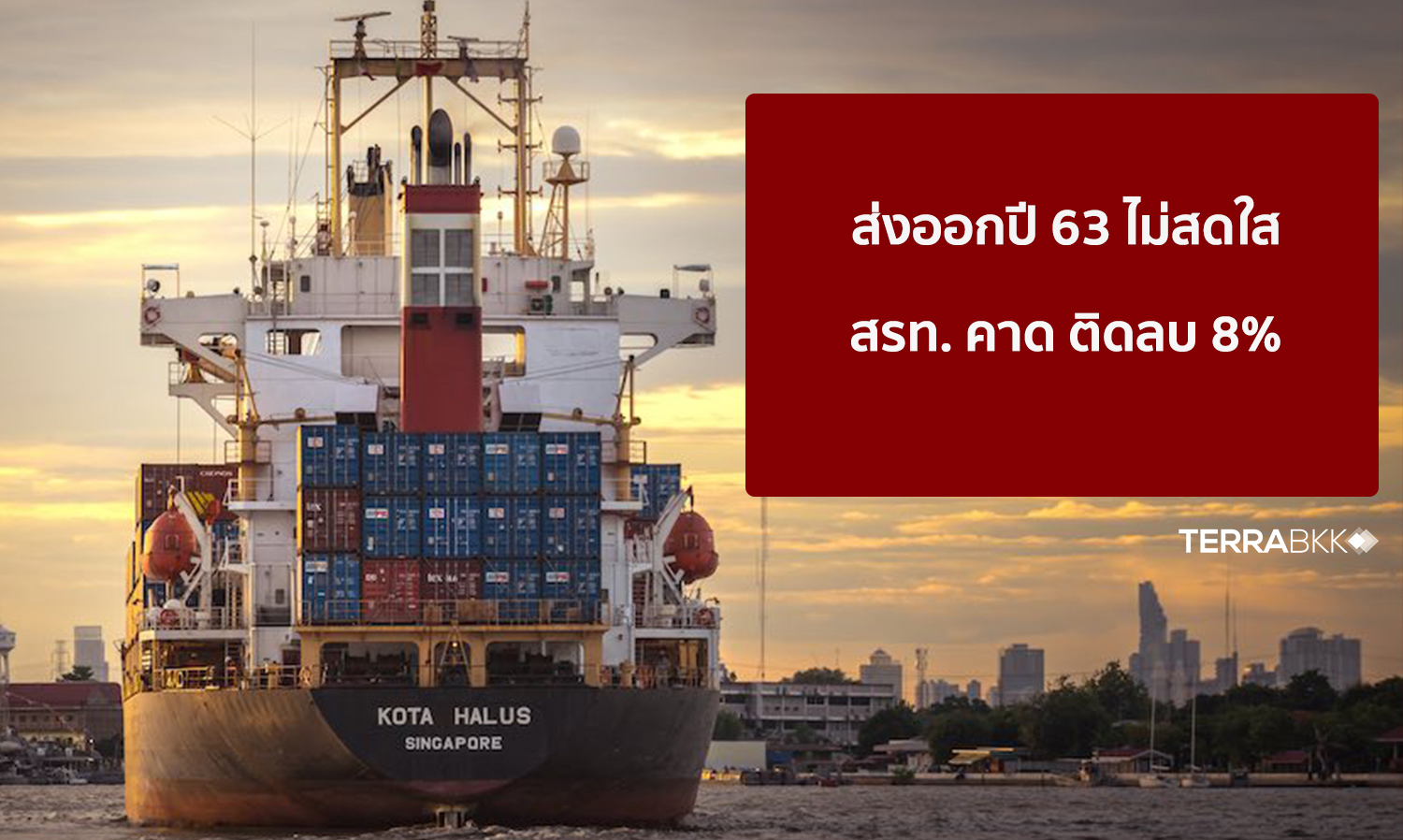
Thai Export Forecast for 2020 Expected to Decline by 8%

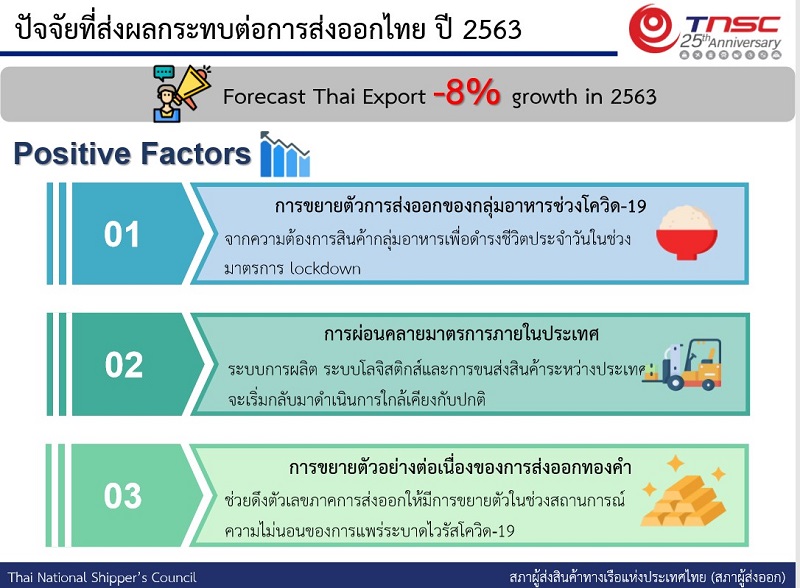
Ms. Kanyapak Tantipipatpongs, President of the Thai National Shippers' Council (TNSC) stated that the TNSC maintains its forecast for Thai exports in 2020 to contract by 8% based on an assumption of 30.5 baht per US dollar. Positive factors include the growth in food exports, which are performing well, and the easing of lockdown measures within the country, allowing production, logistics, and international shipping systems to return to near-normal operations. However, exports will need to be closely monitored in the second half of the year due to the situation in various countries. Although conditions are improving, concerns remain regarding the purchasing power of workers who have lost jobs, which affects imports. Additionally, the TNSC plans to discuss the export situation and low-interest loan measures with the Bank of Thailand (BOT) on June 4, 2020.
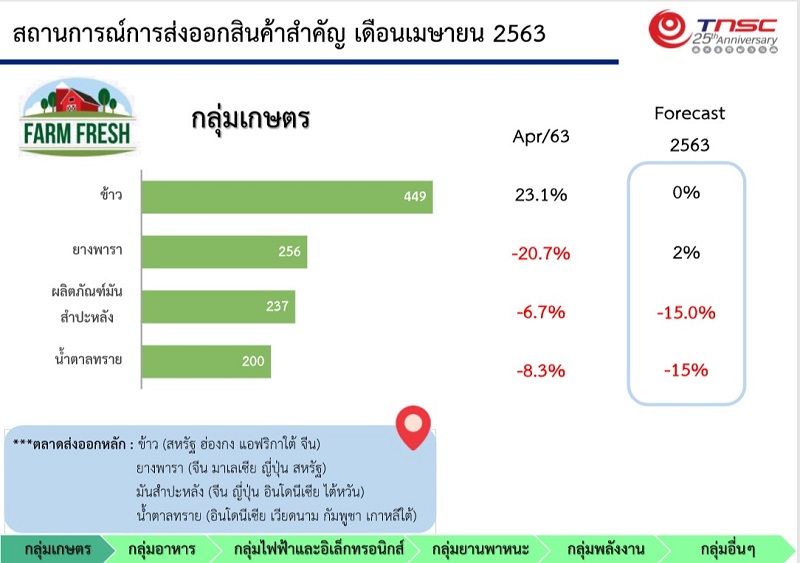
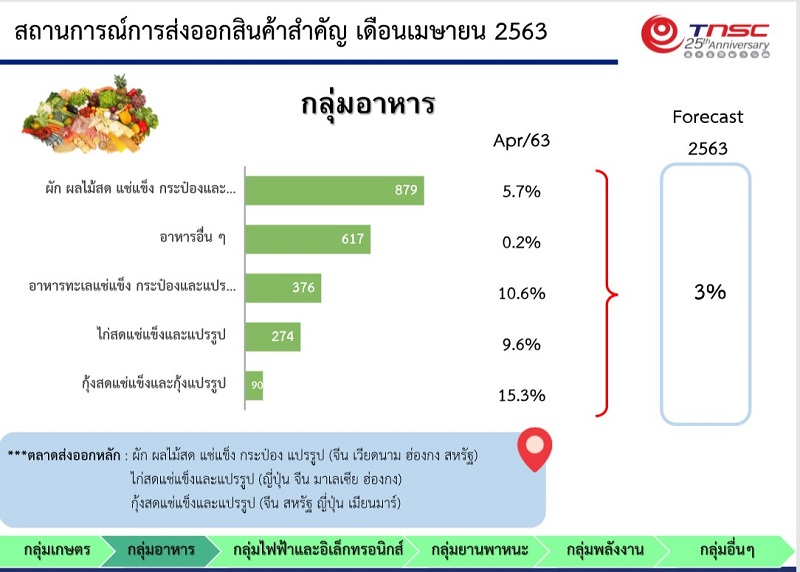
In April, exports of agricultural and agro-industrial products grew by 4.0% compared to the same period last year. The products that performed well included rice, fresh vegetables, fruits (fresh, chilled, frozen, and processed), fresh chicken (chilled, frozen, and processed), pet food, and food seasonings. However, the products that contracted included rubber, granulated sugar, cassava products, and beverages. Meanwhile, the industrial sector also saw a growth of 4.0% compared to the same period last year, with expanding products including gold, other vehicles, and aircraft and spacecraft components.
"In April 2020, exports were valued at 18.948 billion USD, growing by 2.12% compared to the same month last year. Imports in April 2020 were valued at 16.486 billion USD, contracting by -17.13% compared to the same period last year, resulting in a trade surplus of 2.462 billion USD for April 2020. When excluding gold, oil, and military equipment, exports in April contracted by -7.53%"
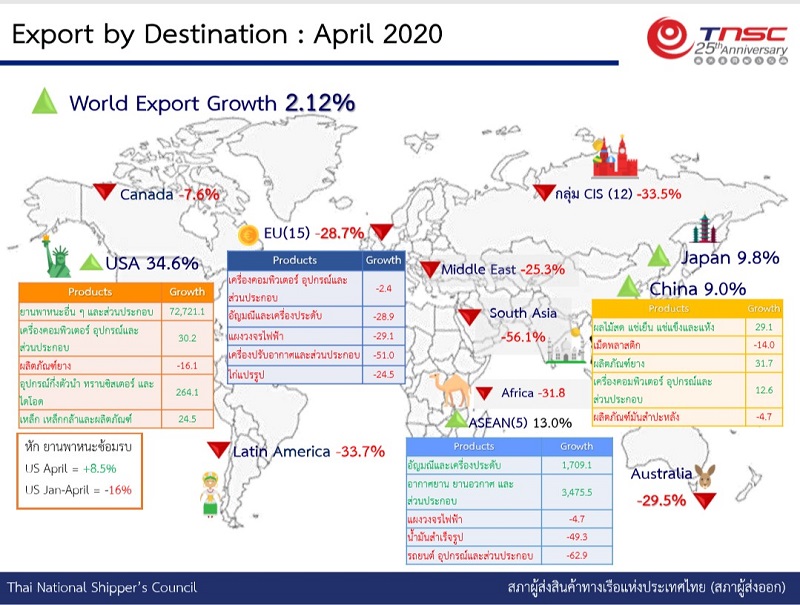
Overall, from January to April 2020, Thailand's total exports were valued at 81.620 billion USD, growing by 1.19% compared to the same period last year, while imports were valued at 75.224 billion USD, contracting by -5.72% compared to the same period last year, resulting in a trade surplus of 6.396 billion USD from January to April 2020. When excluding gold, oil, and military equipment, exports from January to April contracted by -0.96%.
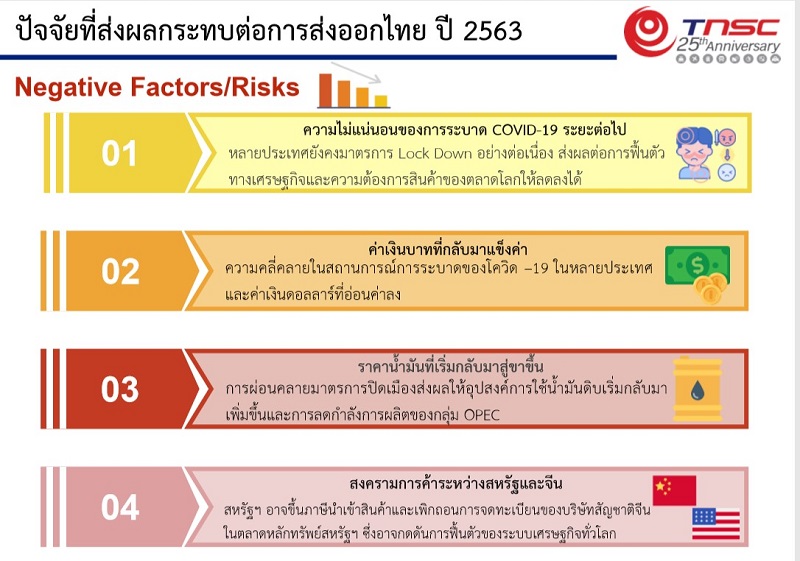
Nevertheless, Thai exports must be cautious of risk factors, such as the uncertainty of the ongoing COVID-19 outbreak, which has led many countries to continue lockdown measures, impacting economic recovery and potentially reducing global market demand for goods; the Thai baht, which is showing signs of strengthening due to the situation in Thailand being better than in many countries, making it viewed as a safe haven again; as well as economic figures from the US, which are below expectations, putting pressure on the dollar to weaken, potentially affecting economic fragility; oil prices, which are starting to rise again after COVID-19 as many countries begin to ease restrictions, which could increase costs for exporting businesses; and the renewed conflict between the US and China, with the likelihood of increased import tariffs on goods from China, as well as the delisting of Chinese companies from the US stock market and pressure on China through support for protesters in Hong Kong.
The TNSC has made several recommendations to relevant agencies:
1) Request the Bank of Thailand to maintain exchange rate stability to prevent it from strengthening beyond 34 baht per US dollar.
2) Accelerate the use of public budgets to invest in creating sustainability for the economy, especially in adapting to the digital disruption of the public sector.
3) Support Thailand's participation in CPTPP negotiations to stimulate the economy while reserving the right to withdraw if the terms are not beneficial for the country, and expedite negotiations for other FTAs such as RCEP and Thai-EU.
4) Consider trade in the form of Trade to Localization, focusing on neighboring countries in ASEAN and CLMV (CLMV is our home market) as they are close markets and can facilitate cross-border transport easily, and support the establishment of policies to create a single market and develop a feasible cross-border transport plan.
5) Request the government to promote industries with potential related to the current situation to stimulate export volumes, such as rubber products (in the medical supplies sector), food industry, electronics and equipment, and plastic products; and 6) Propose that the Center for COVID-19 Situation Administration consider lifting restrictions on businesses in trade and services across various sectors under close monitoring to allow businesses to resume operations more smoothly.
Source: Thai National Shippers' Council (TNSC)