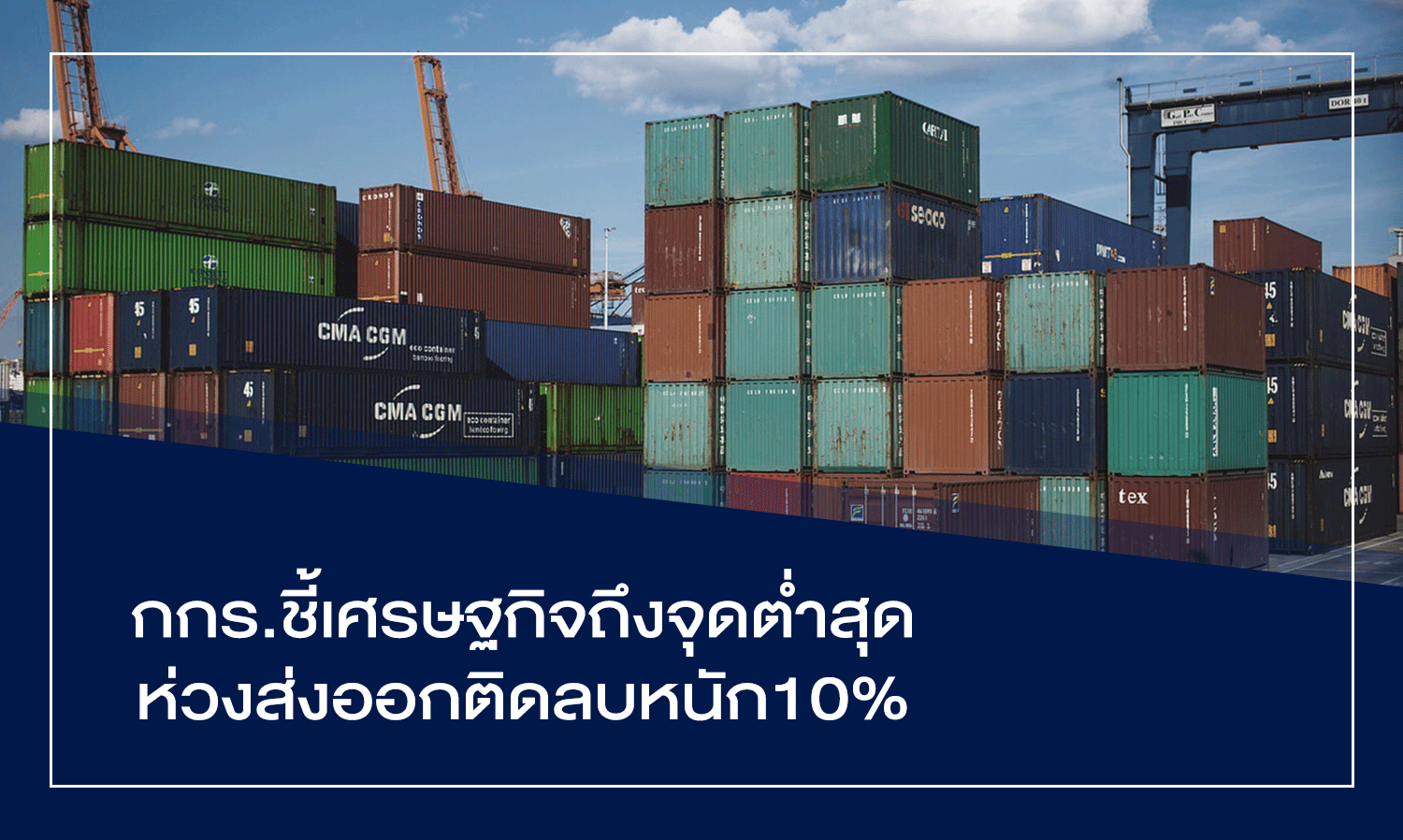
Joint Private Sector Committee (JCC) Indicates Economy at Lowest Point, Concerns Over 10% Negative Export
The COVID-19 pandemic has severely impacted the economy, prompting various agencies to gradually revise their forecasts. Recently, the Joint Private Sector Committee (JCC), consisting of the Thai Chamber of Commerce, the Federation of Thai Industries (FTI), and the Thai Bankers' Association, has made new assessments.
Mr. Suphan Montree, President of FTI and Chairman of JCC, revealed that the JCC meeting evaluated the economic impact of the COVID-19 crisis and adjusted the economic forecast based on the assumption that COVID-19 will not resurge in Thailand. It is expected that Thailand's GDP this year will contract by 3% to 5%, down from the previous forecast of a growth of 1.5% to 2.0%.
This forecast is better than the International Monetary Fund (IMF), which estimated a contraction of 6.7%, due to the government's ongoing relief measures and a budget injection for recovery amounting to 20% of GDP. Exports in 2020 may decline by 5% to 10%, and the general inflation rate is projected to be between 0% and -1.5%.
In the first quarter of 2020, Thailand's exports grew by 0.91%, valued at $62.672 billion, while imports amounted to $58.738 billion, contracting by 1.92%, resulting in a trade surplus of $3.934 billion.
Currently, the JCC believes that the Thai economy has reached its lowest point. Following the government's easing of economic activities, economic figures are expected to gradually improve, but the recovery will not be rapid like a V-shape; instead, it will resemble a U-shape with a broad base, indicating that economic recovery will take time. Although COVID-19 cases in Thailand have significantly decreased, the pandemic remains severe abroad, causing the Thai tourism sector to take longer to return to normal. Additionally, the global economy is in a recession this year, which will affect exports.
Furthermore, the JCC is monitoring 34 proposals from the private sector submitted to the government, covering tax, finance, labor, and public utilities, aimed at alleviating and revitalizing the business sector from the impacts of COVID-19. Currently, the government has approved 11 of the JCC's proposals, with another 11 measures in progress.
The remaining 12 measures include proposals to adjust withholding tax rates to a flat rate of 1% for all types for the year 2020, exempting corporate income tax for SMEs for three years (2020-2022), reducing mortgage and land transfer fees to 0.01% for 2020, and refunding electricity deposit fees for SMEs using 50-amp meters.
The JCC will send a letter to the responsible agencies to expedite these measures. Additionally, to support Thai agriculture, the JCC will encourage the private sector and consumers to purchase agricultural products, including vegetables and fruits.
Banking Sector Supports Soft Loans for SMEs
Mr. Pridi Daochai, President of the Thai Bankers' Association, stated that the association is currently in close discussions with the Bank of Thailand (BOT) to assist entrepreneurs in accessing credit affected by COVID-19. Currently, the BOT's low-interest soft loan program, with a budget of 500 billion baht, has started to be disbursed to SMEs, although some customers may not qualify for the loans or may lack sufficient collateral.
SMEs can request services from the Small Industry Credit Guarantee Corporation (SICGC). Meanwhile, financial institutions have measures in place to mitigate impacts for the general public, such as waiving principal and interest for six months, although interest rates will still accrue. Therefore, it depends on the customers' willingness to choose the type of assistance they need, whether to defer principal or interest.
Private Sector Supports Continued Work from Home
Mr. Klynth Sarsin, President of the Thai Chamber of Commerce, mentioned that as the COVID-19 situation begins to ease and the government relaxes restrictions, the business sector will allow employees to work from home, or work from home will be reduced to 50% of the total workforce. This measure will be maintained for one month to reduce crowding in public places and to monitor the government's easing of restrictions.
Additionally, it is expected that by mid-month, the government, through the COVID-19 Situation Administration Center, will relax restrictions for large stores or medium-risk locations, such as shopping malls, to reopen, depending on the infection rates during the easing period. The COVID-19 Situation Administration Center will reconsider the clarity of this matter.
SOURCE: www.bangkokbiznews.com