
COVID-19 Leads Thai Automotive Industry to Lowest Point in 9 Years... Resulting in Supply Chain Adjustments and New Automotive Parts Production Processes in Thailand
The current global crisis caused by the COVID-19 pandemic has significantly impacted the Thai automotive industry in various aspects, including triggering an economic recession both in Thailand and globally, which is a major factor affecting car orders from both domestic and export markets. This has led to a severe contraction in automotive production in Thailand, which is expected to shrink dramatically this year. At the same time, the COVID-19 outbreak has accelerated changes in the automotive supply chain, focusing on risk diversification alongside increased operational flexibility. The halt in automotive parts production in China has highlighted the risks of relying on a single production base. Additionally, the changing social behaviors influenced by the Social Distancing culture will inevitably affect the adjustments in automotive and parts production processes in factories, particularly with a greater reliance on automation. These points will be elaborated on by the Kasikorn Research Center.
COVID-19 Causes Severe Decline in Thai Automotive Production in 2020... Rapid Recovery May Occur in the Second Half of 2021
Following the widespread outbreak of COVID-19, which has led to a significant global economic downturn, the automotive industry has been one of the most affected sectors. IHS Markit forecasts that global sales of passenger cars and small commercial vehicles in 2020 may decline by as much as 22% compared to the previous year, with the U.S. and Europe experiencing sharper contractions than other regions, pushing global production of these vehicles down by over 21.2% from last year.
In Thailand, COVID-19 has also severely impacted orders both domestically and internationally, consequently affecting automotive production, which is expected to contract sharply this year as well. The Kasikorn Research Center has preliminarily assessed the current outbreak situation and estimates that automotive production in 2020 may shrink by approximately 21% to 25%, resulting in production of only 1,520,000 to 1,590,000 units compared to 2,013,710 units produced the previous year, marking the lowest production figures in 9 years.
This decline in production is expected to be driven by a significant drop in exports, potentially falling to 750,000 to 780,000 units, a contraction of 26% to 29% from the 1,054,103 units exported in 2019. Meanwhile, domestic sales are at risk of dropping to 800,000 to 820,000 units, a decline of 19% to 21% from the previous year's sales of 1,007,552 units. However, due to the uncertainty surrounding the COVID-19 outbreak, with no vaccine or definitive treatment available, these estimates may not be final and could change in the future if further severe outbreaks occur before the end of 2020.
Forecast for the Thai Automotive Industry in 2020
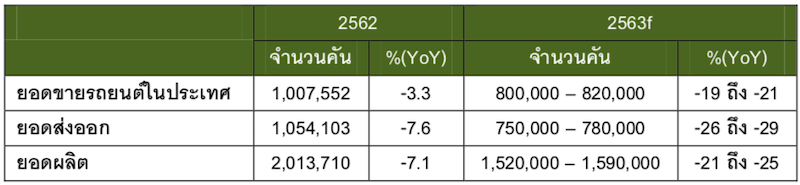
Source: Kasikorn Research Center
Regarding the recovery trajectory of the Thai automotive industry, the Kasikorn Research Center predicts that as the COVID-19 outbreak situation begins to ease with widespread vaccination, which is expected to occur as early as the beginning of 2021, the overall economic conditions both in Thailand and abroad will still be in a gradual recovery phase. Therefore, it may take until mid-2021 to early 2022 for the global automotive market to return to normal.
Supply Chain Management for Automotive Parts to Focus on Increased Risk Diversification Post-COVID
After the widespread outbreak of COVID-19, particularly during the shutdown of automotive and parts production in China, significant impacts have been felt across the automotive manufacturing industry. In Thailand, although there is less reliance on parts from China, as over 80% to 90% of parts needed to assemble a vehicle can be produced domestically, some components still need to be imported from China, such as certain electronic parts like advanced sensors and ECUs. The inability to import these from China has necessitated sourcing from other countries, such as Japan. This excessive reliance on a single production base has prompted automotive manufacturers and parts suppliers to consider more flexible approaches in the future by diversifying their automotive parts supply chain.
The Kasikorn Research Center anticipates that automotive manufacturers and parts suppliers will adopt two main strategies moving forward:
- Relaxing the Just In Time production system due to its significant weakness of maintaining minimal stock of raw materials and parts. While this approach reduces inventory costs, unexpected risks, such as the COVID-19 outbreak, can severely impact the supply chain if there are insufficient raw materials or parts available for production, potentially leading to customer loss or reduced future orders. Countries with a high dependence on imported materials or parts in their supply chains, particularly those with fewer comprehensive local suppliers, may be more vulnerable than countries with large clusters of parts manufacturers and integrated production processes.
Moreover, the Kasikorn Research Center believes that Thailand still holds advantages over other production bases in the region due to its long-standing development of parts manufacturing clusters, allowing most automotive production processes to occur domestically. Thus, the need to relax the Just In Time production system may not be as pronounced. However, for certain complex automotive parts that require imports and rely on limited sources, increasing inventory levels may be necessary to manage future uncertainties in the supply chain.
As for automotive assembly plants in Thailand, the Kasikorn Research Center believes that the relaxation of the Just In Time system may not occur, except for critical imported parts that are small, do not take up much space, and can be shared across multiple vehicle models using the same platform. Conversely, automotive manufacturers are likely to seek collaboration with parts suppliers, especially those requiring increased imports, which will directly impact inventory costs for those parts manufacturers.
The Kasikorn Research Center sees that an important strategy for Thai automotive parts manufacturers who may need to increase raw material or parts inventory to cope with rising costs is to closely monitor production situations more frequently than in the past, plan operations more flexibly, and seek alternative sources of materials or parts for emergencies.
- Considering relocating certain automotive parts production bases, especially from China, to strategically viable production bases in the region that offer lower production costs and sufficient capacity to support automotive production. Thailand is expected to be one of the attractive options for automotive manufacturers and parts suppliers. This strategy may lead to a clearer direction for a new supply chain management model, including:
- Utilizing shared platforms across different vehicle models and parts within the same manufacturer and between manufacturers, which is anticipated to be accelerated in the future. Currently, some automotive manufacturers and parts suppliers, particularly in the electric vehicle sector, have already begun implementing this approach, as it aids in risk diversification by consolidating production bases in each region, achieving Economies of Scale more easily through shared parts across multiple products, and reducing risks associated with sudden shortages from specific production sources. Conversely, if automotive manufacturers and parts suppliers continue to operate in the traditional manner, striving to differentiate each vehicle and part model to the extent that parts cannot be interchangeable, risk diversification through establishing additional production bases, even in strategic countries, may prove more challenging.
New parts, such as various electronic components, sensors, electric motors, and batteries, are expected to find it easier to invest in Thailand, reinforcing its opportunity to become a regional electric vehicle production hub.
- Consolidating certain types of work across different Tier levels into the same company, particularly within the same business group as Tier 1 parts manufacturers, will shorten the supply chain (Shorten Supply Chain). The use of shared platforms will reduce differences among parts across each Tier, allowing for greater interchangeability. This may lead to mergers or joint ventures among parts manufacturers within the same Tier and across different Tiers to develop automotive parts more effectively. The larger scale of operations, increased capital, and higher order volumes will enhance the likelihood of achieving Economies of Scale, especially if consolidation facilitates higher investments in robotics and automation, allowing for greater integration of parts across different Tiers and improving production quality while reducing costs.
However, the Kasikorn Research Center believes that while the use of shared platforms among parts and vehicles, as well as consolidating businesses across different Tiers, may enhance the effectiveness of relocating production bases to new locations, it could also lead to the demise of Tier 2, 3, and 4 parts manufacturers with limited financial resources who cannot adapt to these changes, particularly when faced with competition from foreign parts manufacturers with superior technology and capital investing in Thailand. Nevertheless, Thai parts manufacturers that can still cope may need to explore opportunities for collaboration with domestic parts manufacturers or those planning to invest from abroad to strengthen their businesses.
Social Distancing Impacts Thai Automotive and Parts Production Processes, Increasing Automation
The COVID-19 pandemic has not only compelled automotive manufacturers and parts suppliers to adjust their strategies to increase risk diversification in their supply chains but has also led to changes in social behaviors that emphasize maintaining distance between individuals, which will begin to influence production processes in factories. This is to prevent infections and control the spread of diseases, both for the current COVID-19 situation and for future infectious diseases. Consequently, automotive assembly plants and parts manufacturers are likely to consider adjusting their work environments to align with these changes, such as increasing spacing in work areas and intensifying the use of various forms of robots and automation in production processes. While this may lead to increased short-term costs, in the long run, it will enable businesses to better manage costs and product quality, address Social Distancing issues, and reduce risks associated with human labor.
Although the trend of incorporating automation into production processes may intensify following the COVID-19 outbreak to mitigate labor-related issues, it may also prompt factories to relocate production bases back to their home countries across various industries, as there is less need to seek low-cost labor sources as in the past, particularly in industries with short and uncomplicated supply chains. However, in the case of the automotive and parts industry, which involves multiple levels of interconnected components, the adoption of automation will promote policies to diversify risks by establishing factories in other strategic production countries, especially as automation technologies facilitate production using the same platform to achieve Economies of Scale more easily.
The Kasikorn Research Center believes that for the ASEAN and Oceania markets, Thailand has the potential to be the preferred country for parts manufacturers to establish production bases to diversify risks from sudden shortages of parts from specific sources, given its significant strengths in non-labor costs compared to competitors, especially when participating in various government investment promotion programs, along with having sufficient automotive production capacity to meet high domestic demand and substantial exports to neighboring countries in the region. The primary investors are expected to be parts manufacturers relocating from China and those with vehicles in the ASEAN and Oceania markets, particularly for electric vehicle components, which Thailand currently supports and where the market is growing significantly faster than other countries in the region.
In summary, the Kasikorn Research Center views the current COVID-19 pandemic as having caused a significant disruption in the Thai automotive industry, but it may also present an opportunity for Thailand if it prepares to attract suitable investments in the future, particularly in electric vehicles, as many foreign parts manufacturers from China and other countries recognize the need to prepare for increasing future risks by diversifying away from a single production base, such as China, to other strategic production centers in each region.
The key approach is to adapt to the changing operational models of automotive manufacturers and large Tier-1 parts suppliers, particularly by promoting the increased use of robotics and automation in production processes beyond current levels. This may impact some smaller parts manufacturers with limited financial resources who cannot adapt to these trends, potentially leading to the exit of some manufacturers from the industry, along with certain labor groups in that sector who cannot adjust to working alongside automation. Additionally, there will need to be a focus on developing a workforce that can work alongside robots in the future, as well as promoting the development of knowledge and supporting the growth of the robotics industry domestically to reduce reliance on imports and enhance opportunities for creating new innovations for use in the automotive and parts industries, as well as other industries in the future.
[1] The use of shared platforms has another significant advantage: it allows for quicker model changes in response to shifting consumer demands, as the core components are less differentiated than in the past, which aligns with the future trend of vehicles using much less of the original core structural components, such as electric vehicles and autonomous vehicles, where manufacturers focus more on selling service experiences rather than competing on engine power as in the past.