EIC Expects Fed, BOT, and Other Central Banks to Further Cut Interest Rates
The Federal Reserve, or Fed, has made an emergency rate cut of 50 basis points due to the economic outlook of the United States being affected by COVID-19. On March 3, 2020, the Fed held an unscheduled monetary policy meeting where the FOMC voted to lower the policy interest rate by 50 basis points from the range of 1.75%-1.50% to a new range of 1.25%-1.00% because of:
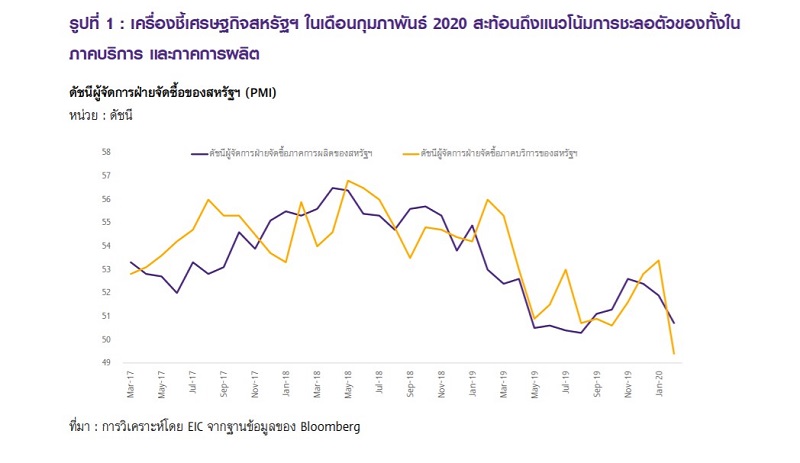
- The U.S. economy is expected to slow down more than previously assessed. The COVID-19 outbreak is likely to prevent the U.S. economy from expanding as the Fed had previously estimated (the Fed estimated a growth of 2.0% in December 2019). Additionally, Mr. Powell stated in a press conference that the risks from the COVID-19 outbreak to the U.S. economy have significantly increased and will impact current economic activities. The impact may widen, as evidenced by the U.S. services purchasing managers' index (PMI) in February 2020, which was at 49.4, down from 53.4 the previous month (a figure below 50 indicates contraction), and the U.S. manufacturing PMI was at 50.7, down from 51.9 the previous month (Figure 1).
- The Fed aims to ease financial conditions in the U.S. which have tightened significantly. Before the Fed's rate cut, the U.S. stock market (S&P 500) had dropped by 4.4% since the beginning of 2020, while the U.S. dollar index had strengthened by about 2.7%. Furthermore, volatility in both equity and bond markets had increased, leading to a rapid tightening of overall financial conditions. After the Fed signaled a rate cut on February 29, 2020, market participants largely anticipated that the Fed would cut the policy interest rate by 50 basis points in March. Therefore, if the Fed eases monetary policy less than the market expects, it could lead to a further decline in the U.S. stock market and a rapid strengthening of the U.S. dollar, which would tighten financial conditions further.
The U.S. economy is expected to grow at a slower rate than previously estimated due to the severe impact of the COVID-19 outbreak.
EIC estimates that the U.S. economy will grow at a rate of 1.3% in 2020, compared to the pre-outbreak estimate of 2.1%. The COVID-19 virus has impacted the U.S. economy both directly from the onset of the outbreak domestically and indirectly through connections with the Chinese economy. EIC has identified five main channels of impact:
- Export channel to China: Due to a slowdown in domestic demand in China, exports to China, which accounted for 13.5% of the total value of U.S. exports in 2019, are expected to decline in the first half of 2020.
- Income from Chinese tourists: After the U.S. government announced the temporary suspension of U.S.-China flights, the number of Chinese tourists, who made up 3.8% of total tourists in 2018, has disappeared during this period.
- Supply chain disruptions for U.S. manufacturers: The COVID-19 virus has caused factories in China and other countries facing outbreaks to be unable to produce parts for U.S. factories in the short term, leading to production disruptions due to the inability to source replacement parts.
- Supply chain disruptions for U.S. retailers: Reduced production capacity in China and several other countries due to the COVID-19 virus has prevented U.S. retailers from importing enough goods to meet domestic consumer demand, which will negatively impact retail sales.
- Consumer confidence and domestic consumption: As the number of COVID-19 cases in the U.S. has continued to rise over the past month, U.S. consumers have become increasingly concerned about the outbreak, leading them to delay spending on luxury goods, which will affect household consumption, accounting for two-thirds of the U.S. economy.
EIC expects the Fed may cut interest rates another 1-2 times (25 basis points each time) in the first half of the year to ease financial conditions, support the economy, and build confidence among households and businesses.
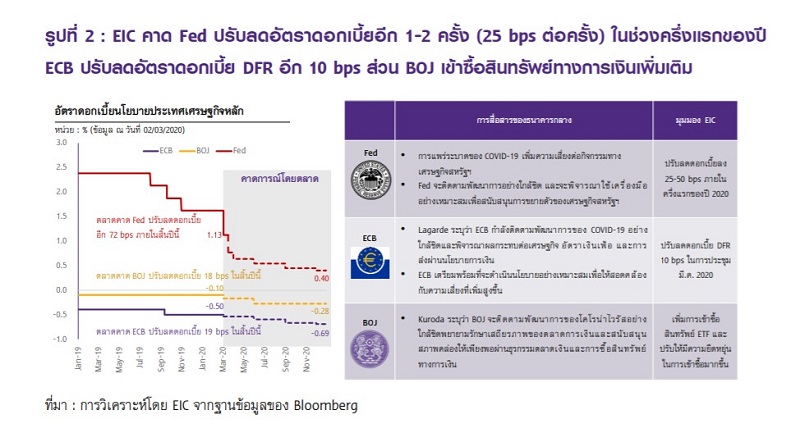
The response from the financial market indicates that the recent cut in the policy interest rate has not significantly eased financial conditions in the U.S. Additionally, the market anticipates that the Fed will cut interest rates by another 25 basis points in the meeting on March 17-18, 2020, and another 25 basis points by June 2020 (Figure 2). Therefore, EIC believes that the Fed needs to further reduce the policy interest rate to support the economy and further ease financial conditions, as well as to build confidence among households and businesses. Furthermore, EIC believes that the Fed's communication in the FOMC report stating that the Fed is ready to use appropriate tools to support the expansion of the U.S. economy signals the possibility of additional rate cuts in the future.
EIC expects the ECB to cut the Deposit Facility Rate (DFR) by 10 basis points and the BOJ to increase its asset purchases.
Other central banks in the region are also likely to ease monetary policy further, as follows:
- The ECB is likely to cut the interest rate on commercial bank reserves held with the ECB (Deposit Facility Rate: DFR) from -0.5% to -0.6% per annum in the meeting on March 12, 2020 due to the significant impact of COVID-19 on the European economy, combined with Ms. Lagarde's communication indicating that they are closely monitoring the developments of the COVID-19 outbreak and considering its impact on the real economy, inflation, and the ability to transmit monetary policy. She also communicated that the ECB is prepared to implement appropriate policies in response to the increasing risks (Figure 2).
- The BOJ may increase its ETF asset purchases and adjust to be more flexible in its purchasing. Mr. Kuroda's statement indicated that the BOJ will closely monitor the developments of COVID-19 to maintain financial market stability and support liquidity through money market transactions and financial asset purchases. EIC believes that the BOJ will likely maintain its guidance for ETF asset purchases at 6 trillion yen per year, with increased flexibility, especially during significant declines in the Japanese stock market (Figure 2).
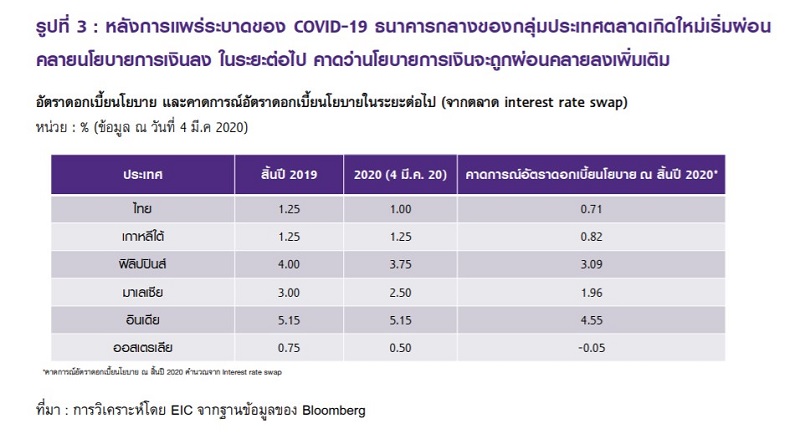
- Other central banks in the region are also beginning to ease monetary policy. Additionally, market participants believe that these central banks may further reduce policy interest rates in the near future. Following the outbreak of COVID-19 in several countries, many central banks have recently cut their policy interest rates, such as the Philippines (cutting the policy interest rate by 25 basis points to 3.75% per annum), Malaysia (cutting the policy interest rate twice by 25 basis points each time to 2.50% per annum), and Australia (cutting the policy interest rate by 25 basis points to 0.50% per annum). In the near future, the market expects that most central banks in the region will further reduce their policy interest rates.
The BOT may cut the policy interest rate again by 1 time (25 basis points) in the first half of the year, with a high likelihood of a cut in the March meeting.
Due to the increasing risks to the global and Thai economies from the COVID-19 outbreak, EIC believes that the impact on the real economy of both Thailand and the world is more severe than previously estimated, as reflected by many central banks adjusting their economic forecasts downward and implementing more accommodative monetary policies.
The global economy, which is slowing more than expected, is impacting the Thai economy through exports and tourism, with a tendency for more severe effects than originally estimated. Additionally, the impact on the global supply chain is also more severe than previously assessed. The shutdown of manufacturing plants in China at the beginning of the year has disrupted the import of certain intermediate goods from China to Thailand (supply disruption) in some industries. Furthermore, the inability to export final goods from China has also affected Thailand's retail sector. Regarding concerns about the ongoing increase in domestic outbreak cases, EIC believes that this may impact domestic consumption and investment more than previously anticipated.
- Therefore, the BOT may need to further reduce the policy interest rate to minimize potential impacts on the economy. EIC believes that lowering the policy interest rate will help increase liquidity in the Thai financial system and benefit households looking to restructure their debts, as lower interest rates will reduce monthly debt repayment burdens. Additionally, reducing the policy interest rate will also enhance confidence among investors and businesses regarding the outlook for the Thai economy in the future.
- The need for other measures beyond interest rate cuts is becoming more critical. EIC believes that this interest rate cut may not significantly stimulate the Thai economy, as the current slowdown in both the Thai and global economies is primarily due to supply-side issues. Lowering the policy interest rate to stimulate new demand may have limited effects. Therefore, the use of monetary policy in conjunction with other measures is becoming increasingly necessary.
"The BOT may not have much room left to cut interest rates further and will need to rely on policies from other sectors, as the capacity to implement monetary policy is becoming increasingly limited, especially as the BOT has already reduced the policy interest rate to 0.75% as expected. Relevant sectors have already begun to implement policies."
The Ministry of Finance, the Bank of Thailand, and both private and state financial institutions have introduced measures to assist those affected by COVID-19. The Ministry of Finance has extended the deadline for filing personal income tax returns until June 2020 and allowed hotel businesses to receive additional tax deductions. They are also preparing to allocate a budget to support the tourism sector. Financial institutions have implemented measures to assist debtors, including the suspension of principal repayments (mostly allowing a suspension of up to 12-18 months depending on the affected industry) and increasing liquidity for businesses needing additional working capital through low-interest loans. For instance, the Government Savings Bank is preparing to provide low-interest loans of 100 billion baht to commercial banks for onward lending to their customers. The Bank of Thailand has recently requested cooperation from commercial banks to reduce interest rates and fees to facilitate debt restructuring for businesses and households. They have also relaxed criteria for classifying non-performing loans as regular loans. Internationally, there is a trend towards using fiscal policy to stimulate the economy more. For example, Singapore has increased its budget for the Ministry of Health and introduced measures to assist businesses through corporate tax reductions and financial aid for low-wage workers and freelancers to mitigate the impact of COVID-19. Hong Kong has reduced income taxes for employees and businesses and provided low-interest loans with 100% government guarantees, as well as preparing to inject additional budgets to support the tourism and hospital sectors. In China, the government has implemented tax reductions for businesses in areas affected by COVID-19, and the People's Bank of China has injected 300 billion yuan and reduced loan interest rates (both LPR and MLF) and lowered the reserve requirement ratio (RRR) to support the severely slowing economy. Moving forward, EIC believes that the government will implement additional fiscal measures to help sustain the recovery of the Thai economy.
"Future economic stimulus measures will focus on boosting domestic purchasing power (e.g., cash handouts) and injecting liquidity through low-interest loans to businesses and industries directly affected by the COVID-19 outbreak, such as tourism, hotels, and restaurants impacted by the loss of foreign tourists, or industries facing supply shortages from China."