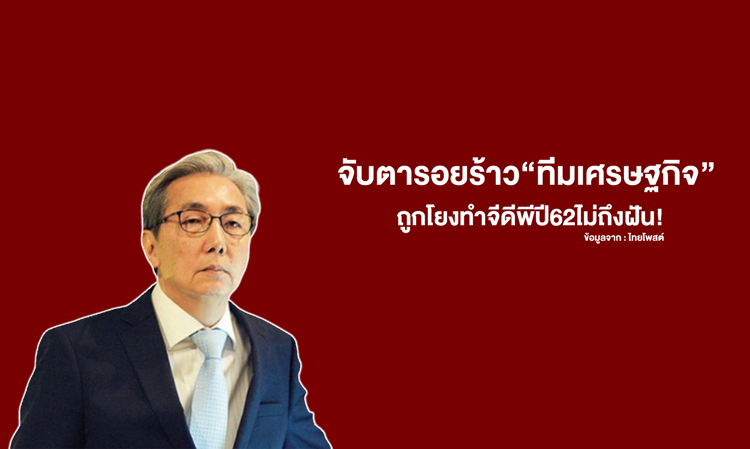
Watch for the Cracks in the 'Economic Team' Linked to GDP Missing Targets in 2019!
“We must sympathize with Mr. Somkid, as he is no longer the Deputy Prime Minister for the economy. With a coalition government dividing power into three parts, we need to consider how to coordinate all sectors to move in the same direction, especially regarding economic management.”
“The National Economic and Social Development Board (NESDB) has revised its forecast for Thailand's economic growth in 2019 down to 2.6% from the previous estimate of 2.8%, marking the lowest growth in five years. It is also expected that Thailand's economy will be affected by the export sector, which is projected to contract by 2% this year before starting to recover in 2020 for both the overall economy and exports.
Meanwhile, the “Ministry of Finance” has remained confident that Thailand's economic figures this year will still grow towards the target of 3%, following the government's efforts to implement a set of economic stimulus measures focused primarily on domestic drivers. However, it seems these measures have not been strong enough, leading to an acceptance that this year’s GDP may not reach the desired target. The GDP forecast for 2019 has been revised down to 2.8% from the original 3% due to external risk factors. The overall export growth for Thailand this year is expected to contract significantly at -2.5%, down from the previous forecast of -0.9%.
The “Bank of Thailand (BoT)” previously adjusted its forecast for Thailand's economy this year down to 2.8% from an earlier estimate of 3.3%. Export growth is expected to contract by -1.0%, down from the previous estimate of 0%. This is due to a continuous slowdown in exports, which is beginning to affect private sector investment and employment. Recently, BoT Governor Veerathai Santiprabhob stated that in December, the BoT will review the growth outlook for Thailand's economy again, initially predicting that this year’s GDP will grow below 2.8% due to the impact of trade barriers affecting all countries.
In the private sector, “Krungsri Bank”, represented by Somprawin Manprasert, Executive Vice President and Head of Economic Research, has revised its GDP forecast for Thailand this year down to 2.4%, while exports are expected to contract by 2.5%. He acknowledged that Thailand's economy is still in a downward trend, but it is a gradual slowdown, allowing time for adjustment unlike during a crisis.
The “EconSCB EIComic Intelligence Center of Siam Commercial Bank (SCB EIC)” has also revised its forecast for Thailand's economy in 2019 down to 2.5% from the previous 2.8%, predicting that in the fourth quarter of 2019, the economy will grow around 2.6% due to lower-than-expected growth in the third quarter, impacted by a significant slowdown in domestic economic activity, particularly private sector investment affected by the ongoing contraction in exports.
Given the direction of Thailand's economic growth this year, it must be acknowledged that it may not reach the desired target. This is not only due to external factors, which are the main pressures on growth, but also due to “domestic factors” that are equally under scrutiny, particularly the issue of the unity of the economic team, reflected in the economic stimulus measures that many see as disjointed efforts, suggesting that many initiatives seem to be conceived from only one part of the economic team.
This has led many to believe that there may be cracks within the economic team, as the current government is a coalition with multiple political parties involved. Therefore, the objectives and goals of each party may lead to differing perspectives on economic management.
This was further emphasized when previously “Somkid Jatusripitak”, the Deputy Prime Minister, stated on a platform that “I am no longer the Deputy Prime Minister overseeing the economy; I am just the Deputy Prime Minister overseeing four economic ministries.” This raised questions about whether the “economic team of the government is facing issues?” Ultimately, “Somkid” had to rise to deny such doubts, asserting that everything is fine; there are no problems!
Although “Somkid” has come out to reaffirm the unity of the economic team, things still seem to be not improving. Previously, “Kobsak Pootrakool,” Minister attached to the Prime Minister’s Office, had commented on this issue, stating that this government does not have the power to control all economic policies and ministries because it is a coalition government, with each party having its own Deputy Prime Minister overseeing its economic ministries. Given the election results, there is little that can be done, leading to a lack of unity in economic policy implementation. This is why it is necessary to have an Economic Cabinet (EconCabinet) chaired by Prime Minister General Prayuth Chan-o-cha to centralize power in economic oversight and facilitate joint discussions, thus there is no longer a Deputy Prime Minister for the economy as before.
“We must sympathize with Mr. Somkid, as he is no longer the Deputy Prime Minister for the economy. With a coalition government dividing power into three parts, we need to consider how to coordinate all sectors to move in the same direction, especially regarding economic management.”
Recently, “Somkid” spoke again, stating that the current economic drive involves many factors, including exports, cost of living, government spending, and support for farmers. All these engines of economic growth must move forward together. The Ministry of Finance has implemented economic stimulus measures, which are specific to the areas under its purview. This is what the Ministry of Finance can do, but other economic stimulus measures need to be discussed with the relevant agencies or responsible parties.
In the past, economic management had four legs; now it has only one. However, we still work together. For measures to support the economy from various perspectives, details need to be discussed with each ministry. I believe they are making an effort. If you want to know, you must ask them. I also confirm that the government is still working together, and each ministry must drive the economy in its area of responsibility. The Ministry of Finance does not handle exports as it is not its duty, but discussions have been ongoing.
This issue remains interesting as it is crucial for driving the country's economy amidst external risk factors, while there are also many domestic factors to monitor.
Thank you for the information from www.thaipost.net