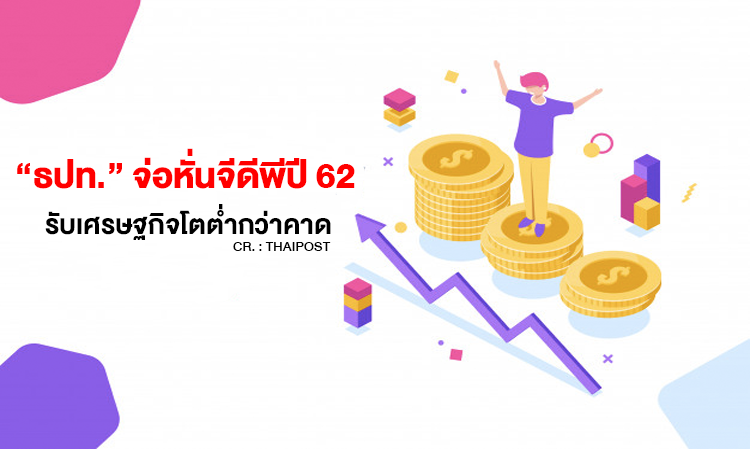
"Bank of Thailand" Set to Cut GDP Forecast for 2019 as Economic Growth Falls Short of Expectations
On May 17, 2019, Mr. Veerathai Santiprabhob, Governor of the Bank of Thailand (BOT), revealed that the economy is likely to grow at a rate lower than previously estimated. This is due to risks stemming from the intensifying trade war between China and the United States, which has impacted Thailand's exports and investors' decision-making. Additionally, the ongoing political uncertainty in the country remains a risk factor that needs close monitoring. The BOT plans to revise its economic growth forecast in June, which was initially projected at 3.8% for 2019, with exports expected to grow at 3%.
The trade barriers between China and the U.S. have created uncertainty and will undoubtedly affect the Thai economy. However, the extent of the impact will vary by industry. Some sectors may benefit, such as components exported to the U.S., which could gain an advantage from tariff measures. Conversely, negative effects will be felt in industries that export to China for further production and export in a supply chain context. The BOT will need to closely monitor the situation and adapt to certain markets while emphasizing the importance of trade agreements with regional countries.
"The situation regarding the Thai baht will continue to be volatile and highly uncertain, primarily due to external factors, especially the trade war and the policy directions of major industrial countries, which create uncertainty affecting asset prices, stock indices, and foreign exchange markets. This confirms that managing exchange rate risks is essential for businesses and operators to consistently undertake," Mr. Veerathai stated.
Regarding the U.S. preparing to announce a list of countries to be monitored for currency intervention, increasing from 13 to 20-25 countries, although Thailand is included in this special watch list, it will not impact the economy, and there is no need for concern. Thailand has previously discussed this with the U.S. and has consistently affirmed that it does not have a policy of intervening in the currency for trade benefits. The surplus in the current account and trade balance with the U.S. is the only aspect. Thailand has maintained a floating exchange rate policy, and the baht has appreciated against many countries. Any intervention would likely need to be in the direction of depreciation.
Thank you for the information from www.thaipost.net