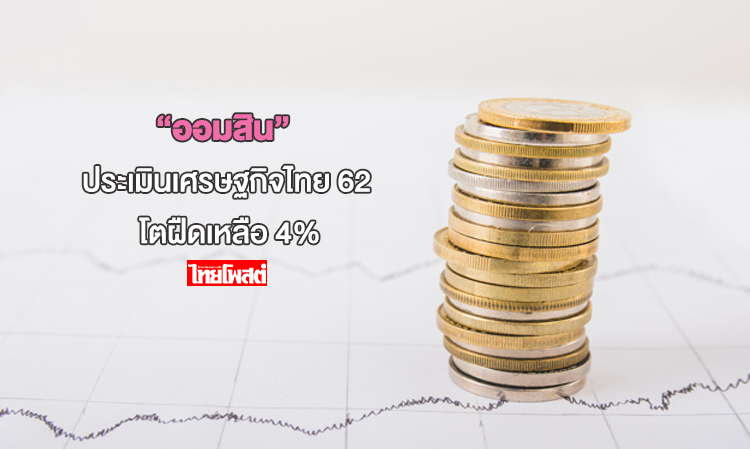
"Government Savings Bank" Assesses Thai Economy to Grow at 4% in 2019
Mr. Chatchai Payuhanaveechai, Director of the Government Savings Bank, revealed that the Economic Research Center of the Government Savings Bank predicts that the Thai economy will grow at 4% in 2019, down from the expected growth of 4.2% in 2018. This is attributed to investments and measures to support low-income earners as key drivers of the economy.
The growth of the Thai economy in 2019 is supported by several factors: 1. Additional funds from measures to assist low-income earners through the state welfare card amounting to 38.7 billion baht, which began to flow into the economy in December 2018, helping to stimulate spending among the grassroots population. 2. Increased public investment expected from the disbursement of the budget for the fiscal year 2019. 3. Infrastructure investment projects in the Eastern Economic Corridor (EEC), where many projects have progressed and received investment approval, are expected to accelerate construction this year. 4. The number of foreign tourists continues to grow as Thailand remains a popular vacation destination for travelers worldwide. 5. Crude oil prices are trending down compared to last year, positively impacting production and transportation costs, offsetting the rising financial costs.
However, there are risks to the Thai economy in 2019, including: 1. Exports may be affected by the slowdown in the global economy and the economies of trading partners. 2. Public investment disbursement may fall short of targets due to the complexity of large-scale projects. 3. The first interest rate hike in seven years by the Bank of Thailand (BoT) may initially slow down credit quality and consumer spending.
4. Continuous interest rate hikes by the U.S. Federal Reserve and the diminishing impact of tax reduction measures to stimulate the economy may affect U.S. economic growth. 5. The tight monetary policy of major economies may lead to increased volatility in financial markets, potentially affecting Thailand's financial stability.
Regarding economic stability, it remains in good condition, with the current account surplus continuing due to trade and service surpluses. General inflation is slowing down due to decreasing oil prices, while core inflation is gradually increasing in line with economic growth.
However, there are still pressures from the global economic slowdown and the economies of trading partners, along with the BoT slightly reducing its accommodative monetary policy, including implementing Macro Prudential measures.
Thank you for the information from www.thaipost.net