Experts Warn! Continuous Rain Accelerates 'Moisture Accumulation' - A Silent Threat That Can Deteriorate Homes Faster Than Expected
Due to the erratic weather and heavy rainfall in many areas across the country, many homeowners are beginning to face issues such as blistering paint, cracked walls, peeling plaster, mold growth on walls, and increasingly visible damp stains, especially in older homes or those frequently exposed to rain.
Experts in paint technology and surface protection materials from Bayer Co., Ltd. revealed that the moisture problems commonly found in homes are often a 'silent threat' that has accumulated over time. The root cause is not just the deterioration of paint but also the infiltration of water and moisture into the walls from outside the building, as well as moisture from the ground, known as Rising Damp, which gradually moves up through the bricks and plaster.
'Moisture at the lower levels is a critical warning sign that homeowners should not overlook. We often find damp stains, blistering paint, or peeling plaster at the lower parts of the walls before other areas, as moisture from the ground is absorbed into the structure, especially during the rainy season when moisture accumulation is high.'

Research in construction materials indicates that moisture is one of the key factors accelerating the deterioration of cement and porous materials. When moisture and salts accumulate within the material for an extended period, internal pressure builds up, causing the plaster surface to crack, commonly referred to as 'exploding plaster.' This also leads to mold growth, efflorescence, and long-term deterioration of the paint film.
Experts state that the first line of defense against moisture is 'primer' as it is the layer that directly contacts the walls, acting to block moisture, reduce water permeability, enhance adhesion, and help protect the overall paint system for a longer lifespan.
'Effective moisture problem-solving must start with prevention at the source, not just repairs at the end. No matter how beautifully you repaint, if moisture continues to penetrate the walls, the paint system will deteriorate in no time.'
Thus, the first line of defense against moisture is 'primer,' which directly contacts the walls, reducing water permeability, blocking moisture, enhancing the adhesion of the topcoat, and extending the lifespan of the overall paint system.
Ms. Puangpen Saengphet, Director of Marketing and Business Development at Bayer Co., Ltd., stated, 'The topcoat acts as an outer armor protecting the home, but the primer is the first barrier that blocks moisture. If the right primer is chosen from the start, it can effectively reduce the chances of blistering paint, peeling, cracked walls, and mold, while also extending the lifespan of the paint job.'
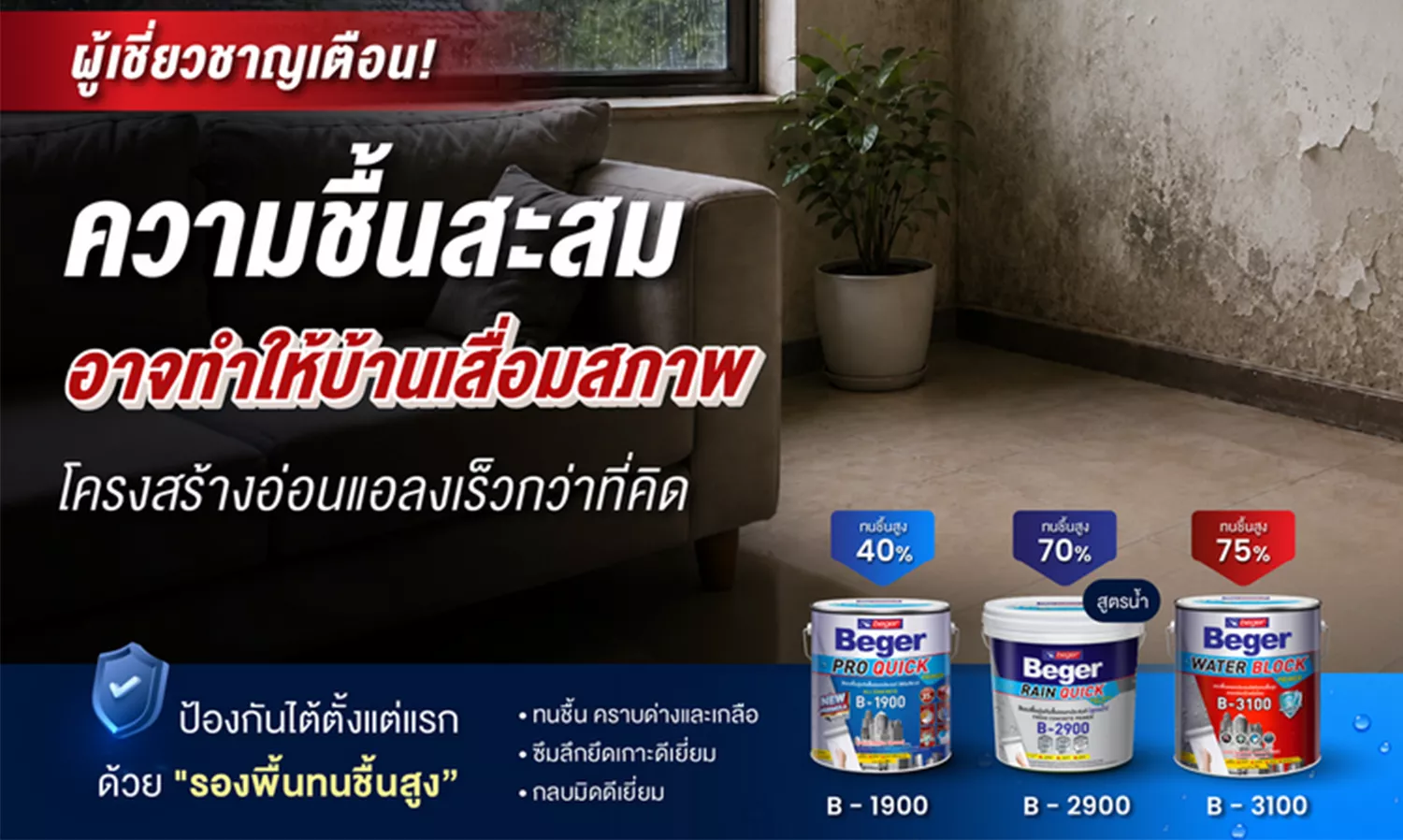
To address varying moisture issues in different wall conditions, Bayer has developed a range of high-moisture-resistant primer products, including Beger B-1900 for general plaster priming, both new and old, with moisture resistance up to 40%; Beger B-2900 for interior walls, water-based, low odor, with moisture resistance up to 70%; and Beger B-3100 for walls requiring high moisture protection, especially in older homes, walls after rain, or areas previously affected by blistering paint, peeling, salt stains, and recurring mold, with moisture resistance up to 75%.
In an era of increasingly volatile weather and frequent heavy rainfall, moisture issues are not just about aesthetics but also about maintaining and protecting the structural integrity of homes in the long term. Choosing appropriate moisture protection materials from the outset is another investment that can help reduce future repair costs while extending the durability and livability of homes.