
20 Years, 50,000 Units, and a New Challenge for the Business World Without a Formula
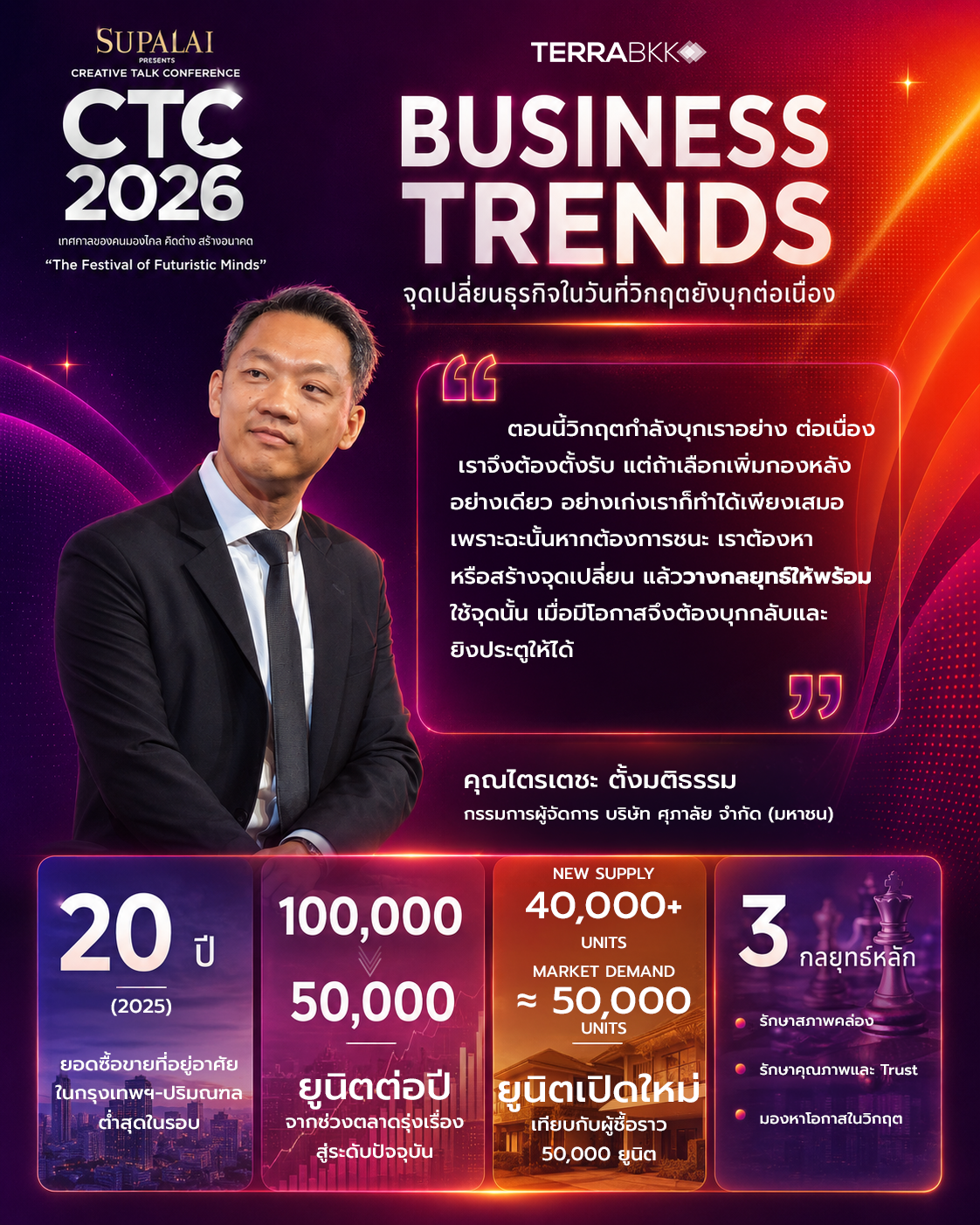
The data presented on stage reflects that the sales of residential properties in Bangkok and its vicinity have dropped to the lowest level in approximately 20 years, from a peak of around 100,000 units per year to about 50,000 units. Meanwhile, the number of new projects launched is just over 40,000 units. These figures may lead many to view the market as facing one of its toughest challenges, but on the other hand, the number of buyers still exceeds the new supply entering the market, which could signal that "demand has not completely disappeared"; rather, purchasing power, market structure, and consumer decision-making processes have changed.
Amidst a situation where many businesses feel they are "doing the same but getting less" or even "doing more but achieving the same results," the Business Trends forum invited two executives from different industries to share lessons on how businesses should prepare, adapt, and strategize not only to survive today but also to be ready for growth when opportunities arise.
The speakers included:
- Mr. Traitecha Tangmitthum, Managing Director of Supalai Public Company Limited
- Ms. Kantima Leelertyutthakarn, Chief Human Resources Officer of Advanced Info Service Public Company Limited and Intouch Group
Mr. Traitecha Tangmitthum: This Crisis is Tough, but the Impact is Not Uniform Across All
Mr. Traitecha views the current economic situation as one of the most challenging periods since he started working, potentially more complex than the COVID-19 crisis. During COVID, everyone could see a light at the end of the tunnel; once vaccines were available or people could return to normal life, the economy would gradually recover.
However, today's situation lacks a clear endpoint and is linked to purchasing power, household debt, consumer confidence, financial costs, and global economic volatility, suggesting that the business sector may have to endure this condition for some time.
Nonetheless, the phrase "the economy is bad" does not mean that every industry is affected equally, nor does it imply that every company within the same industry will have the same outcomes.
Mr. Traitecha cites the Tom Yum Kung crisis, where many businesses were severely impacted, yet some export businesses managed to grow due to a weakened Thai baht. Similarly, despite the overall contraction in the real estate market, Supalai was still able to achieve sales growth compared to the previous year.
This reflects that the overall market is just one part of the equation; what will determine whether an organization survives or thrives are its financial fundamentals, organizational strength, product quality, and the ability to identify hidden opportunities within a crisis.
The First Thing Businesses Must Maintain is Not Growth, but "Liquidity"
For Mr. Traitecha, the top priority in any crisis is cash flow or financial liquidity, as liquidity determines how many options executives have for decision-making.
Organizations with high debt burdens or lacking liquidity may spend most of their time and energy managing basic questions, such as how to pay contractors, how to care for employees, or how to keep existing projects moving forward, leaving little room for new investments.
Conversely, organizations that manage liquidity well can look ahead and ask different questions: during a time when most people are on the defensive, what assets, land, personnel, or business opportunities can be invested in?
- Liquidity helps organizations care for employees and business partners.
- Liquidity allows companies to maintain product and service standards.
- Liquidity opens up space for investing in people and internal processes.
- Liquidity enables organizations to make investment decisions when potential assets enter the market.
- Liquidity gives businesses time to wait and increases their bargaining power.
In the real estate market, land and property taxes, along with economic pressures, have led some landowners to start selling their assets more. Meanwhile, the number of ready buyers has decreased.
For financially strong organizations, such conditions are not just risks but opportunities to access land or assets that may not have been available during a booming market or can be purchased under better conditions.
Price Reductions Are Possible, But Don't Undermine Value and Lose Trust
Another significant trap during an economic slowdown is the interpretation that when customers have less purchasing power, businesses should lower the quality of their products to reduce prices further.
Mr. Traitecha emphasizes that while the real estate market is currently filled with discounts, promotions, and special offers, businesses must be cautious not to let price reductions diminish the value that customers have come to expect from the brand.
Customers may choose to buy products for various reasons, including price, location, design, service, and quality. However, once a brand has built trust, what maintains the relationship between customers and the organization is trust.
If customers once believed that a brand delivered a certain level of quality, but one day the organization chooses to put in only 95% effort and expects customers to feel the same, the accumulated trust may begin to waver.
Trust can be lost quickly, but rebuilding it may require more time, effort, and budget than the savings gained from reducing quality.
Therefore, the challenge for businesses is not just "how to sell for less" but:
- How to make customers feel they are getting more value.
- How to ensure promotions do not affect the core standards of the product.
- How to reduce costs from inefficient processes instead of lowering the quality received by customers.
- How to ensure customers still believe the brand will take care of them in the long run.
The Real Estate Market May Be at a Low Point, But That Doesn't Mean There's No Demand
According to data presented by Mr. Traitecha, the sales of residential properties in Bangkok and its vicinity have dropped to about 50,000 units from a peak of nearly 100,000 units per year.
While this is the lowest figure in about 20 years, if viewed from another angle, the market still has around 50,000 buyers, while the number of new projects is just over 40,000 units. This means that demand has not completely disappeared, and at certain times, it may even exceed the new supply.
Especially in the condominium market, which has been discussed regarding oversupply for several years, historical data shows that at one point, the number of new condominiums launched exceeded sales continuously. However, in the last six years, only a few years saw new supply outpace sales.
It is therefore possible that the backlog of inventory that had accumulated in the market is gradually being absorbed, and some areas may begin to experience limited new supply.
The key issue is not merely asking whether "the market is good or bad" but analyzing deeper into:
- Which price segments still have genuine demand.
- Which locations are experiencing reduced supply.
- Which customer groups still have purchasing power.
- Which types of products meet real living needs.
- Where competitors are reducing their investments.
- Whether the organization has sufficient strengths to fill those gaps.
Not Every Crisis Opens Opportunities Only for the Big Players, but Also for New Entrants
Mr. Traitecha cites several real estate companies that have become well-known brands in the market over the past 15 years. These companies did not start expanding during peak market conditions but began investing, building their brands, and accumulating strength during market downturns.
The time when most organizations are cautious about investing may be the time when new players can more easily access resources, have more space to communicate with the market, and can create differentiation without competing with as many players as during a booming market.
However, opportunities will only arise if organizations are prepared in advance, in terms of capital, people, data, processes, and clarity of strategy.
Being Defensive Alone May Prevent Loss, But Is Not Enough to Ensure Victory
Mr. Traitecha compares doing business in a crisis to a football match. When competitors and situations are continuously attacking, reinforcing the defense may improve the team's ability to prevent goals, but the best outcome of merely being defensive may only be a "draw."
If the organization's goal is victory, it must create turning points that allow it to become offensive again.
These turning points do not need to be the same for every organization. Some companies may need strong products that reach a broad market, while others may leverage agility, speed, technology, or specialized expertise as key weapons.
What executives need to do is clearly understand what resources the organization has, where its strengths lie, and how to design the game so that those strengths can translate into actual business results.
Mr. Traitecha leaves the following principles for entrepreneurs:
- Analyze the industry based on current data, not last year's.
- Assess the situation in advance over the next 3–6 months, as contexts may change faster than traditional long-term planning.
- Know the organization's position regarding strengths or weaknesses.
- Maintain liquidity to ensure the organization has options.
- Preserve quality and customer trust.
- Use the market slowdown to develop people, systems, and processes.
- Prepare turning points to shift from defense to offense.
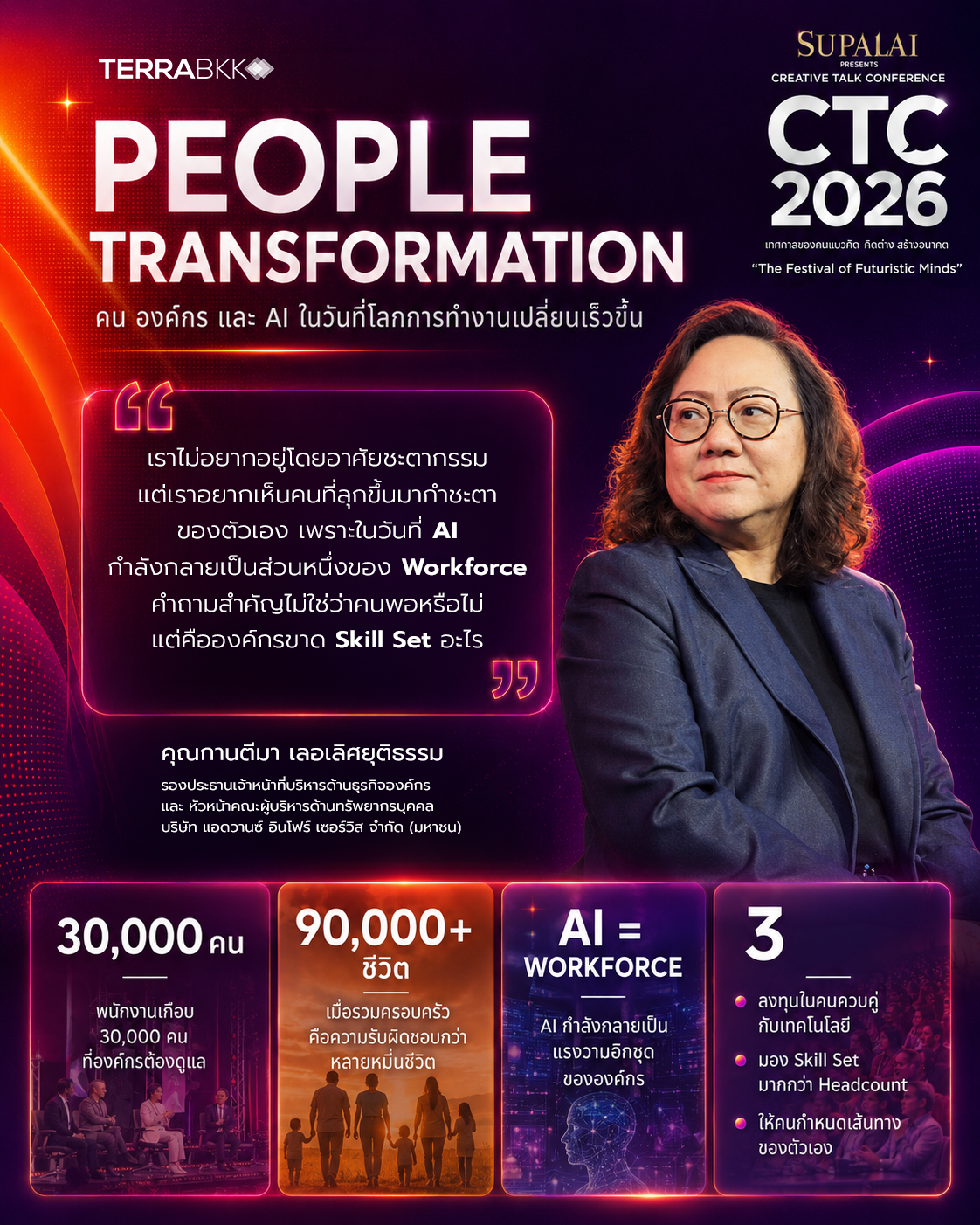
Ms. Kantima Leelertyutthakarn: Technology Changes Rapidly, But Tools Hold No Value If People Cannot Use Them
From the perspective of the real estate industry, the forum connected to another major challenge in the business world: the changes in technology and human management in an era where AI is becoming part of the workforce.
Ms. Kantima believes that all types of businesses are being affected by these changes, albeit in different ways. Even AIS, which operates in the technology industry, must continuously adapt.
Previously, the telecommunications business focused on mobile phone services, but today, telecommunications networks have become infrastructure connecting to numerous new services, including entertainment, digital banking, cloud services, data centers, and other digital offerings.
These changes are not only affecting products but also organizational structures, work methods, employee skills, and leadership roles.
As new technologies emerge more frequently, the time organizations have to pause, regroup, and adapt is becoming shorter. From digital transformation to the pandemic, from the pandemic to AI, and moving towards even more advanced technologies in the future.
Organizations Should Not Only Invest in Tools but Also Ensure People Can Use Them Effectively
One of Ms. Kantima's concerns is that many executives prioritize purchasing new tools or systems. When presented with these technologies, they often seem capable of solving problems and transforming organizations immediately.
However, tools will not produce results if the people in the organization lack understanding, skills, or the ability to connect the tools with business challenges.
Especially in an era of rapid technological change, tools that are purchased may become outdated quickly if organizations do not develop their people alongside them. The money spent on investments may turn into significant costs that do not yield the expected returns.
Sometimes, tools that should help reduce burdens end up causing employees to waste time learning systems, duplicating data, or becoming subservient to the processes of technology instead.
The questions executives should ask are not just "Should we buy AI or what system should we add?" but rather:
- What problem is this tool solving?
- Who will actually use it?
- Do those users have sufficient knowledge?
- What skills does the organization need to develop further?
- What outcomes do we want to measure?
- Does this tool improve people's work, or does it merely add new steps to the organization?
Don't Just Ask If Headcount is Sufficient, But What Skill Sets the Organization Needs
Ms. Kantima encourages organizations to shift from focusing on the number of people to the necessary capabilities for the future.
When executives say that the number of people is insufficient, the next question should be whether the additional work genuinely requires more people or if processes can be redesigned, technology can be utilized, or existing employees' skills can be enhanced to work better.
Conversely, if an organization can clearly identify which skill sets are lacking, decision-making will be more effective, whether it involves developing existing personnel, hiring new staff, using external experts, or allowing AI to take on certain tasks.
The key is for organizations to stop viewing AI merely as an additional tool and start recognizing that AI is becoming a resource.