Revealing 3,115 Quality Housing Demands Awaiting Matching System to Connect with Housing Supply
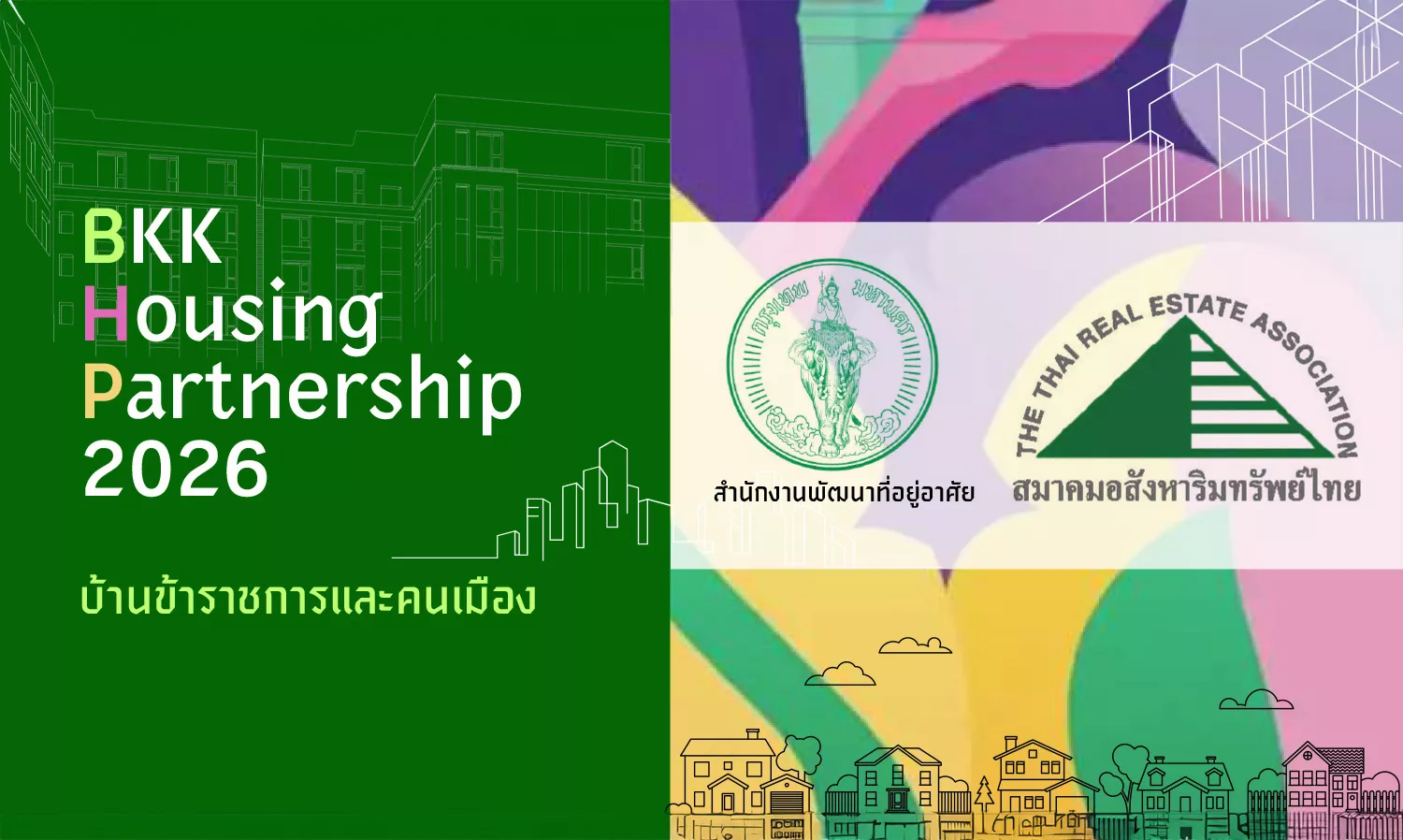
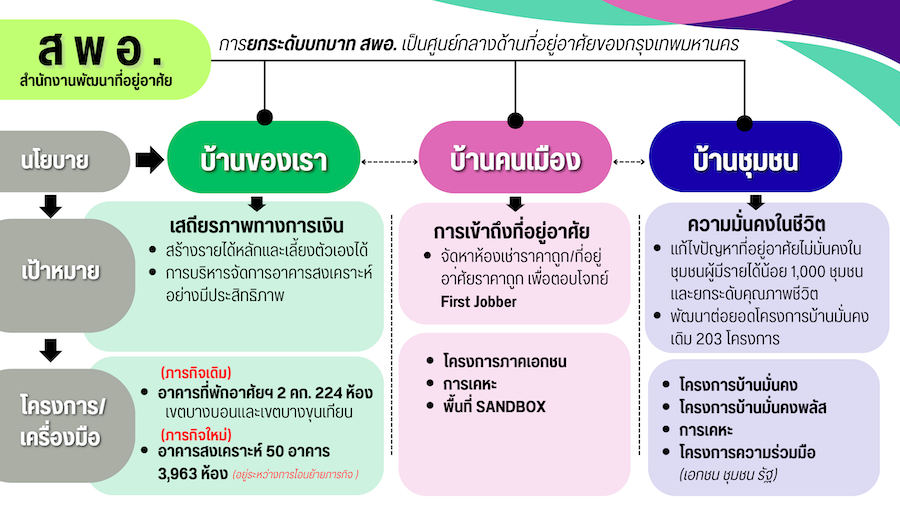
The Bangkok Housing Development Office was established under the Bangkok Metropolitan Ordinance of 2023, with a clear mission: to support citizens, government officials, and personnel of Bangkok, especially those with low income or disadvantaged backgrounds, in accessing stable housing at affordable prices. The agency has the authority to engage in housing development and systematically collaborate with the public sector, state enterprises, and the private sector. A significant turning point occurred at the BKK Housing Partnership forum on March 2, 2026, reflecting the shift in Bangkok's role from 'self-developer' to a fully-fledged 'central mechanism for Housing Matching,' aiming to transform scattered demand into measurable purchasing power.
-
Actual Demand Based on Empirical Data
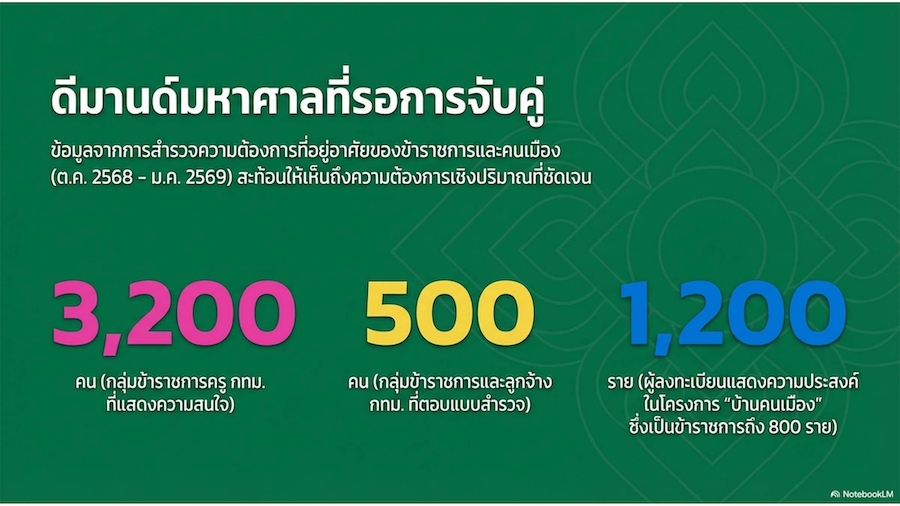
Surveys conducted by the Housing Development Office from late 2025 to early 2026 revealed that:
-
Over 3,200 Bangkok teachers expressed interest.
-
Approximately 500 Bangkok government officials and employees responded to the survey.
-
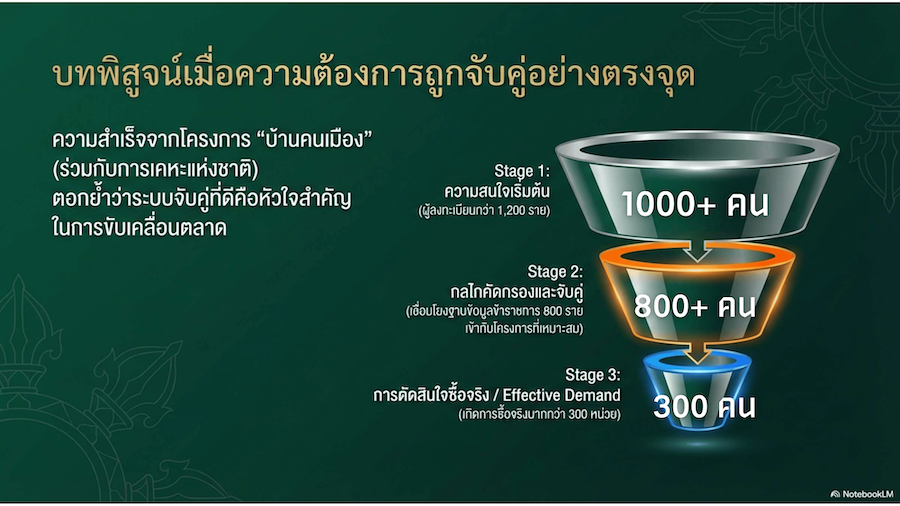
In the Urban Housing Project, over 1,200 individuals registered, with more than 300 units already converted into actual buyers.
These figures highlight an important reality: when there is an appropriate data matching system, demand can be transformed into actual transactions. Khun Pornnaris Chuanchaisit, President of the Thai Real Estate Association, stated at the forum, "In the past, homes priced in the low millions were not without buyers, but we didn't know where the buyers were. With over 3,000 individuals in Bangkok clearly indicating their repayment capacity, this is quality demand that the private sector should seriously consider." This statement reflects that the key challenge in the market is not to create more supply but to improve the accuracy of matching.
-
In-depth Analysis of 3,115 Bangkok Teachers
An in-depth survey of 3,115 teachers revealed their housing status:
-
44.6% rent rooms.
-
40.2% have housing costs between 3,001–5,000 baht per month.
-
23.1% pay between 5,001–8,000 baht per month.
-
16.1% pay more than 8,000 baht per month.
Income:
-
29.3% earn less than 20,000 baht per month.
-
21.9% earn between 20,001–25,000 baht per month.
This reflects limited purchasing power but a stable income and clear financial discipline.
Main Demands:
-
Homes near schools: 65.74%
-
Special rental prices: 61.3%
-
Long-term installment rights: 56.74%
If purchasing a home:
-
41% can afford installments of no more than 5,000 baht per month.
-
33.7% can afford installments of 5,001–8,000 baht per month.
This is a detailed database at the district level, income level, and repayment capability that the private sector has never had before.
-
Examples of Previous Projects
3.1 Our Home
The government housing project in Bang Bon and Bang Khun Thian districts comprises 224 rooms, charging approximately 3,300–3,400 baht per month (including rent and common fees). Currently, the occupancy rate is high, demonstrating that reasonably priced projects close to workplaces can effectively meet demand. Additionally, Bangkok has 50 welfare buildings with a total of 3,963 rooms spread across 17 districts, which are existing assets that can be managed more efficiently.
3.2 Urban Housing
Within about a month, 1,075 individuals expressed interest, with 28 contracts signed and another 180 in progress, reflecting that with appropriate information channels and financial tools, demand can shift to actual transactions.

3.3 Community Housing
Bangkok has over 2,001 communities, covering 151,266 households, many of which still lack stable housing. The Housing Development Office thus operates on a local level, collaborating with landowners, the public sector, and private entities to develop thousands of households annually. The lesson from these three projects is that development alone is insufficient without accurate data systems and financial mechanisms to support it.
-
Government Housing: The Latest Upcoming Project
The "Government and Urban Housing" project builds on past experiences, enhanced with new tools such as:
-
Demand Map and Heat Map databases by district.
-
Matching with actual market supply, e.g., in Nong Chok district, there are 209 demands and over 75 projects available.
-
Collaboration with state banks, such as GHB, Krung Thai, and Government Savings Bank, to design salary deduction loans to reduce non-performing loan (NPL) risks.
Thus, Bangkok's role is not to compete with the private sector but to act as a "central link" connecting three components: actual demand, real area data, and actual loans. Khun Jakkapan Phiwngam, Deputy Governor of Bangkok, stated, "The role of Bangkok is not to compete with the private sector but to reduce system costs, simplify regulations, clarify data, and make it easier for citizens to access loans. If we can alleviate this burden, housing prices will naturally decrease."
-
A New Dimension of the Low Million Baht Housing Market
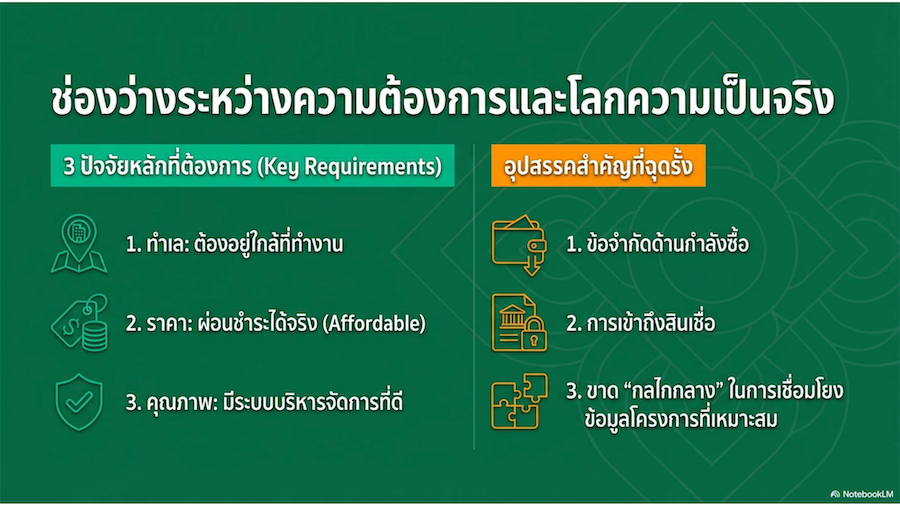
In the past, low million baht homes were difficult to sell due to miscommunication and a lack of understanding of the true demand location. However, today, Bangkok has data on 3,115 teachers, segmented by district, age, income, and repayment capability. Districts with high demand, such as Nong Chok, Sai Mai, Khlong Sam Wa, and Bang Kapi, present opportunities for the private sector to design projects.
-
Close to schools.
-
Reduce unnecessary common areas.
-
Increase motorcycle parking.
-
Set prices to allow for installments of 5,000–8,000 baht per month.
The chances of closing sales will significantly increase. The report from the Bangkok Housing Development Office is thus not just an activity report but a declaration of a "new market structure" for government housing.
From Our Home, which focuses on allocating housing, to Urban Housing, which tests the matching system, and now moving towards Government Housing, which uses Data + Partnership + Financial Model as its core. The crucial question is not whether people want homes, but how we can match them accurately, at the right time, and in accordance with their purchasing power. This is the concrete challenge that Bangkok is actively addressing.