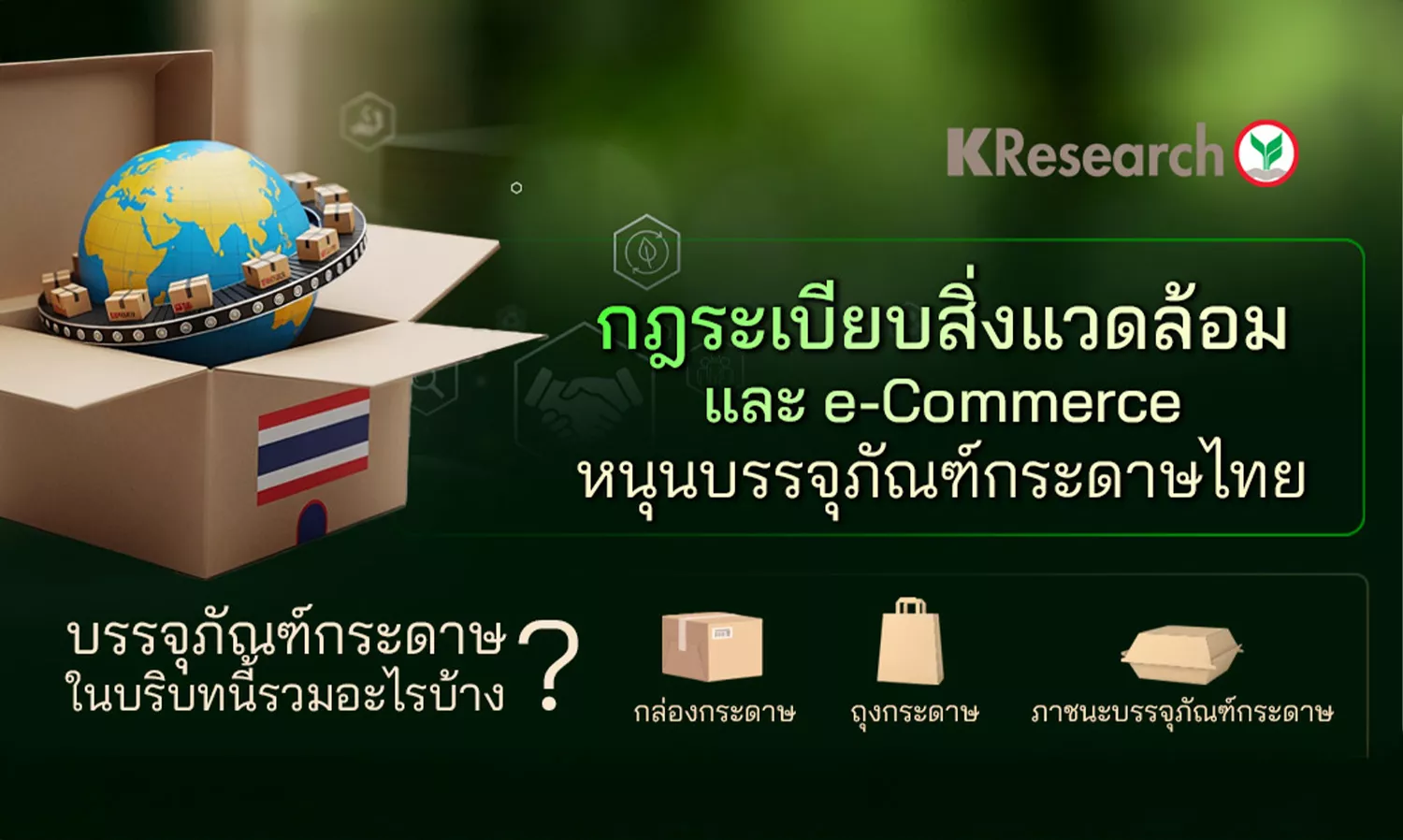
Environmental Regulations and e-Commerce Boost Thai Paper Packaging (Kasikorn Research Center Infographic)
The environmental trend is no longer just an ideological concept but has become a "structural pressure" that shapes the direction of industries. Data from the Kasikorn Research Center clearly reflects that stricter environmental regulations, combined with the growth of e-Commerce, have become two significant driving forces pushing the demand for paper packaging in Thailand to expand continuously.
In an era where plastic is being questioned, paper packaging has been elevated from a "choice" to a "new standard" for businesses.
1) e-Commerce Growth Changes Demand Structure
The expansion of online shopping has significantly increased the demand for corrugated boxes and kraft paper, especially among SMEs and small retailers that rely primarily on product delivery.
• Consumer behavior emphasizes convenience and home delivery.
• Brands are seeking recyclable packaging to align with ESG standards.
• Businesses must adapt to the sustainability standards of international partners.
The result is that "the demand for kraft paper in Thailand has reached a five-year high," clearly reflecting the growth in the use of paper packaging.
This is not just a short-term recovery but a structural adjustment in the industry.
2) Environmental Regulations Create Long-term Momentum
Many countries have implemented measures to reduce single-use plastics and have set stricter conditions for environmentally friendly packaging.
For Thai manufacturers, this presents both a "pressure" and an "opportunity."
• Operators who can quickly adjust their production lines will gain a competitive advantage.
• Factories investing in recycling technology and carbon reduction will align with the global market.
• Products meeting environmental standards have the opportunity to access premium markets.
Investing in Green Packaging is therefore not a cost but a long-term strategy.
3) The U.S. Reduces Dependence on China: New Opportunities for Thailand
Geopolitical trade factors are another element that shifts the equation. As the U.S. trends towards reducing dependence on Chinese goods, Thai exporters have a "market gap" to fill some of that space.
Especially for paper packaging, which is in high demand in the e-Commerce supply chain and the food industry.
This opportunity can become a reality if Thai manufacturers can:
• Control raw material costs.
• Maintain quality standards.
• Manage energy and environmental risks.
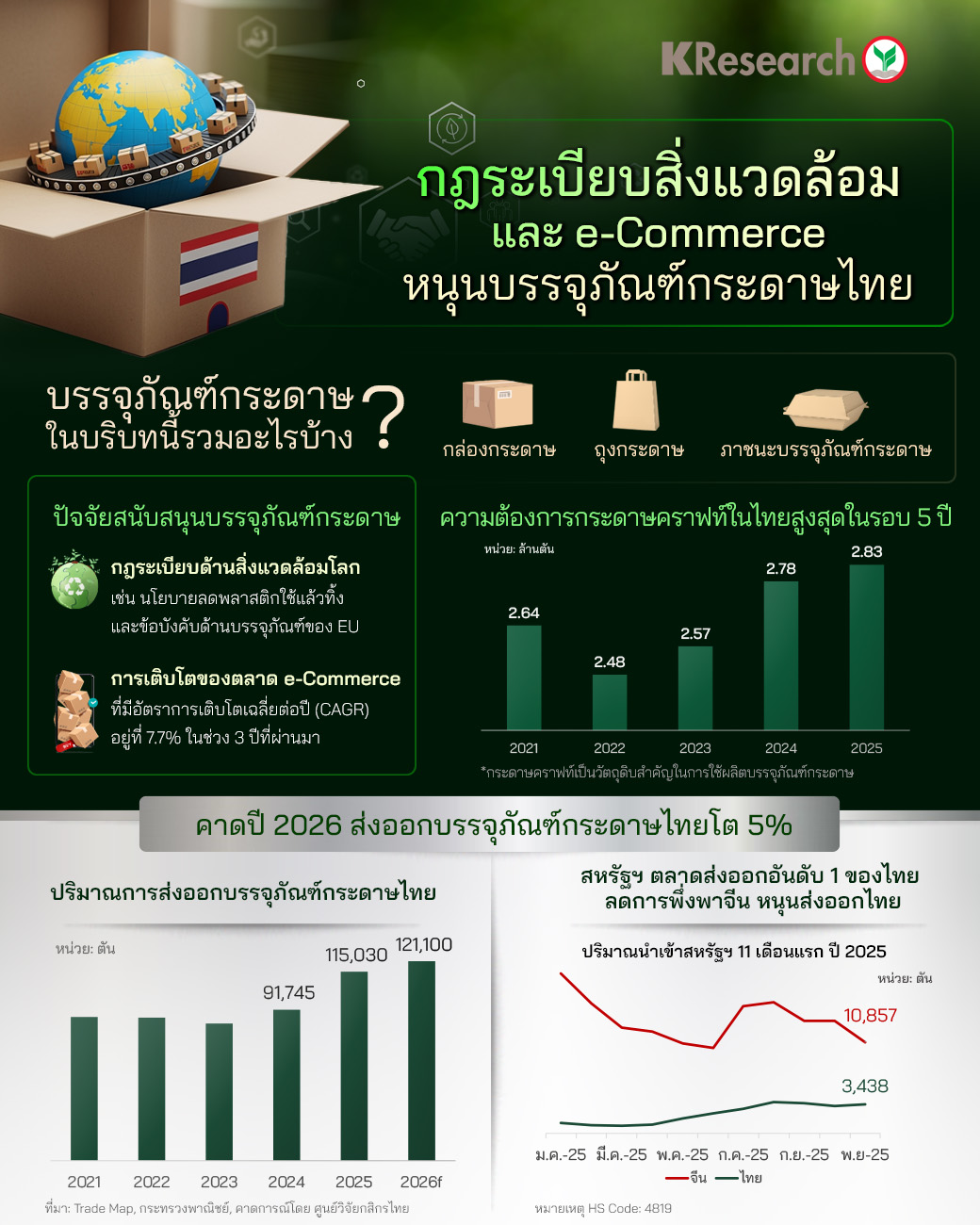
The Thai paper packaging industry is currently in a phase of "structural growth" driven by three main factors:
-
Permanent changes in consumer behavior.
-
Stricter global environmental regulations.
-
Changes in the global supply chain.
However, risks still exist regarding pulp costs, energy prices, and competition from neighboring countries.
For investors or entrepreneurs, this is a time to view this industry through the lens of ESG and Global Trade, not just short-term sales.
Today, paper packaging is not just a material for wrapping products
but is one of the infrastructures of the digital economy and the emerging green economy in Thailand.