TOP 10 Thai Provinces with the Highest Tourism Revenue in 2025: When 'Revenue' is the Measure of Economic Power Beyond Visitor Numbers
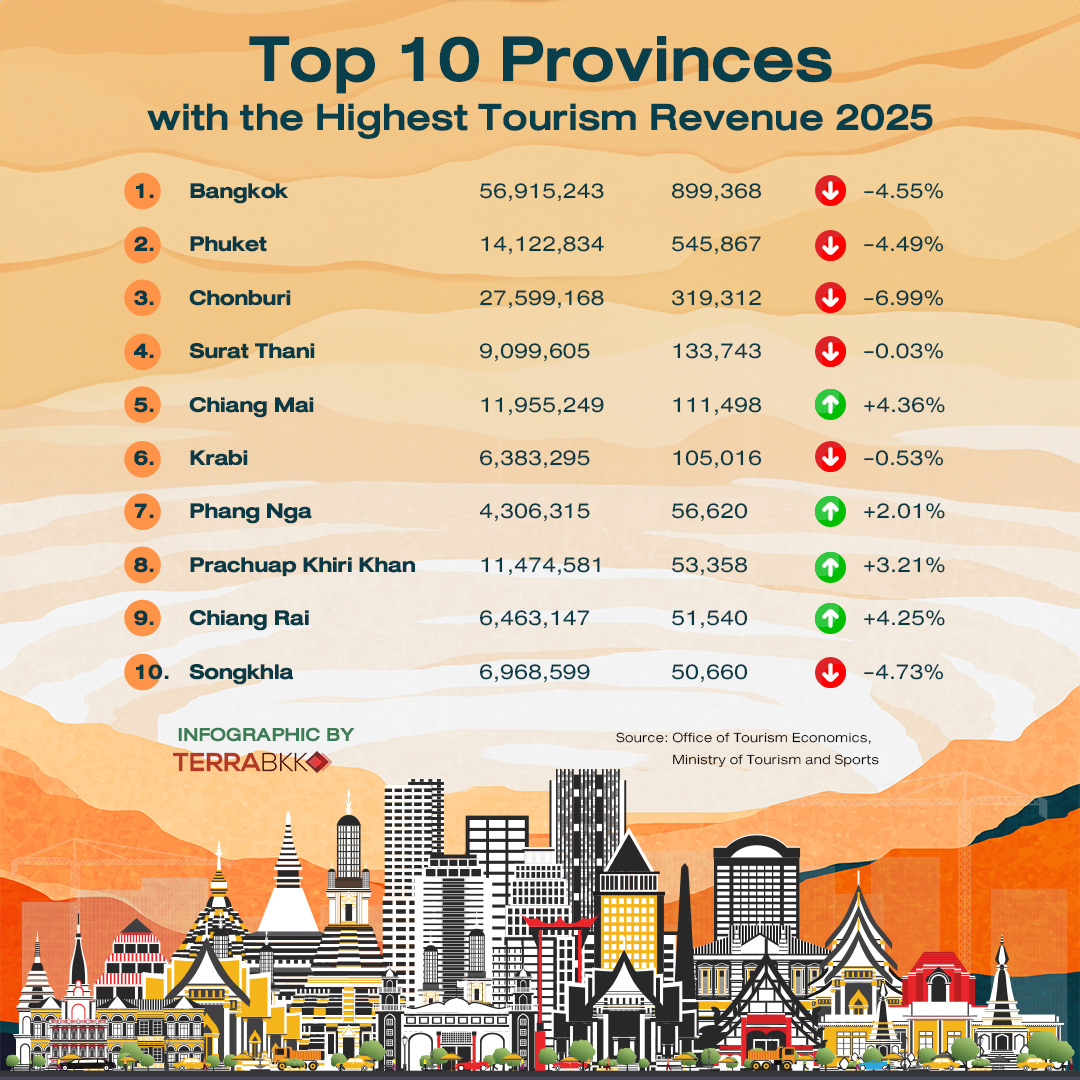
Although the overall tourism picture in Thailand for 2025 may not show significant growth in terms of quantity, a closer look at 'economic value' reveals a clear transition. The ranking of the TOP 10 provinces with the highest tourism revenue (cumulative from January to December 2025) reflects that Thai tourism is shifting from relying on the number of visitors to focusing more on the quality of spending per capita.
Rank 1: Bangkok
Revenue: 899,368.68 million baht
Visitors: 56,915,243 people
Change: -4.55% (YoY)
Bangkok continues to hold the top position in tourism revenue. Although revenue has slightly decreased from the previous year, the diverse economic activities, including business travelers, conferences, events, and long-term tourists, ensure that Bangkok remains a clear hub for the country's tourism value.
Rank 2: Phuket
Revenue: 545,867.60 million baht
Visitors: 14,122,834 people
Change: -4.49% (YoY)
Phuket reinforces its role as a global tourist destination. Despite having significantly fewer visitors than Bangkok, the high revenue per capita reflects the purchasing power of international tourists and a strong luxury market.
Rank 3: Chonburi
Revenue: 319,312.27 million baht
Visitors: 27,599,168 people
Change: -6.99% (YoY)
Chonburi remains a major quantity-driven tourist province, especially Pattaya. Although revenue has slowed compared to the previous year, it continues to be one of the main engines of the eastern tourism economy.
Rank 4: Surat Thani
Revenue: 133,743.48 million baht
Visitors: 9,099,605 people
Change: -0.03% (YoY)
Surat Thani reflects stability, with revenue remaining nearly unchanged from the previous year, indicating the strength of key tourist destinations such as Koh Samui and Koh Phangan.
Rank 5: Chiang Mai
Revenue: 111,498.62 million baht
Visitors: 11,955,249 people
Change: +4.36% (YoY)
Chiang Mai is one of the few major provinces where revenue has grown compared to the previous year, reflecting the success of cultural, health, and lifestyle tourism that attracts quality tourists who stay longer and spend more.
Rank 6: Krabi
Revenue: 105,016.27 million baht
Visitors: 6,383,295 people
Change: -0.53% (YoY)
Krabi maintains revenue levels close to the previous year, supported by nature-based tourism and a consistent demand from international markets.
Rank 7: Phang Nga
Revenue: 56,620.11 million baht
Visitors: 4,306,315 people
Change: +2.01% (YoY)
Phang Nga is an example of a province with a lower number of tourists but strong revenue per capita. The growth in revenue reflects a high-quality tourist segment and a robust resort market.
Rank 8: Prachuap Khiri Khan
Revenue: 53,358.71 million baht
Visitors: 11,474,581 people
Change: +3.21% (YoY)
This province near Bangkok benefits from domestic tourists and short-term travel, with improving revenue per capita.
Rank 9: Chiang Rai
Revenue: 51,540.09 million baht
Visitors: 6,463,147 people
Change: +4.25% (YoY)
Chiang Rai reflects the growth of a secondary city through cultural and nature tourism that attracts quality tourists.
Rank 10: Songkhla
Revenue: 50,660.14 million baht
Visitors: 6,968,599 people
Change: -4.73% (YoY)
Songkhla remains a central economic hub for tourism in the southern Gulf of Thailand, despite a decline in revenue from the previous year.
National Overview (Cumulative from January to December 2025)
Total number of visitors (round trip)
2025: 357.11 million people
2024: 353.56 million people
Increase: 1.00%
Total tourism revenue
2025: 278.77 trillion baht
2024: 270.38 trillion baht
Increase: 3.10%
Revenue from Thai tourists decreased by 5.81%
Number of foreign tourists decreased by 2.18%
But revenue from foreign tourists increased by 4.18%
Although many key tourist provinces still show negative growth compared to the previous year, the overall revenue of the country continues to grow, reflecting a structural transition in Thai tourism from focusing on visitor numbers to creating economic value per capita. This will be a crucial challenge for future policies and investments.
Source: Ministry of Tourism and Sports (www.mots.go.th)