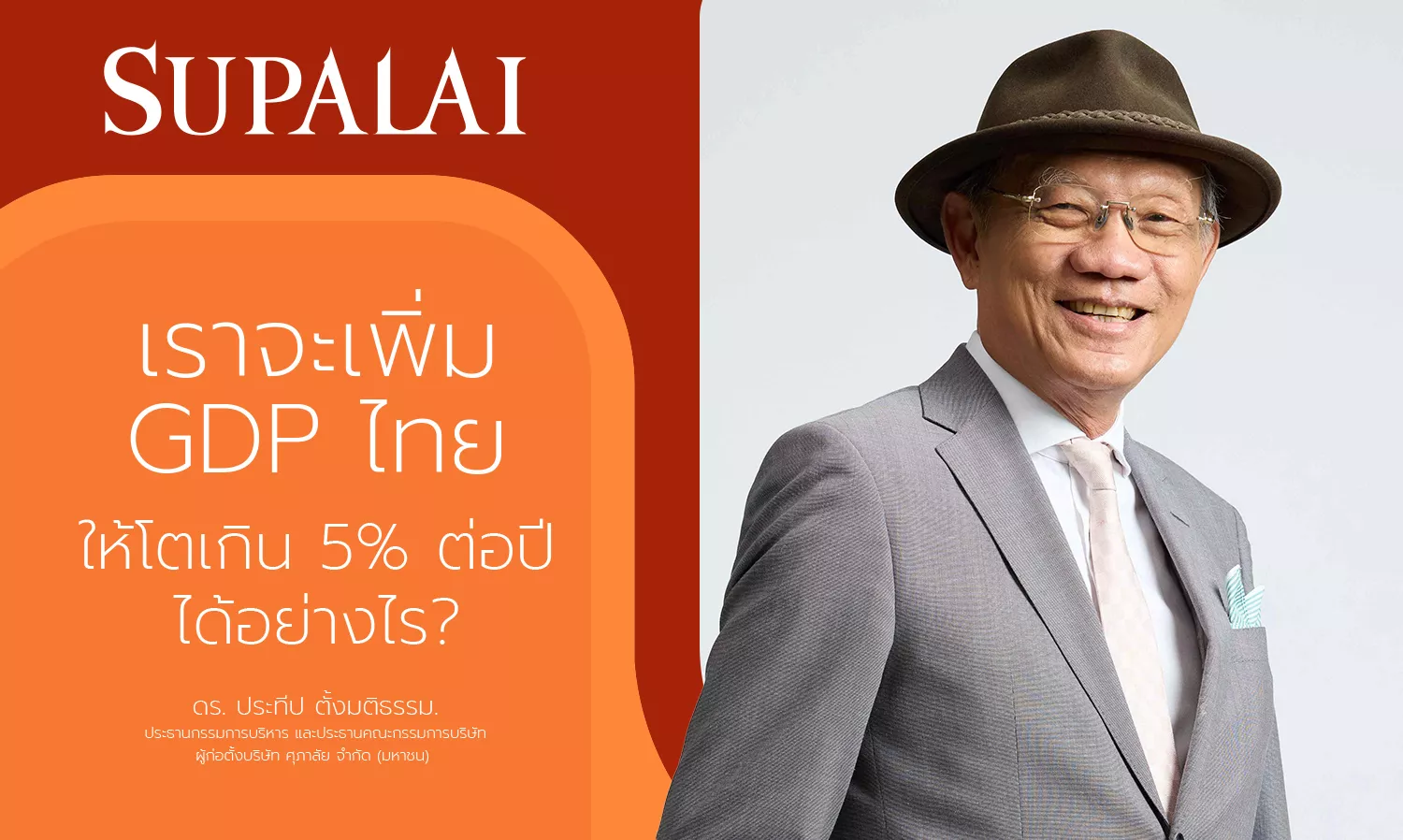
How Can We Increase Thailand's GDP to Grow Over 5% Per Year?
Thailand should not only aim for a GDP growth rate of more than 5% per year, but it must sustain this growth rate for at least 15 years. This is necessary for the average income of Thai people to rise from approximately 20,000 baht per month to about 37,000 baht per month, which would bring it closer to Malaysia's current income levels. However, this would still only be about one-third of the income levels in Taiwan and South Korea today.
We want to see Thai people lift themselves out of poverty, right?
We want to see Thailand overcome the poverty trap and become a developed country without poor people, which must be accompanied by effective income distribution policies. Many people say that Thailand is stuck and regressing, as the economy that once grew over 5% per year has now dwindled to 2%. Many people see no future, so how can we change this?
Let’s look at countries that have achieved a GDP growth of around 5% per year over the past 10 years:
- Singapore: 6.92%
- Vietnam: 6.20%
- China: 5.79%
- Hong Kong: 5.48%
- Philippines: 5.20%
- Malaysia: 4.90%
Thailand's latest GDP is approximately 18.579 trillion baht. To achieve a GDP growth of 5% per year, we would need an annual increase of 928,950 million baht. Currently, we are only achieving about 2% per year, which amounts to 371,580 million baht, meaning we need to increase this by 557,370 million baht per year.
How do countries with a GDP growth exceeding 5% per year achieve this?
China has invested heavily in infrastructure development, including the creation of major cities like Shenzhen in the '80s and Pudong in the '90s, which have improved transportation, disaster prevention, and job creation, significantly increasing citizens' incomes. The high-speed rail and high-speed internet have made it easier for rural youth working in cities to stay connected with their families.
Singapore has invested in architecture and the environment, starting with housing to enhance family stability and quality of life, followed by projects like the Opera House, large sports venues, entertainment complexes, Gardens by the Bay, and museums, continuously creating new attractions. Additionally, it has positioned itself as a financial, trade, and investment hub with ease of doing business, propelling the country forward compared to other leading nations.
UAE has transformed the desert into a thriving metropolis with innovative and modern architecture, such as the Palm Jumeirah, Burj Khalifa, the Grand Mosque, and the Louvre Museum, alongside attractive tax measures for foreigners, facilitating property purchases and residency.
Despite various Thai governments attempting to boost export revenues and tourism income to exceed imports, stimulate consumer spending, and promote private and public investment, the economy has only managed to grow by 2% per year.
There is hope when we look at one province in Thailand that has recorded an economic growth rate or GDP growth over the past 10 years of 8.3%, which is significantly higher than the national average: “Phuket.”
This is because “Phuket” is an open province with around 33,068 foreigners residing and working there (not including tourists), which is about 7.7% of its total population of 429,583, compared to only 1.5% of foreigners in the entire country.
Moreover, the Thai population in “Phuket” has consistently increased over the past 10 years, averaging 1.05% per year or 11.1% over the decade.
The increase in both Thai and foreign populations has led to higher consumption and the development of new housing across the island.
Thus, the growth in population, both Thai and foreign, is the main reason for the continuous economic growth in “Phuket,” while the overall Thai population is gradually declining.
It will never be possible if we do not think big and take it seriously...
If Thailand is to create beneficial Mega Projects to boost GDP, is it feasible?
In the past, the government has attempted to invest in various infrastructures, but due to public debt limitations (Public Debt) not exceeding 60% of GDP, many good projects have been postponed or canceled.
In fact, Thailand should leverage its geographical potential. If the government uses a Public-Private Partnership (PPP) approach, utilizing mostly state resources like land and exercising its authority to issue licenses and investment promotion regulations, many beneficial projects could be realized, leading to economic growth, job creation, and increased income.
The issue of public debt would not be a problem anymore, as the private sector would invest in construction and development, while the government would only provide land and regulatory support.
For example:
- Elevate “Bangkok” to become a financial, investment, trade, and securities trading hub.
Currently, the potential of “Bangkok” is comparable to that of Singapore and Hong Kong, not as different as before. However, multinational companies still cluster in these two cities because Singapore and Hong Kong have incentivized lower tax rates and provided better facilitation for business transactions, registrations, and visa approvals for foreigners.
If “Bangkok” becomes a financial, investment, and trade hub, Thailand will become another leading country in the world and reap immense benefits from foreign companies establishing long-term operations instead of just short visits like tourists, as “Bangkok” offers many advantages that Singapore and Hong Kong do not, such as greater convenience, friendlier people, and more cost-effective business and living expenses.
However, we need to improve the bureaucratic system, which is strict about minor issues, requiring excessive documentation and lengthy approval processes. Foreigners in Thailand must report every three months, for example.
What foreigners demand is an extension of property lease terms from 30 years to 90 years and more attractive tax incentives, comparable to Singapore and UAE...
The approach is simply to implement sufficient incentive measures and announce them globally, as the fundamental factors are already quite ready. Importantly, we must eliminate the complex and time-consuming bureaucratic processes. We need a major reform; if we are serious, it could take just 3 months to reduce unnecessary procedures to match what Singapore uses.
If this project attracts 10,000 skilled foreigners to live and work in Thailand each year, with each spending about 4 million baht annually, we would gain approximately 40,000 million baht.
- Construct a dam along the Chao Phraya River with docking channels and adjustable gates for boats.
It is crucial to prevent flooding in Bangkok and the lower central provinces during high tide, which causes billions in damages each time. The government has allocated budgets for various flood prevention projects nationwide, yet there has been no initiative to build a dam to protect against rising sea levels.
The investment for this project is relatively low, estimated at 10,000 - 20,000 million baht, depending on the scale we choose and whether we want to acquire some land in the sea for construction.
3. The Southern Seaboard and Land Bridge project has a total investment value of about 1 trillion baht, divided into:
- Deep-sea port in Ranong, Chumphon: 636,477 million baht
- Transport systems (roads and rail): 220,000 million baht
- Transport systems for goods between ports: 140,000 million baht
Currently, Thailand relies on trucks and trains to transport goods to Penang port because we lack a deep-sea port on the western coast, which we should have.
This project aims to leverage Thailand's geographical advantages that other countries do not have. Once completed, it will create immense contributions to exports, generate significant employment, and make Thailand a maritime transport hub between East and West, replacing Singapore.
Some argue that this project is not worthwhile due to the distance and time taken to go around the Malay Peninsula.
In reality, the ones who can determine feasibility are the investors we invite from around the world. If we can be flexible with the concession period or allow for industrial estate development alongside, it will be easier to realize.
This project, if constructed over 10 years, would generate an additional investment value of 100,000 million baht per year during the construction phase.
4. Build a bridge across the Gulf of Thailand from Koh Si Chang to Prachuap Khiri Khan to connect with the Southern Seaboard. This bridge is only 100 kilometers long, making construction easier and likely cheaper than building the Hong Kong-Zhuhai-Macau bridge, which cost nearly 600 billion baht. It will enhance domestic transportation capabilities and facilitate quicker shipping of goods from the EEC to the western ports, further strengthening the Southern Seaboard and Land Bridge.
5. High-speed rail project from Bangkok to Korat to Nong Khai.
Construction costs: Bangkok to Korat: 179,413 million baht
Construction costs: Korat to Nong Khai: 341,351 million baht
Total: approximately 520,000 million baht.
This project has taken much longer than necessary because the government has been slow to invest and decide, causing the funds to remain unutilized. It is essential to expedite completion for public benefit, reduce transportation costs, and enhance export capabilities. Additionally, we should invite private investors from around the world to develop connections to Malaysia and Singapore, which would rapidly spread prosperity throughout the country.
We should promote investment by adjusting conditions to make them attractive, such as concession periods and allowing commercial development around various stations, which would expedite these projects.
6. Comprehensive entertainment complexes (Entertainment Complex) can be developed without necessarily including casinos. Large amusement parks, such as Disney World, Universal Studios, and Gardens by the Bay in Singapore, can serve as both recreational and educational venues.
If we have three such locations, each valued at 10,000 million baht, it would generate an investment of 30,000 million baht plus additional revenue from management.
7. Large sports stadiums, concert halls, and performing arts centers should be promoted for investment in major cities across the country to enhance sports capabilities and host world-class competitions like the Olympics, as well as attract global performances, such as Taylor Swift's concert in Singapore. These can also be structured as investment promotion projects, generating significant investment value.
Although these may not be basic needs for low-income individuals, they are indicators of a country's development and amenities that foreigners seek.
8. Various museums, cultural centers, learning development centers, waste treatment plants, fertilizer factories, and environmentally friendly industries, agriculture, food, medicine, and health, etc.
Encourage private sector development nationwide. If each project is valued at 500 million baht and there are 100 projects, it would amount to an investment value of 50,000 million baht.
9. Promote housing for low and middle-income individuals.
If the government employs measures to promote housing post-‘Tom Yum Goong’ by reducing specific business taxes from 3.3% to 0.11%, transaction fees from 2% to 0.01%, and mortgage fees from 1% to 0.01%, totaling a discount of 6.17%, it would greatly benefit low and middle-income individuals through the provision of affordable housing or condominiums valued at 1 to 2 million baht, or an average of 1.5 million baht per unit. This measure would resonate well with the public, enhancing family stability, as laws and regulations have become increasingly stringent over the past decades, diminishing the hopes of low and middle-income individuals.
There are still questions about whether the “rights denial” of citizens through increased environmental measures and unnecessary land allocation standards, as well as increased building costs that favor the wealthy, while denying rights to low and middle-income individuals to purchase essential housing, contradicts the “Constitution.”
If this project has 100,000 units utilized nationwide each year, it would increase value by 150,000 million baht, with the government needing to support only 9,250 million baht annually. However, the government would recoup tax revenue in the form of a 7% value-added tax, along with remaining specific business taxes, transaction fees, and corporate income taxes, totaling at least 12% or nearly 18,000 million baht.
10. Promote foreign residents in Thailand.
We should enhance measures to attract foreigners to reside in Thailand for the medium to long term instead of promoting short-term tourism. This includes:
- Encouraging students to enroll in international programs in Thailand.
If there are 10,000 students per year spending 1,000,000 baht each, it would generate 10,000 million baht.
- Encouraging retirees from higher-income countries (especially those with cold climates) to move to Thailand.
If there are 10,000 retirees per year spending 1,000,000 baht each, it would also generate 10,000 million baht.
Encouraging professionals in Digital Technology, Finance, and Marketing, which are in short supply, to work in Thailand.
If there are 10,000 professionals per year spending 4 million baht each, it would generate 40,000 million baht annually.
- Encouraging various types of investors, from securities and currency to real estate and various service and industrial businesses.
If there are 10,000 investors per year spending 10 million baht each, it would generate 100,000 million baht annually.
11. Promote and integrate the informal economy into the formal economy.
According to UNCTAD research, developing countries can see GDP growth of 1-2% per year by partially integrating nearly 50% of the informal economy into the formal economy. Thailand is at a critical juncture; are we becoming a chronically poor country that cannot recover? Who wants to see Thailand fall further behind other ASEAN countries? At this moment, we need beneficial Mega Projects to help propel Thailand forward without increasing public debt. The proposals above are examples for the government and political parties to consider and build upon, with the hope that Thailand will swiftly overcome poverty and become a developed nation without poor people.