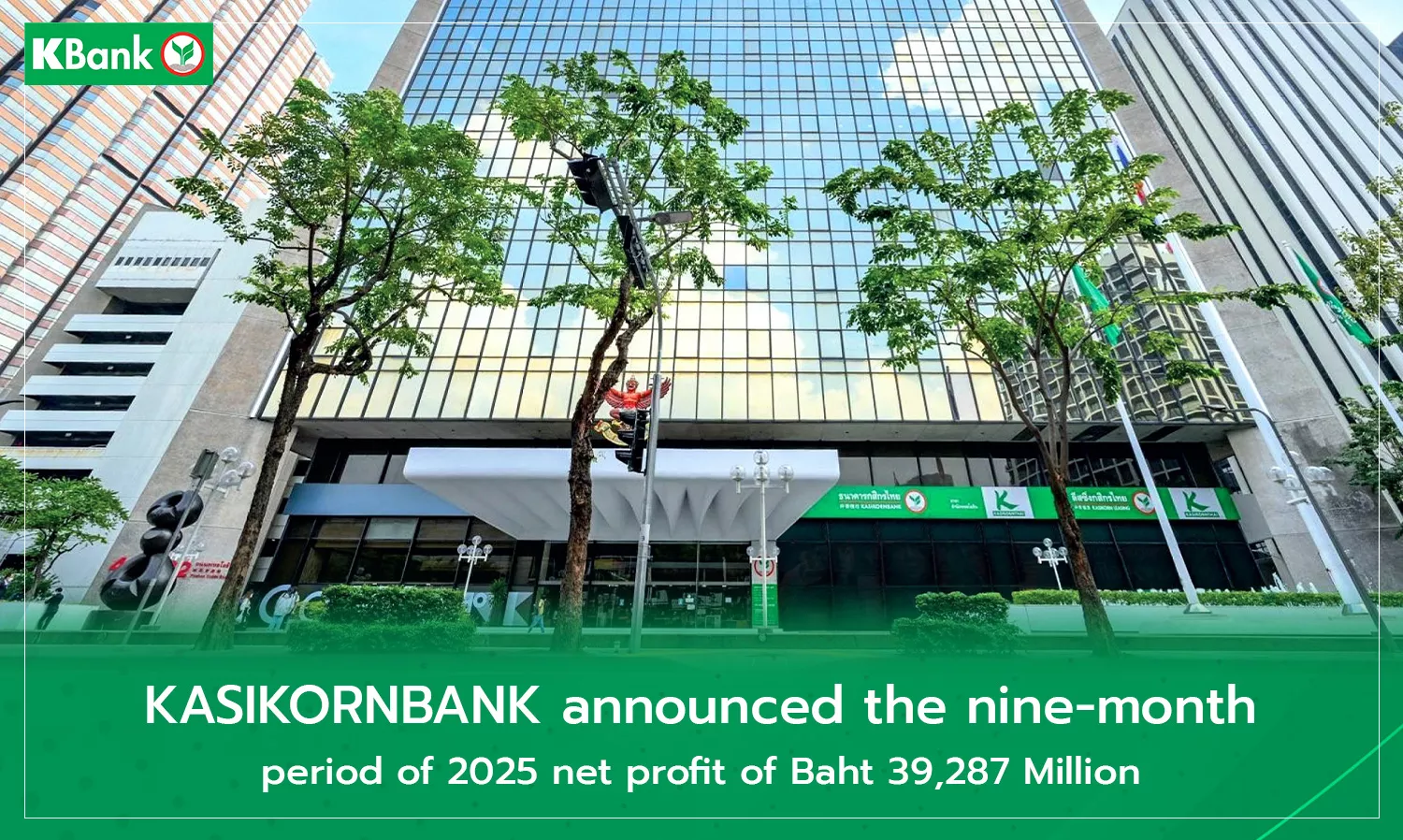
Kasikorn Bank Reports 9-Month Earnings for 2025: Profit of 39.287 Billion Baht
Ms. Kattiya Indaravichai, Chief Executive Officer of Kasikorn Bank, revealed that the Thai economy in the third quarter of 2025 is showing signs of slowing down compared to the first half of the year. This is due to pressure from declining exports, a result of the U.S. import tax measures and the weakening economies of trading partner countries, leading Thai businesses to face greater challenges. The number of foreign tourists remains lower than the same period last year, while private consumption continues to slow due to high household debt and declining consumer confidence. For the remainder of 2025, the Thai economy is expected to grow at a lower rate than in previous periods, primarily influenced by the U.S. customs tax increases, which significantly impact the export sector. The private investment climate remains sluggish, and the tourism sector faces challenges from competition and confidence issues, preventing the main tourist markets from fully recovering. Additionally, it is anticipated that government stimulus funds will be limited, and the effects of these measures may only be partially realized within this year. The outlook for both the domestic and global economies may continue to face uncertainties and various challenges into 2026.

Amidst these economic challenges both domestically and internationally, Kasikorn Bank and its subsidiaries continue to operate prudently, following the 3+1 strategy and continuously enhancing operational efficiency to deliver sustainable value to all stakeholders, including depositors, investors, individual customers, and business clients, while providing stable returns to shareholders and fully supporting the government in assisting customers in a highly uncertain economic context.
For the nine-month period of 2025 compared to the revised nine-month period of 2024, the bank and its subsidiaries reported a profit from operations before expected credit loss and income tax of 85.127 billion baht, a decrease of 2.456 billion baht or 2.80%, due to a decline in net operating income. Net interest income was 104.239 billion baht, down by 7.768 billion baht or 6.94%, reflecting the interest rate environment, including the reduction of loan interest rates to help ease the financial burden on customers. This led to a decrease in the net interest margin (NIM) to 3.31%. However, non-interest income rose to 42.709 billion baht, an increase of 5.178 billion baht or 13.80%, primarily from 1) net fee and service income growth driven by services that meet customer needs, alongside improved market conditions; 2) net gains from financial instruments measured at fair value through profit or loss; and 3) investment income in favorable market conditions. Other operating expenses amounted to 61.821 billion baht, a decrease of 134 million baht or 0.22%, due to ongoing operational efficiency management in a highly uncertain economic environment, resulting in a cost-to-income ratio of 42.07%. Additionally, the bank and its subsidiaries set aside expected credit loss provisions of 30.047 billion baht, a decrease of 4.962 billion baht or 14.17%, while maintaining a cautious approach to reserves to ensure they are appropriate for the current economic situation and volatility. Consequently, the net profit attributable to the bank for the nine-month period of 2025 was 39.287 billion baht, a slight increase of 452 million baht or 1.16% compared to the same period last year.
For the third quarter of 2025 compared to the previous quarter, the bank and its subsidiaries reported a profit from operations before expected credit loss and income tax of 28.280 billion baht, a slight increase of 484 million baht or 1.74%, primarily from net operating income of 49.246 billion baht, which increased by 647 million baht or 1.33%. This growth was mainly driven by increased net fee and service income from fund management that meets customer needs and higher investment income, despite net interest income of 34.158 billion baht, which decreased by 497 million baht or 1.43% from the previous quarter. Other operating expenses amounted to 20.966 billion baht, a slight increase of 163 million baht or 0.78%, and were similar to the same quarter last year, despite additional special project expenses for employee care. The bank and its subsidiaries have implemented ongoing operational efficiency measures, resulting in a cost-to-income ratio of 42.57%, down from 42.81% in the previous quarter. Furthermore, the bank and its subsidiaries have set aside expected credit loss provisions of 10.179 billion baht, an increase of 129 million baht or 1.29% from the previous quarter, to ensure reserves are at an appropriate level to address the ongoing uncertainties in the slowing economy and the challenges ahead. Thus, the net profit attributable to the bank in the third quarter of 2025 was 13.007 billion baht, an increase of 519 million baht or 4.16% from the previous quarter.
As of September 30, 2025, the bank and its subsidiaries had total assets of 4,436.648 billion baht, an increase of 95.694 billion baht or 2.20% compared to December 31, 2024. This increase was primarily due to net investments, which were made based on market conditions and interest rate trends. However, net loans decreased in line with economic conditions, as the bank continues to focus on quality loan expansion, emphasizing asset quality and appropriate risk-adjusted returns. The ratio of non-performing loans (NPL) to gross loans stood at 3.19%, necessitating careful monitoring of asset quality in a still uncertain economic environment. The coverage ratio for expected credit loss provisions to non-performing loans increased to 166.43%. The total capital ratio of Kasikorn Bank's financial group, in accordance with Basel III guidelines, as of September 30, 2025, remains strong at 21.60%.