Reciprocal Tariff at 36% Deepens Thailand's Economic Woes ... Risk of GDP Growth Falling Below 1.4%
Thailand is facing a 36% import tax from the United States, which is higher than that of Vietnam, Malaysia, Indonesia, as well as Japan and South Korea.
On July 7, 2025, the U.S. government announced the implementation of new reciprocal tariffs, effective August 1, 2025. Thailand has not received any reduction in the import tax rate from the previously announced rate of 36% on April 2, 2025, meaning Thai exports will face higher tax rates than those from Vietnam, Malaysia, Indonesia, Japan, and South Korea.
The 36% tax rate is still negotiable, depending on trade and non-trade conditions accepted by the U.S. President Trump stated, "If countries open their markets, we may consider adjusting these tariffs. They could be modified, either increased or decreased, depending on our relationship with your country." If negotiations between Thailand and the U.S. continue, the final agreement may require increased access to U.S. goods, as well as other non-tariff agreements, which will need further assessment of their impact on the Thai economy.
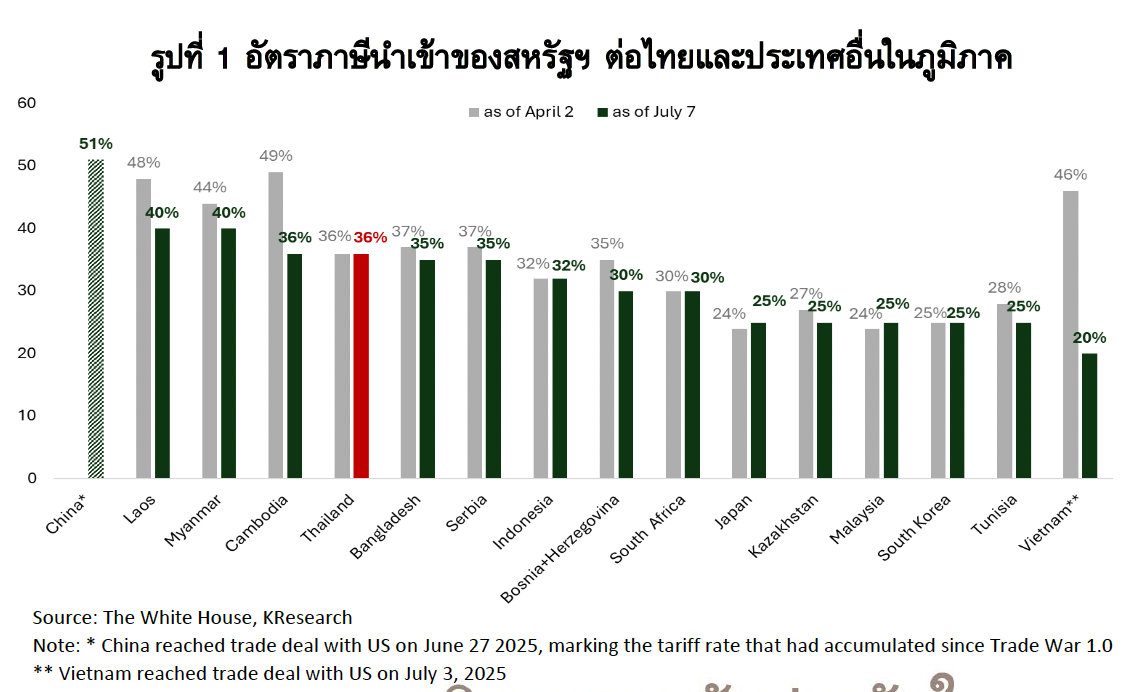
If Thailand faces a 36% tax, it risks losing the U.S. market to regional countries with lower taxes, and must also monitor the impact of industry-specific taxes under Section 232, which will have additional repercussions.
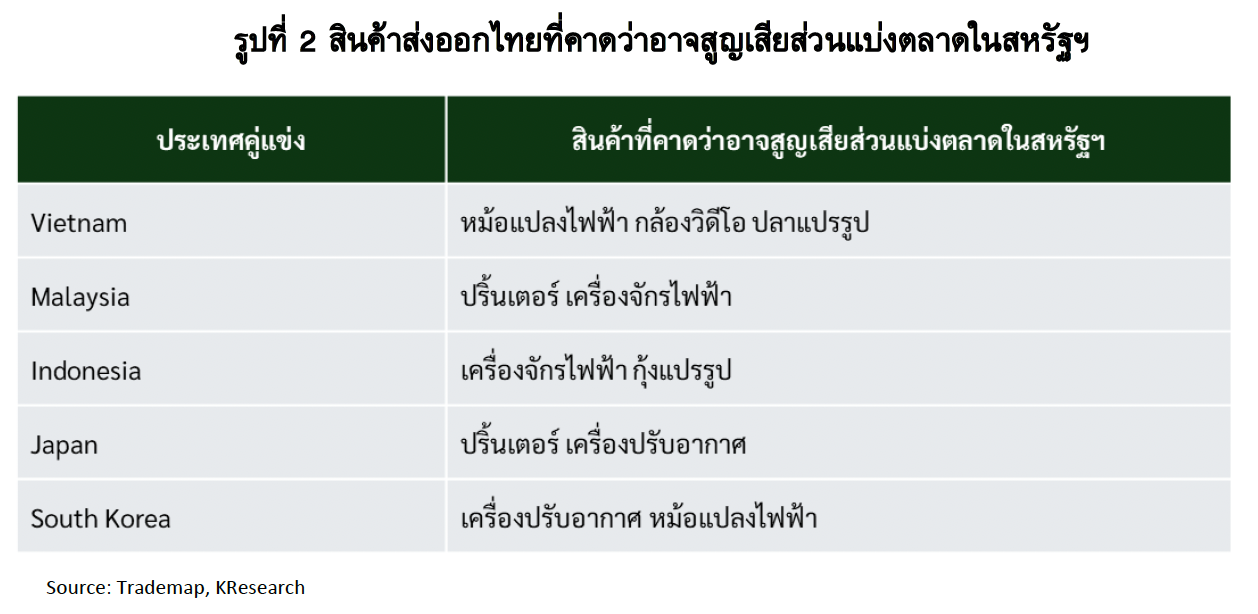
The 36% import tax will likely lead to a significant contraction in Thai exports in the latter half of 2025, while imports are expected to slow down further. The 36% import tax imposed on Thailand will still be higher than many competing countries, resulting in a trend of Thai products losing market share in the U.S., especially in sectors like transformers, printers, air conditioners, and processed fish and shrimp (see Figure 2). However, re-exports to the U.S. through Thailand, utilizing low local content, are also expected to slow down, particularly for machinery products, as imports from China increase alongside exports to the U.S., which will also slow down imports that use Thailand as a transit point.
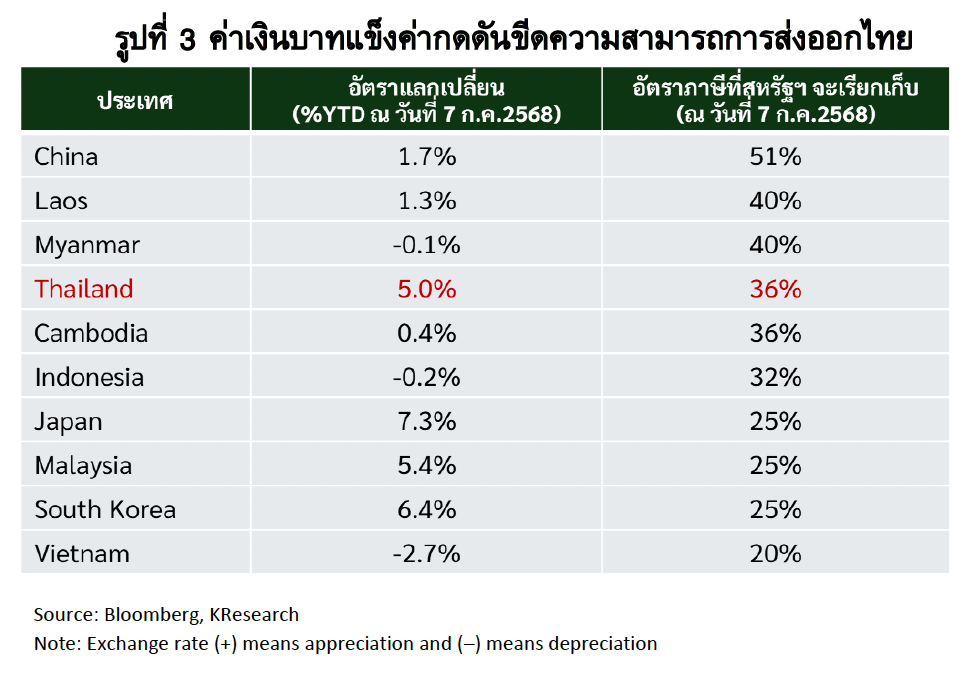
Moreover, the strengthening of the Thai baht against many regional currencies exacerbates export challenges, with the baht appreciating from around 34.50 THB per USD at the beginning of the year to below 32.50 THB as of July 7, 2025, representing a 5% YTD increase since the start of the year, which further pressures the competitiveness of Thai products.
U.S. import taxes on specific industries under Section 232 remain a significant risk, as the U.S. is currently investigating products that may pose a national security threat under Section 232, including semiconductors, copper, pharmaceuticals, and processed wood. This investigation is expected to conclude between late 2025 and early 2026. If additional taxes are imposed, it will further pressure the overall Thai export landscape next year, given the substantial share of these products in total Thai exports.
GDP growth for 2025 is at risk of falling below 1.4%, and we must continue to monitor Thailand's negotiations moving forward, as well as the U.S.-China talks after the 90-day period ends.
The Kasikorn Research Center estimates that if Thailand faces higher import tax rates than many countries, it will negatively impact exports, leading to deeper contractions, and will also slow foreign investment, resulting in a further decline in private investment. Additionally, there are other factors posing risks to the Thai economy for the remainder of 2025, particularly the number of tourists, which is likely to be lower than expected due to increasing negative pressures, such as the situation in the Middle East and the Thailand-Cambodia situation. Furthermore, the Chinese tourist market has yet to recover, and domestic political stability may undermine confidence and budget disbursement. All these factors, including U.S. taxes and domestic issues, contribute to the risk of Thailand's GDP estimate for 2025 falling below 1.4%.
However, there are upcoming events to monitor, including Thailand's efforts for new trade negotiations before the 36% import tax takes effect on August 1, 2025, as well as the U.S.-China negotiations on August 12, 2025, following the end of the 90-day tax delay. The Kasikorn Research Center will assess the various events that will unfold in the near future and will review GDP estimates again.