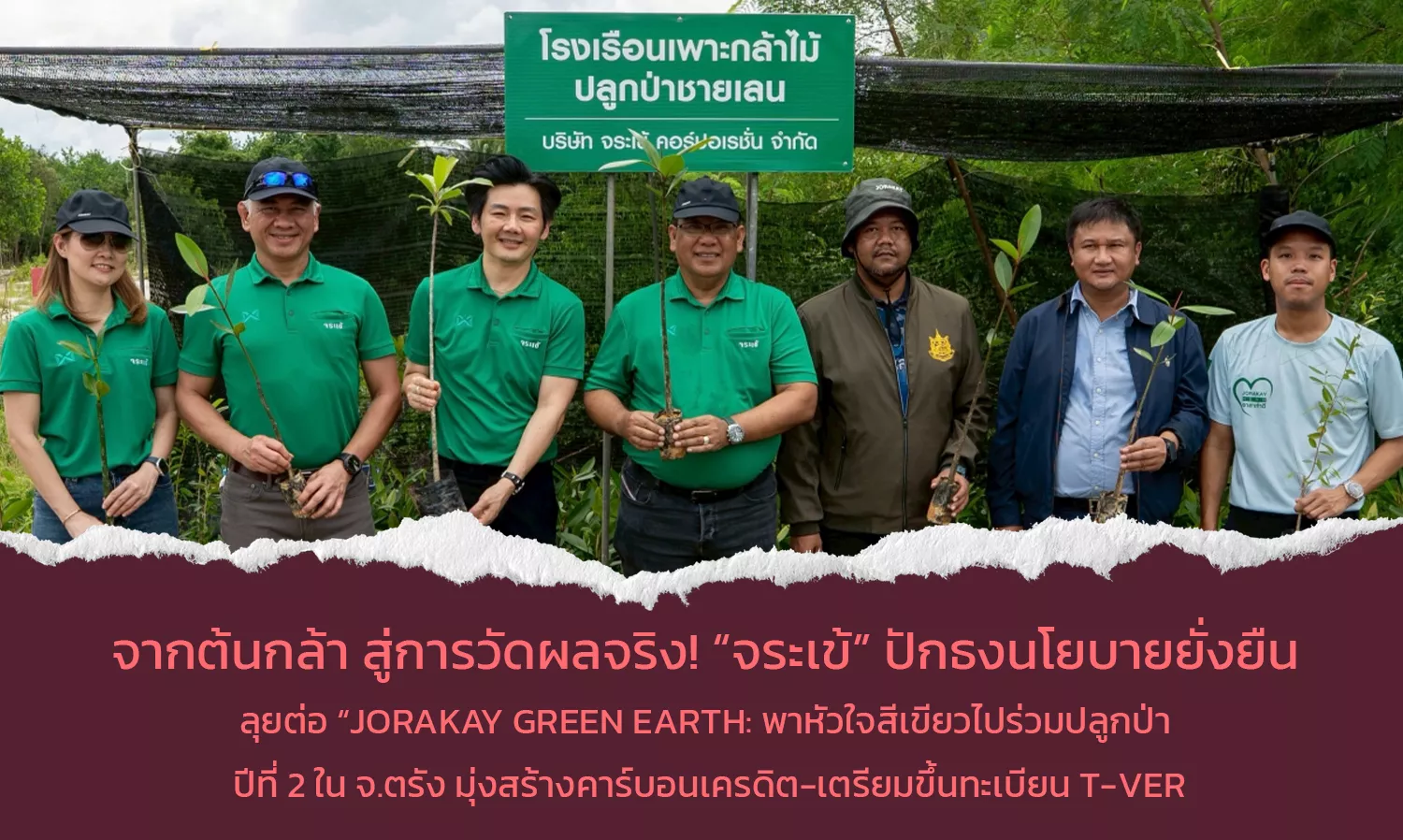
From Seedling to Real Impact! 'Jorakay' Champions Sustainable Policy, Continuing 'Jorakay Green Earth: Bringing Green Hearts Together to Reforest' in Year 2 in Trang Province, Aiming to Create Carbon Credits and Prepare for T-VER Registration
Jorakay Corporation Co., Ltd., a true innovator in comprehensive construction that cares for people and the environment, is advancing its important project Jorakay Green Earth Bringing Green Hearts Together to Reforest in its second year, aiming for systematic measurement according to Thailand's voluntary greenhouse gas reduction standards through the T-VER (Thailand Voluntary Emission Reduction Program) implemented by the Greenhouse Gas Management Organization (Public Organization) or TGO. This reinforces the commitment of "Taking Real Action - Caring for Nature" after previously launching a mangrove reforestation initiative in Trang on 62.5 rai in 2024. This year, Jorakay is continuing its mission by systematically inspecting and assessing the mangrove area, preparing project proposal documents, and entering the verification process by external agencies (Validation and Verification Body or VVB), with the goal of registering for T-VER in the next step. The Jorakay Green Earth project operates under a 10-year plan for continuous forest management, with the assessment of the area and preparation for T-VER registration marking a significant step towards the organization's carbon neutrality by 2025 and achieving Net Zero by 2065.
Once the 62.5 rai of mangrove area is certified and registered for T-VER, the company will receive the actual amount of greenhouse gases sequestered, which will become carbon credits that can offset greenhouse gas emissions in business operations. This lays the foundation for tradable carbon credits that can be utilized in the national carbon market. Jorakay aims to create a tangible model for sustainable policy and emphasizes that reforestation for carbon credits is achievable and must be done systematically, with expectations that the carbon credits from the T-VER project will offset more than 1,200 tons of carbon dioxide equivalent over the 10-year period.
From policy to actual implementation, the organization is committed to achieving Carbon Neutrality by 2050.
Mr. Supapong Petsuthit, CEO of Jorakay Corporation Co., Ltd., stated, "Entering the T-VER system is a significant milestone that demonstrates Jorakay's commitment to reducing carbon emissions from production processes, business operations, and compensation through nature conservation. Every step of the Jorakay Green Earth project is a crucial mechanism in Jorakay's broader strategic plan aimed at achieving carbon neutrality by 2050 and reaching Net Zero by 2065, in line with the 5 SD strategies and business approaches focused on minimizing environmental impact in every process."
Collaborating with government, private sectors, and communities to create long-term systemic results.
The Jorakay Green Earth project in its second year continues to strengthen cooperation with the Department of Marine and Coastal Resources, the Thailand Mangrove Alliance, and local communities. Jorakay is committed to restoring mangrove forests over an area of 62.5 rai for a continuous period of 10 years, providing long-term funding to ensure communities have income and genuinely participate in the conservation of natural resources.
In the first year of the project, we allocated over 77% of the total budget for the first year to distribute income by hiring local community labor for land improvement, seedling cultivation, tree planting, weed removal, and ongoing care of the planting areas. This reflects our intention to drive development that integrates economy, environment, and quality of life for community members.
This collaboration creates a balance between nature conservation and income generation, demonstrating a tangible commitment to elevating sustainable development and carbon reduction at the national level.
“We chose to create carbon credits through mangroves because this area represents the future of the green economy. Mangroves absorb carbon four times more than terrestrial forests, with just one rai capable of absorbing approximately 9.4 tons of carbon dioxide per year. Therefore, planting mangroves is a 'powerful mechanism' for carbon reduction. Additionally, this project helps secure coastlines, nurture aquatic life, and increase community income in the long term. Restoring mangroves is a 'powerful option' for creating sustainable carbon credits that are genuinely valuable to ecosystems,” concluded Mr. Supapong Petsuthit.
Jorakay Corporation aims for the Jorakay Green Earth project to be a model for real action on sustainability. Jorakay is the first private organization among 33 partners to actively plant seedlings and care for mangroves over an area of more than 62.5 rai, with ongoing care for 10 years. In the future, Jorakay aims to set new standards and serve as a model for Thai private organizations to systematically implement sustainability policies while creating a green construction industry that operates alongside efforts to improve the world.