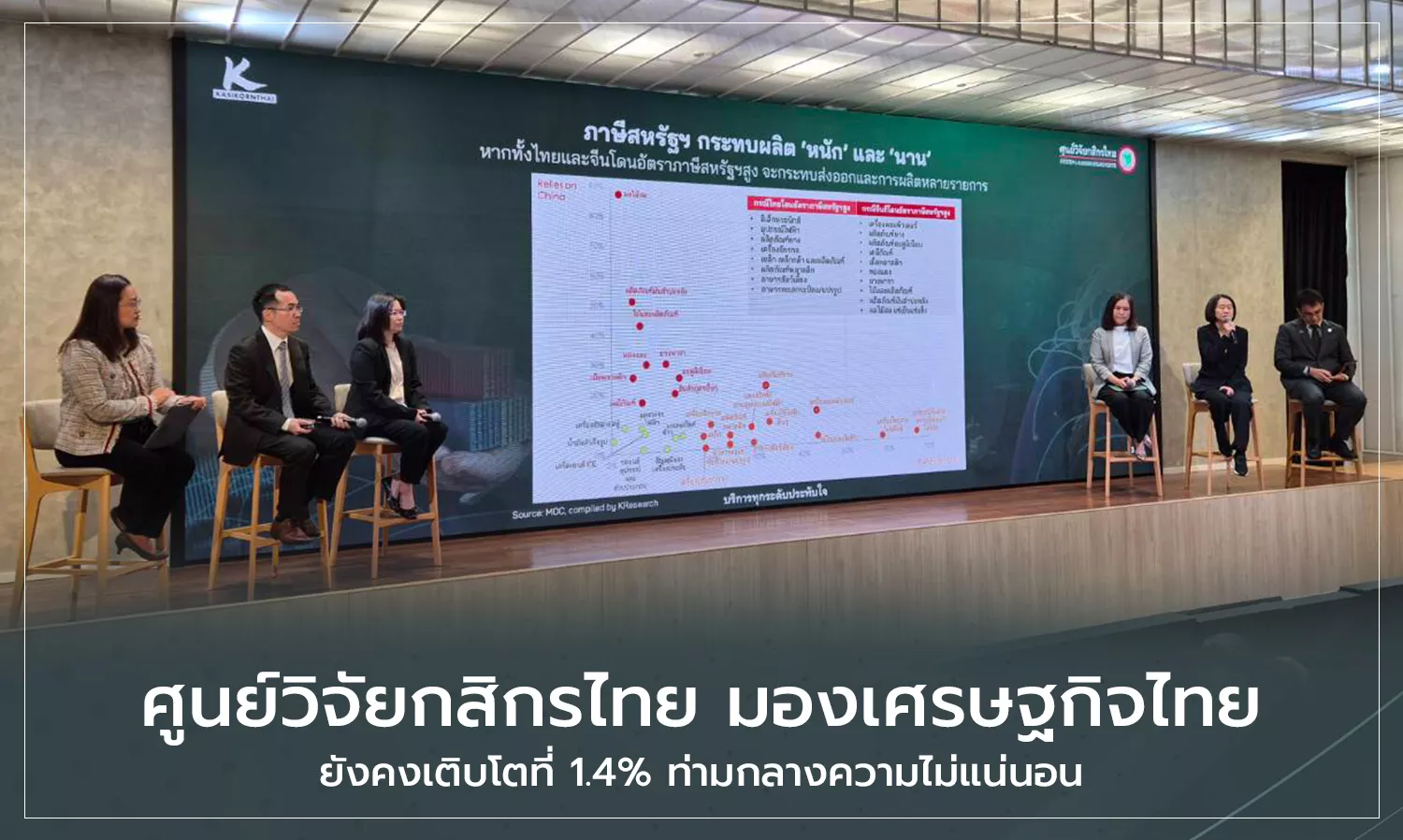
Kasikorn Research Center Projects Thai Economy to Grow at 1.4% Amid Uncertainty
The Kasikorn Research Center projects that the Thai economy will continue to grow at 1.4% despite the risks of a technical recession due to the U.S. import tax measures. Factors such as the export sector, domestic competition with imported goods, a decline in foreign tourists, shrinking car sales, slowing credit growth, and concerns over bad debt contribute to this outlook. However, if the U.S. import tax rate remains at 10% throughout the year, Thai exports are expected to grow by 0.5%, and the Thai economy could trend towards a growth of 1.8%.

Mr. Burin Adulwattana, Managing Director and Chief Economist of Kasikorn Research Center, stated that the uncertainty surrounding President Trump's import tax policies is impacting trade, investment, and the global economy. Recently, the OECD has revised its global economic growth forecast for 2025 down by 0.2% to 2.9% and lowered the U.S. economic forecast by 0.6% to 1.6% compared to the predictions made in March 2025. The uncertainty in U.S. policies regarding trade, finance, fiscal matters, education, and domestic politics has significantly reduced investor confidence in the U.S. dollar, its stability, and economic potential, with the U.S. dollar depreciating by over 8% since President Trump took office, while U.S. government bond yields have increased.
The U.S. Federal Reserve must continue to implement policies cautiously amid the risks of inflation potentially accelerating due to tariff increases and the risk of economic slowdown, despite facing pressure to lower interest rates.
Ms. Natthaporn Treeratnasirikul, Deputy Managing Director of Kasikorn Research Center, revealed that the uncertainty surrounding U.S. import tax measures after the slowdown ended on July 9, 2025, remains high, leading the Kasikorn Research Center to project that the Thai economy will continue to grow at 1.4%, with risks of a technical recession in the second half of 2025. However, if the U.S. import tax rate remains at 10% throughout the year, Thai exports are expected to grow by 0.5%, and the Thai economy could trend towards a growth of 1.8%.
Ms. Kewalin Wangpichaisuk, Deputy Managing Director of Kasikorn Research Center, commented that the unclear U.S. tax policies will lead to a continuous contraction in the industrial production sector due to the risks of exports to the U.S. and China in the electronics, automotive parts, machinery, steel, plastic products, and chemical sectors, among others, as well as domestic competition with imported goods. It is expected that the proportion of the value of imported consumer goods to retail sales in 2025 will exceed 30%, and the number of foreign tourists this year is expected to decline for the first time in three years.
Dr. Rujiphan Assarat, Assistant Managing Director of Kasikorn Research Center, anticipates that domestic car sales will contract further in the second half of the year at -1.7% YoY compared to -1.0% YoY in the first half, due to weak economic conditions and tightened credit issuance, although there are positive factors from the increasing sales of Battery Electric Vehicles (BEVs) driven by price competition from Chinese cars. Meanwhile, Thai agricultural income is expected to contract due to pressures from both prices and reduced demand for agricultural products, as well as increased competition in the global agricultural market.
Dr. Kanjana Chokpaisansilp, Research Executive at Kasikorn Research Center, added that the funding conditions for the private sector remain weak due to slowing credit demand, increased debt repayments, and financial institutions' ongoing concerns about bad debt. This has led the Kasikorn Research Center to revise its forecast for commercial bank credit in Thailand this year down to -0.6% from the previous estimate of 0.6%. At the same time, it is expected that non-performing loans (NPLs) will continue to rise, although the figures may not exceed 3% of total loans, as financial institutions will continue to work on managing bad debts and overdue debts through debt restructuring and selling off bad debts.
Dr. Krit Sittathanee, Assistant Managing Director of Kasikorn Research Center, provided information that ESG activities in the Thai private sector have also slowed down amid several negative factors. The issuance of Sustainable Finance bonds has decreased, partly shifting to green loan services from commercial banks. The target for green loan issuance this year is expected to continue to grow significantly, with large businesses focusing on Project Finance fundraising plans, while SMEs are likely to delay their plans or focus on investments related to solar panels, energy efficiency, or Battery Electric Vehicles (BEVs) that show clear short-term value.
The Kasikorn Research Center concluded that to cope with the increasingly uncertain economic direction in the second half of the year, the government should focus on efficient budget utilization, emphasizing necessary short-term measures while also increasing attention to long-term measures to restructure the Thai economy. As for immediate relief measures to mitigate the impact on producers affected by U.S. taxes, support should focus on products that use domestic raw materials or are produced in Thailand (Local Content and Made in Thailand) and efforts should be made to restore tourist confidence and stimulate the main tourist market. Recommendations for businesses include maintaining cash flow to prepare for the high level of uncertainty that remains.