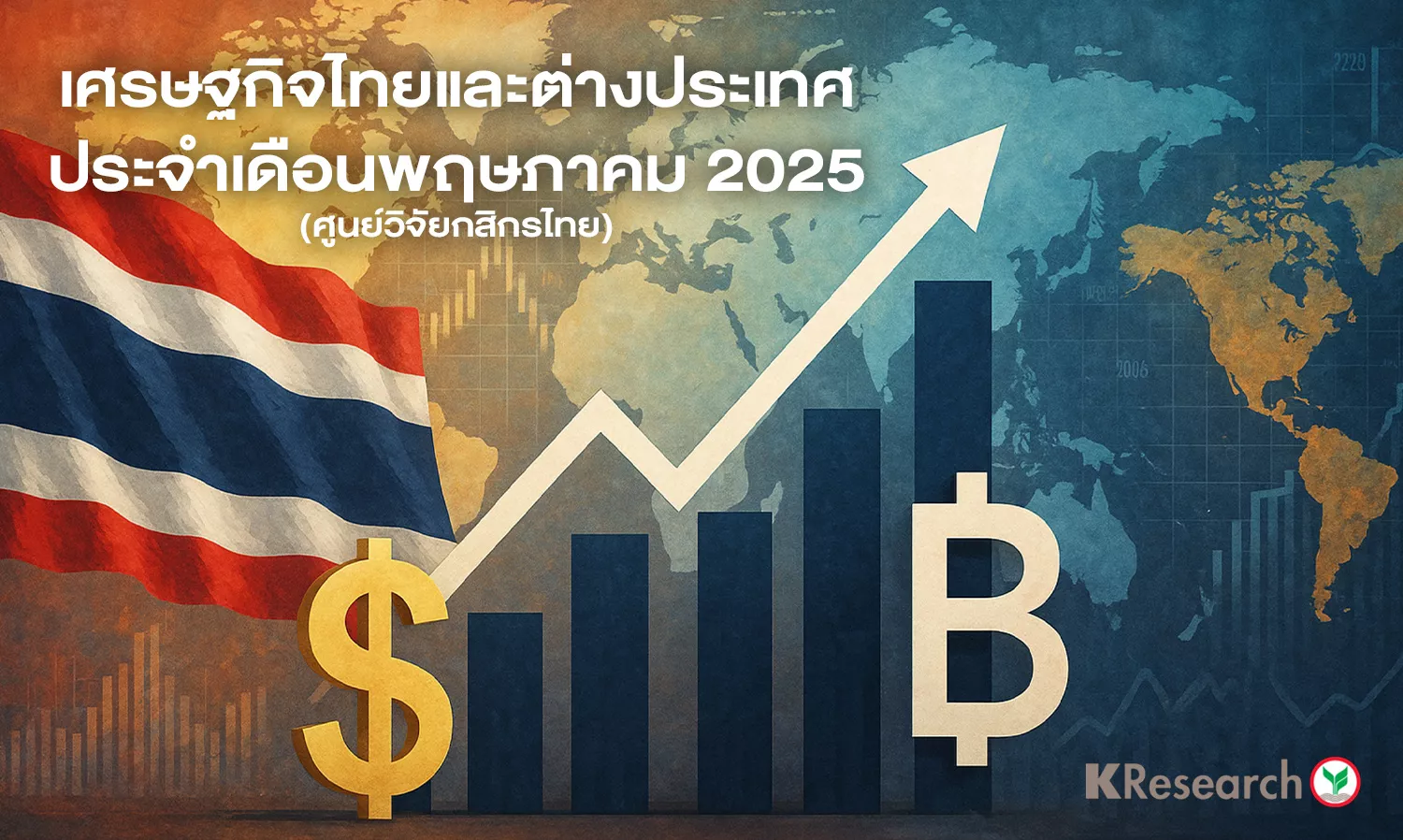
Thai and International Economy for May 2025 (Kasikorn Research Center)
The global economy in May 2025 continues to face uncertainty due to the trade war, particularly from the U.S. plan to impose import tariffs targeting China and several Asian countries, including Thailand. Although the U.S. has extended the enforcement of these tariffs by 90 days, investors remain concerned about the potential repercussions, as reflected in the rising volatility index (VIX), which is nearing levels seen during the COVID-19 crisis. China's countermeasures, including export restrictions on critical minerals and blacklisting U.S. companies, further exacerbate global economic tensions.
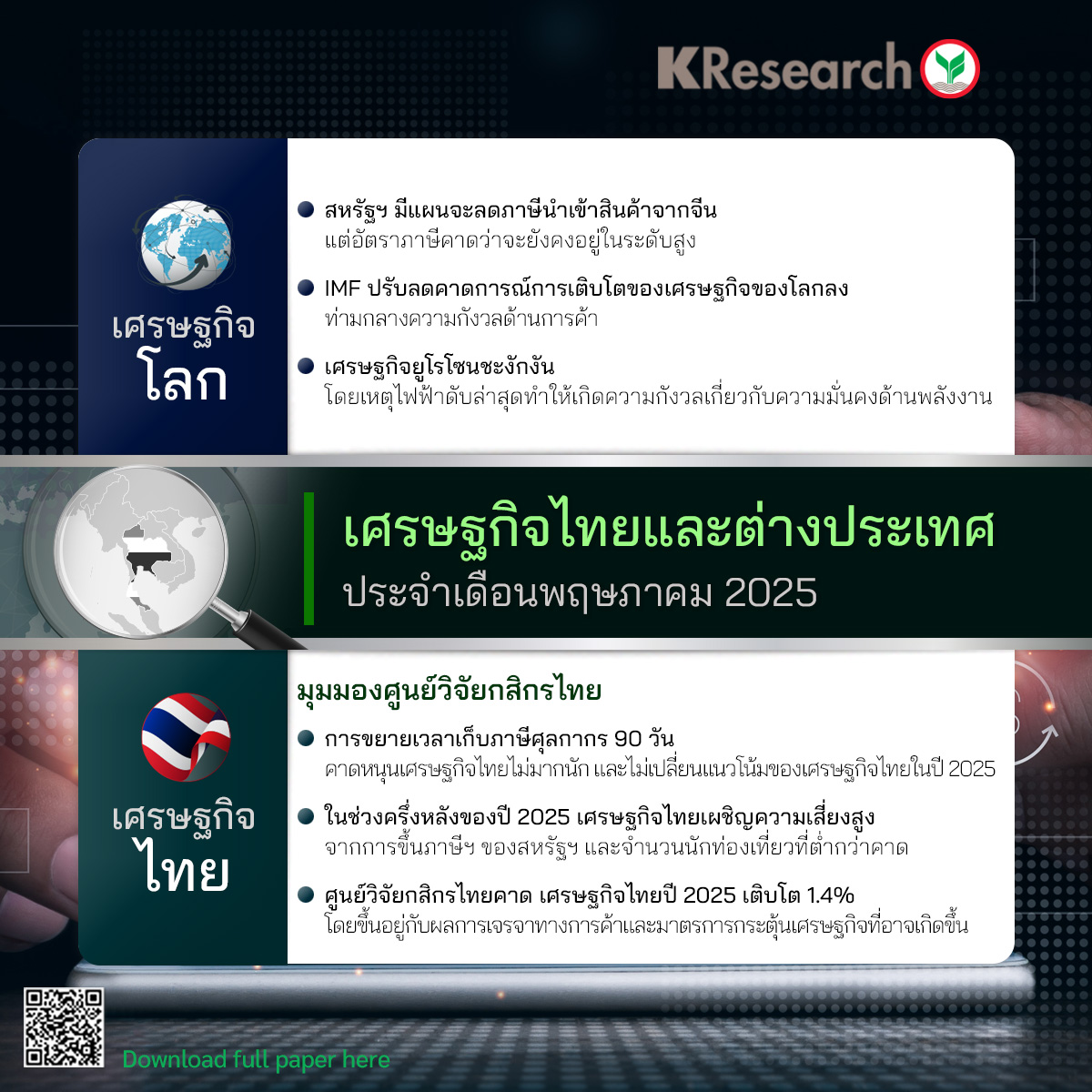
Forecasts for global economic growth and trade have been downgraded. The IMF and WTO have revised their projections for global economic expansion and trade in 2025, primarily due to the increased tariffs from the U.S., which are putting pressure on consumer confidence and are likely to lead to a partial economic recession, especially in countries heavily reliant on trade with China and the U.S., such as the Eurozone and Japan.
The Thai economy is projected to grow by only 1.4% in 2025, which is lower than previously expected. Key risk factors include U.S. tariff increases, which are anticipated to negatively impact Thai exports by approximately -0.5% due to both direct and indirect effects. Additionally, sluggish tourism, particularly the lower-than-expected number of visitors from China and South Korea, is also putting pressure on the overall economy in the early part of the year.
Consumer and industrial confidence indices in Thailand continue to decline amid uncertainties from both external and internal factors, such as earthquakes and exports that rely heavily on foreign tax incentives, which do not reflect actual manufacturing conditions. This makes the economic recovery in the medium term unstable, particularly in the electronics and electrical appliances sectors.
The Thai government plans to stimulate the economy with a budget of 500 billion baht, divided into the 2025 budget, emergency borrowing, and a Soft Loan project aimed at mitigating the impact of U.S. tariffs and stimulating private consumption and investment. However, the increase in public debt burden may cause Thailand to reach its debt ceiling sooner than previously anticipated in 2027, necessitating close monitoring of the outcomes of these measures.