Aftershock Situation Update Day 3 (March 31): Improving Trends, But Monitoring Still Required
**Aftershock Situation Update Day 3 (March 31): Improving Trends, But Monitoring Still Required**
The occurrence of aftershocks is a phenomenon that typically follows a major earthquake, resulting from the adjustment of the Earth's crust after stress is released during the main earthquake event. The latest data on Day 3 after the significant earthquake indicates that the trend of aftershocks is beginning to decrease, which is a positive sign, but monitoring is still necessary in the coming period.
### **Key Trends of Aftershocks on Day 3**
- **Frequency of Aftershocks Decreases**
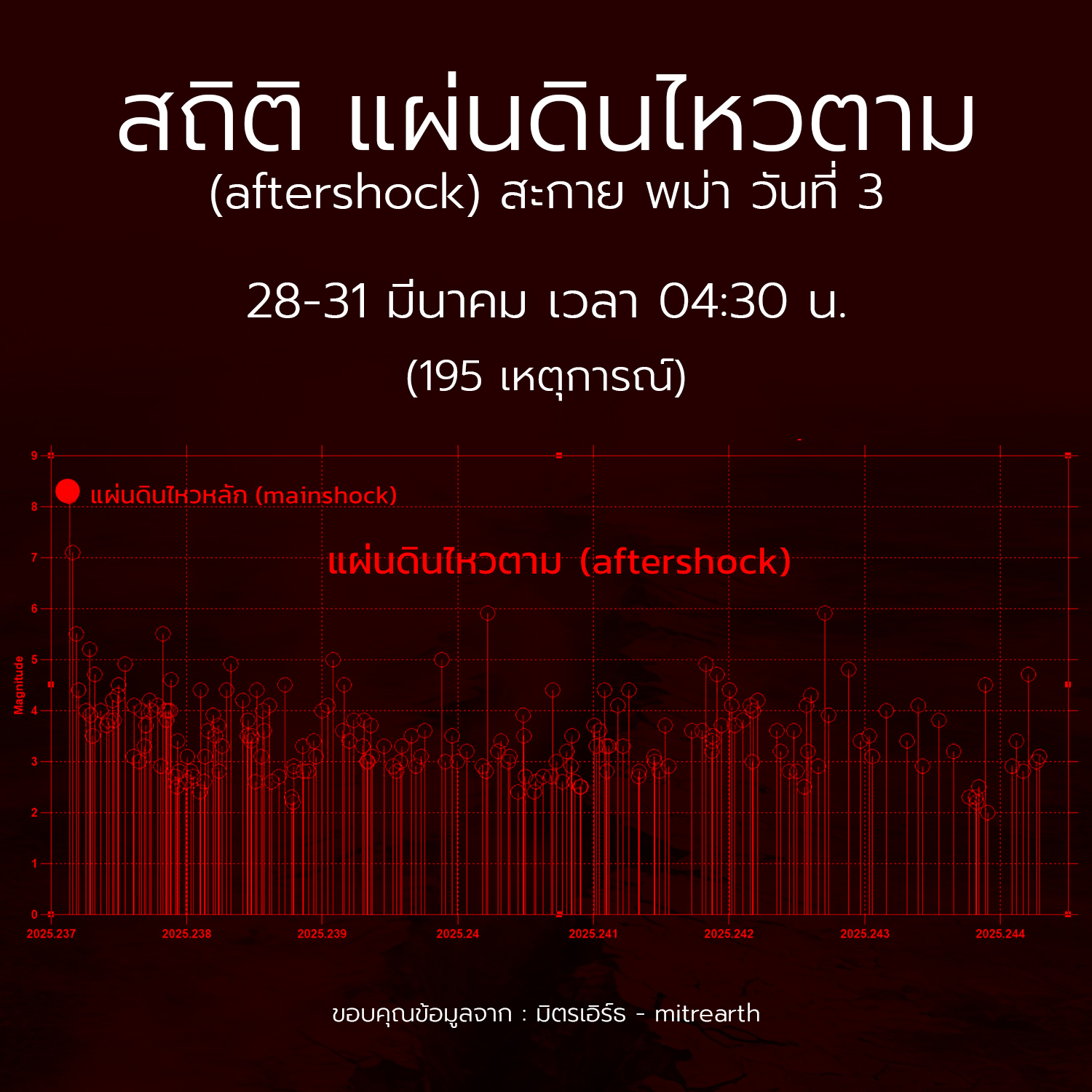
Data collected over the past three days shows that aftershocks are occurring less frequently, with increasing intervals between each event, indicating that stress in the Earth's crust is gradually easing.
- **Magnitude of Aftershocks Slightly Decreases**
On the first day, the aftershocks recorded were slightly larger than those on the second and third days, suggesting that the accumulated stress from the main earthquake is slowly dissipating.
- **Aftershocks Greater than 5.0 Decrease**
On the first day of aftershocks, there were four recorded events with magnitudes greater than 5.0, but on the second and third days, only one event was recorded each day, which is an encouraging trend.
- **Aftershocks of Magnitude 3.0-4.0 Decrease**
Moderate earthquakes in the range of 3.0-4.0 are also decreasing, aligning with the overall improvement in the situation.
- **Aftershocks Below 2.0 Detected on Day 3**
On the third day of aftershocks, earthquakes with magnitudes below 2.0 were detected, a level that typically does not impact structures or people's sensations, indicating a normal process of crustal relaxation.
---
### **Geological Analysis**
Based on the information above, geologists comment that the decreasing trend of aftershocks follows the natural mechanisms of the Earth's crust. After the initial earthquake of magnitude 7.7, the stress accumulated within the ground will gradually be released in the form of aftershocks. However, the decrease in frequency and magnitude of aftershocks over the first three days is a positive sign indicating that this stress is easing.
Although the situation appears to be improving, monitoring is still necessary, as in some cases, aftershocks may continue to occur for weeks or months, depending on the geological structure of the area.
---
### **Recommendations for the Public**
✅ **Stay Updated with Information**
Even though the trend is improving, aftershocks can still occur, so it is important to follow information from reliable news sources.
✅ **Prepare for Emergencies**
Although the intensity of aftershocks is decreasing, having a response plan, such as preparing emergency kits and knowing how to act during an earthquake, remains crucial.
✅ **Avoid Damaged or Unstable Buildings**
Buildings affected by the main earthquake may still pose risks; it is advisable to avoid them and wait for assessments from experts.
---
**Overall Situation Summary**
The overall picture of aftershocks on Day 3 indicates that the stress caused by the main earthquake is decreasing, with a continuous reduction in the frequency and magnitude of aftershocks. While this is a positive trend, monitoring is still required in the coming period, and preventive measures should be in place for everyone's safety.
Wishing everyone safety.
Thank you for the information from: Mitrearth