Fertility Treatment Services Business Continues to Grow with Increasing Demand (Kasikorn Research Center)
- The Thai fertility treatment service market in 2025 is expected to grow by 6.2% from 2024, with a value exceeding 6.3 billion baht, driven by rising demand from both Thai and foreign clients, in line with global trends.
- In 2025, the market value for Thai clients is projected to expand by 5.0% due to changing attitudes towards delayed parenthood and increasingly complex fertility issues, particularly those related to male factors, leading to a reliance on more expensive treatment methods. Meanwhile, the market value for foreign clients is expected to grow by 7.6%, supported by competitive pricing and high-quality services, as well as the expansion of new markets.
Global Trends in Fertility Treatment Services for 2025 are expected to see the global fertility treatment market valued at over 22 billion USD, growing by 6.8% from 2024.
The global fertility treatment market continues to grow, led by in vitro fertilization (IVF) services, which account for over 80% of the market value. This is particularly evident in the Asia-Pacific region, where the market share for IVF is expected to increase from 22% in 2020 to 26% in 2030, as many countries face increasingly severe aging populations.
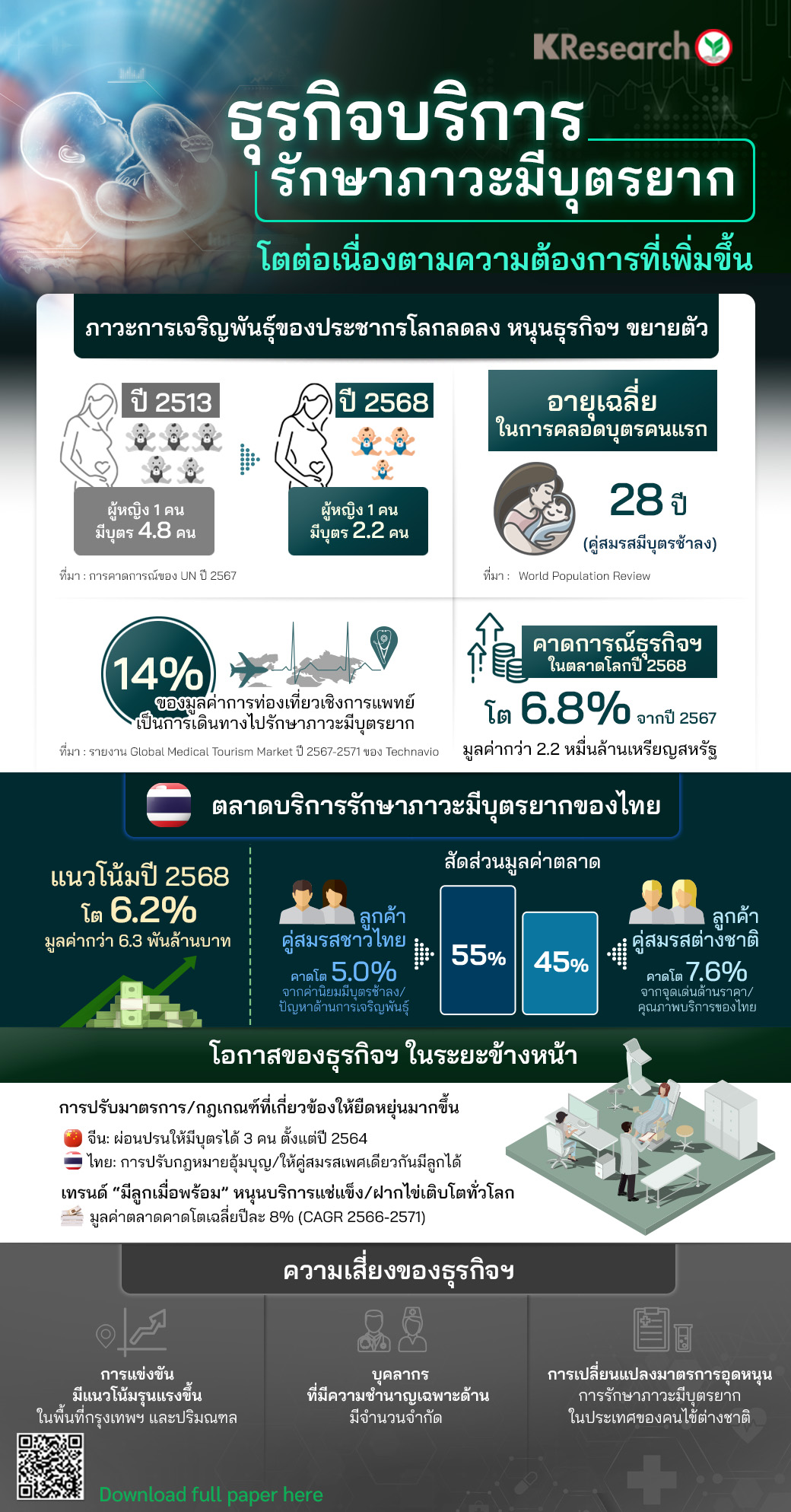
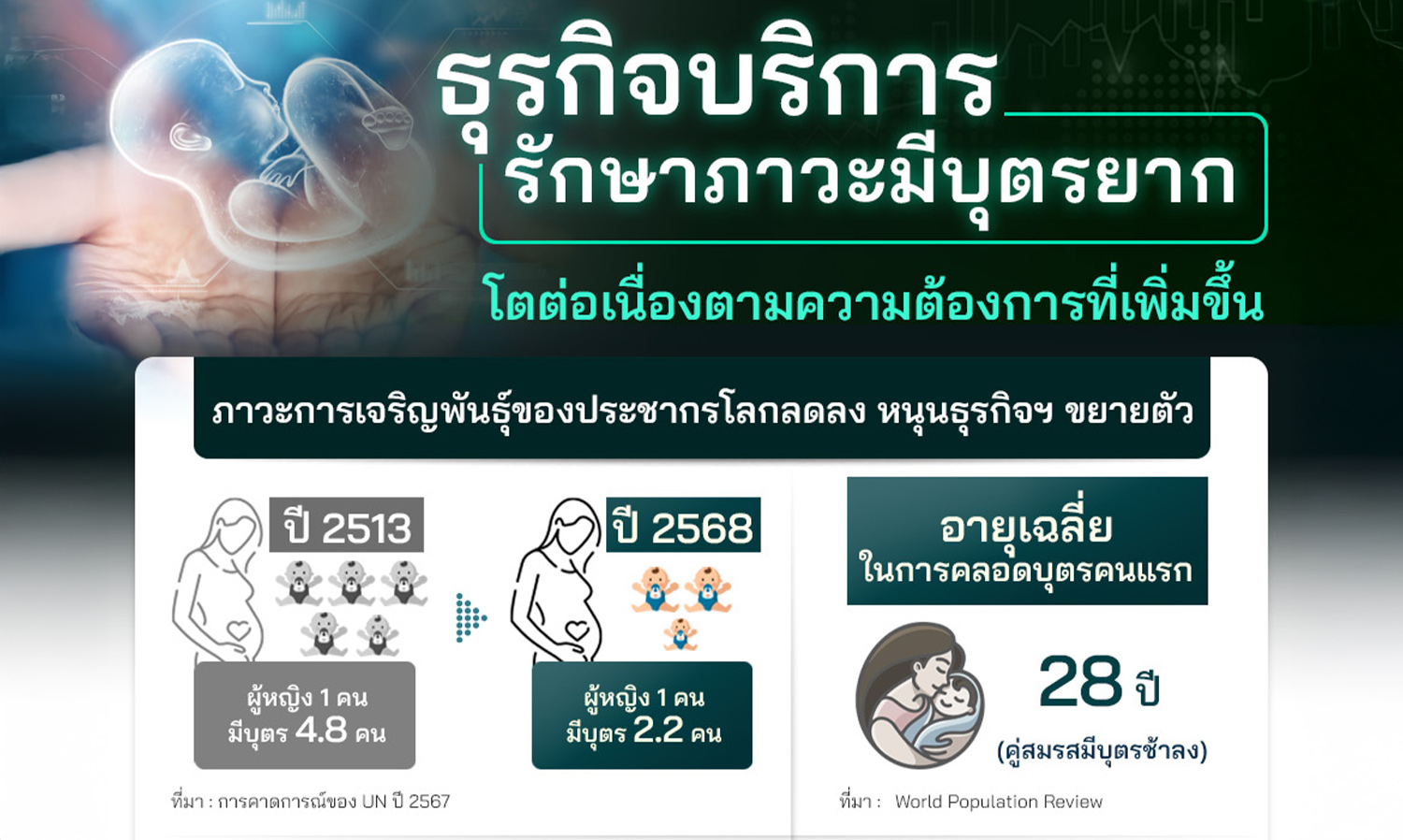
The global fertility rate continues to decline, from 4.8 children per woman in 1970 to just 2.2 children in 2025. Changing attitudes towards parenthood have led couples worldwide to have children later, as reflected in the average age of first-time mothers, which has gradually increased to around 28 years. This trend has resulted in a growing role for fertility treatment services.
Additionally, the increasing prevalence of fertility issues worldwide has fueled the growth of fertility tourism, with the market share in 2023 ranking third at around 14% of the global medical tourism market. This growth in fertility tourism is expected to benefit Thailand as it attracts more foreign clients seeking fertility treatment.
Trends in the Thai Fertility Treatment Market
In 2025, the Thai fertility treatment market is expected to be valued at over 6.3 billion baht, growing by 6.2% from 2024, with two main segments: Thai clients making up 70% of total service users and foreign clients accounting for 30%.
Despite a slowdown in market growth in 2024 due to high base effects from the previous year, the market value in 2025 is expected to accelerate, driven by a higher influx of foreign clients seeking services, particularly IVF, which is anticipated to see a 5.9% increase in treatment cycles. This method is favored by foreigners due to its higher success rates compared to other methods. In contrast, artificial insemination (IUI), which has lower success rates, is expected to see a 3.7% increase in treatment cycles, primarily among Thai clients.
Thai Clients Seeking Fertility Treatment
The market value for Thai clients seeking fertility treatment is projected to grow by 5.0% in 2025 due to changing attitudes towards delayed parenthood and fertility issues.
The market value for Thai clients, which accounts for over 55% of the total market, continues to grow due to changing economic and social conditions, leading Thai couples to prefer having children later. This is reflected in the increasing proportion of births among women aged 30 and older, which is expected to rise from around 35% in 2012 to 46% in 2025. Additionally, many couples face fertility challenges due to health issues such as hormonal imbalances, obesity, and work-related stress.
ICSI (Intracytoplasmic Sperm Injection), a high-cost IVF method, is gaining popularity among Thai clients due to the complexity of fertility issues increasingly related to male factors.
IUI is becoming less popular, as evidenced by a decrease in treatment cycles from 31% in 2022 to an expected 28% in 2025. Similarly, traditional IVF is seeing an average growth rate of only 2% per year, while ICSI is growing at an average rate of 8% per year (CAGR from 2022-2025).
The increasing trend towards ICSI aligns with reports from businesses indicating that fertility issues among Thai couples are becoming more complex, with a higher incidence of male-related infertility due to factors such as poor sperm quality linked to risky behaviors like smoking, alcohol consumption, and certain medications. ICSI, as an innovative method, offers higher success rates compared to other methods when addressing these issues.
Foreign Clients Seeking Fertility Treatment
The market value for foreign clients seeking fertility treatment is expected to grow by 7.6% in 2025, as Thailand continues to excel in pricing and service quality.
The market value for foreign clients, which accounts for over 45% of the total market, is also on the rise, particularly among clients from China, India, and ASEAN countries who prefer to travel to Thailand for fertility treatment. Thailand is a primary destination for fertility tourism, offering several advantages:
- Lower treatment costs: The average cost of IVF in Thailand is around 6,000 USD, which is lower than key competitors like Singapore and Malaysia. Additionally, Thai hospitals have higher standards, such as Joint Commission International (JCI) accreditation, compared to many countries.
- Availability of facilities: Various amenities enhance the experience for foreign clients beyond treatment, including hotels, restaurants, shopping centers, and the provision of Medical Treatment Visas for foreign clients who need to stay in Thailand for follow-up care.
The foreign client market remains a potential growth area, as businesses focus on marketing to attract more clients.
The continuous growth in the number of foreign clients is partly due to marketing efforts in the past 1-2 years, where fertility treatment businesses in Thailand have focused on both offline and online marketing, as well as agents, to attract more foreign clients. The cost of fertility treatment for foreign clients is approximately double that of Thai clients due to the inclusion of additional services in treatment packages (such as interpreters, transportation, and commissions). Therefore, expanding into new markets reflects opportunities for additional revenue for businesses, especially private hospitals, which derive about 20-30% of their total revenue from foreign clients.
Future Opportunities for the Fertility Treatment Services Business
- The relaxation of China's two-child policy to three children since 2021 due to the severe aging population and the declining Chinese population since 2022 suggests that the Chinese government will likely maintain this policy in the medium to long term. This could benefit Thailand, a primary destination for Chinese clients seeking fertility treatment, as domestic services in China may not sufficiently meet the increasing demand.
- Proposed amendments to Thailand's surrogacy laws, such as allowing relatives of wives aged 20-40 to donate eggs without marriage and permitting wives over 55 to access surrogacy services, could significantly boost the fertility treatment market for Thai clients if successfully implemented. However, the details of these legal adjustments need to be monitored to assess their impact on the fertility treatment market.
- The enforcement of the Equal Marriage Act in 2025 will require adjustments to various laws to align with equal marriage legislation, particularly allowing same-sex couples to have children through assisted reproductive technology. This is expected to positively impact the Thai fertility treatment market, making it more inclusive for the LGBTQ+ community, which currently comprises about 5.9 million people, or 9% of Thailand's total population, with numbers expected to continue rising.
- The trend of having children when ready is driving the growth of egg freezing, with the global market for egg freezing services expected to grow at an average of 8% per year (CAGR 2023-2028), outpacing the growth rate of other fertility treatment services. This positions Thailand to compete more effectively in the fertility tourism market, given its less stringent regulations compared to some competitors, such as Singapore, which restricts service to women aged 21-37, and Malaysia, which prohibits unmarried Muslim women from freezing eggs.
Risks in the Fertility Treatment Services Business
- Competition is expected to intensify in Bangkok and surrounding areas, where over 70% of service providers are located. However, business revenue remains heavily dependent on standards and success rates, necessitating ongoing improvements in service quality and investments in new technologies to enhance success rates and maintain long-term profitability.
- The number of specialized personnel in fertility treatment is limited, particularly embryologists, as there are currently no higher education programs in Thailand directly teaching this field. This necessitates careful workforce planning, training of medical scientists, and the establishment of appropriate compensation policies to mitigate risks associated with personnel shortages or job changes in the future.
- Changes in government subsidies for fertility treatment in patients' home countries, such as China's current IVF subsidies through health insurance in four cities, may expand in the future, potentially affecting decisions to seek treatment in Thailand. Additionally, advancements in new technologies could impact success rates and service delivery models.
[1] Referenced from the Global Medical Tourism Market report for 2024-2028 by Technavio. Medical tourism primarily involves travel for medical services, excluding massages, spa treatments, and health foods, etc.
[2] Market value estimated from fertility treatment services using three methods: Intrauterine Insemination (IUI), In Vitro Fertility (IVF), and Intracytoplasmic Sperm Injection (ICSI).
[3] The number of IVF treatment cycles includes both IVF and ICSI treatments.
[4] Referenced from the LGBTQ+ report: Diversity without Difference to Open Up to Gender Equality by the National Economic and Social Development Council.