Kasikorn Research Center Projects GDP Growth of 2.4% in 2025 Due to Declining Tourism and Exports
Mr. Burin Adulwattana, Managing Director and Chief Economist of Kasikorn Research Center Co., Ltd., stated that the return of President Donald Trump has created uncertainty for global investment and trade, particularly concerning the clarity of import tax policies expected early next year. This has raised concerns that the global economy may stagnate like it did in the 1930s. Additionally, the 'America First' policy is likely to alter the global order, posing risks to international organizations such as the WTO and NATO.

Ms. Natthaporn Treeratnasirikul, Deputy Managing Director of Kasikorn Research Center Co., Ltd., elaborated that in 2025, Thailand's economy is expected to grow at 2.4%, slightly slower than the projected 2.6% growth for 2024. This slowdown is attributed to reduced tourism momentum as the number of tourists approaches pre-COVID levels, as well as slower export growth impacted by trade war effects, both directly through the U.S. export market and indirectly through competition with Chinese goods in other markets. However, public investment is expected to grow better than last year due to continuous budget disbursement, while private investment is recovering from a contraction in 2024, aligned with incoming FDIs in the automotive and electronics industries. Nonetheless, risks to the Thai economy remain high due to uncertainties surrounding the trade war, a slowdown in major global economies, particularly China, and heightened competition in Thailand's manufacturing sector from Chinese products amid declining competitiveness.

Ms. Kewalin Wangpichayasuk, Deputy Managing Director of Kasikorn Research Center Co., Ltd., believes that in 2025, the situation in the Thai industry is unlikely to improve significantly due to various pressures, including the trade war under Trump 2.0, which will affect exports and production, certain government measures that may impact costs, and structural issues that continue to lead to cautious spending. The sectors that are still recovering slowly are small and medium-sized enterprises, with risks that the number of operators in the automotive, electronics, chemicals, metals, and fashion industries may decline further. In the trade and service sectors, while the number of operators may increase, sustaining business operations will not be easy either.

Additionally, Ms. Thanyalak Watcharachaisurapol, Deputy Managing Director of Kasikorn Research Center Co., Ltd., added that in 2025, the trend of credit in the commercial banking system registered in Thailand is expected to grow slowly and remain low, with an estimated growth rate of around 0.6%, following a projected contraction of 1.8% in 2024. This is amid high household debt issues that will continue to pressure retail credit. Meanwhile, non-performing loans remain a persistent problem that needs continuous monitoring, both in retail and SME lending. Kasikorn Research Center has analyzed business credit data from the corporate debtor database, which is anonymized statistical data from the National Credit Bureau (NCB), and identified five key issues:
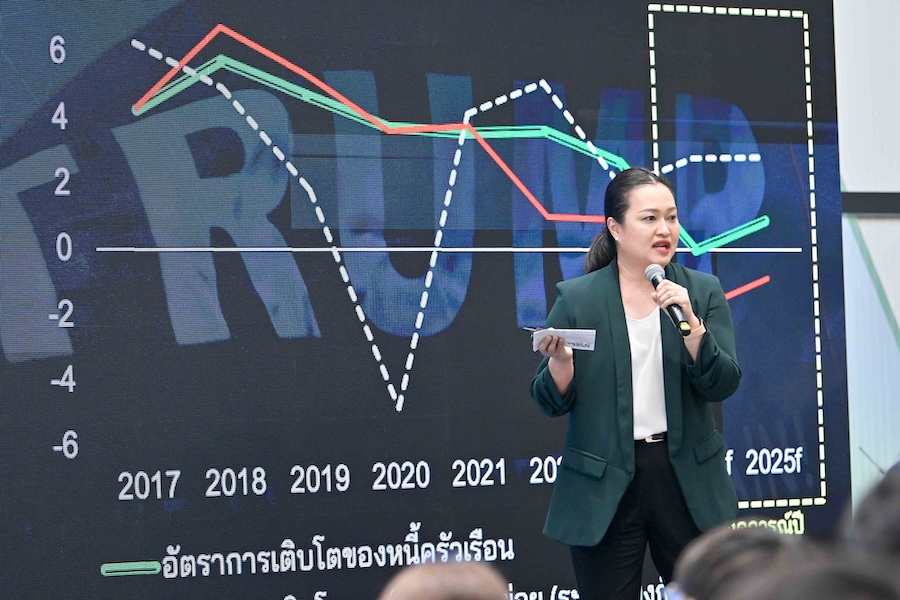
1. Thai business debt has been declining since late 2023 to early 2024 after the financial assistance measures during COVID lost their momentum.
2. The smaller the business, the more severe the debt problem.
3. Financial institutions of all types that extend credit are increasingly facing issues with non-performing loans.
4. Addressing chronic debt issues reveals that businesses with existing non-performing loans over the past three years are showing increasing concern, particularly among small and medium-sized enterprises.
5. The main types of businesses facing non-performing loan issues are concentrated in real estate, wholesale and retail, accommodation and food services, and manufacturing, reflecting immediate challenges such as declining consumer purchasing power, intense competition, and uneven business recovery, as well as structural issues stemming from declining competitiveness. According to a survey of SME operators at the end of November 2024, supporting overall economic growth to benefit business income will be one of the sustainable solutions.