REIC Reports Electric Trains Boost Land Price Index Before Development in Bangkok - Surrounding Areas Rise
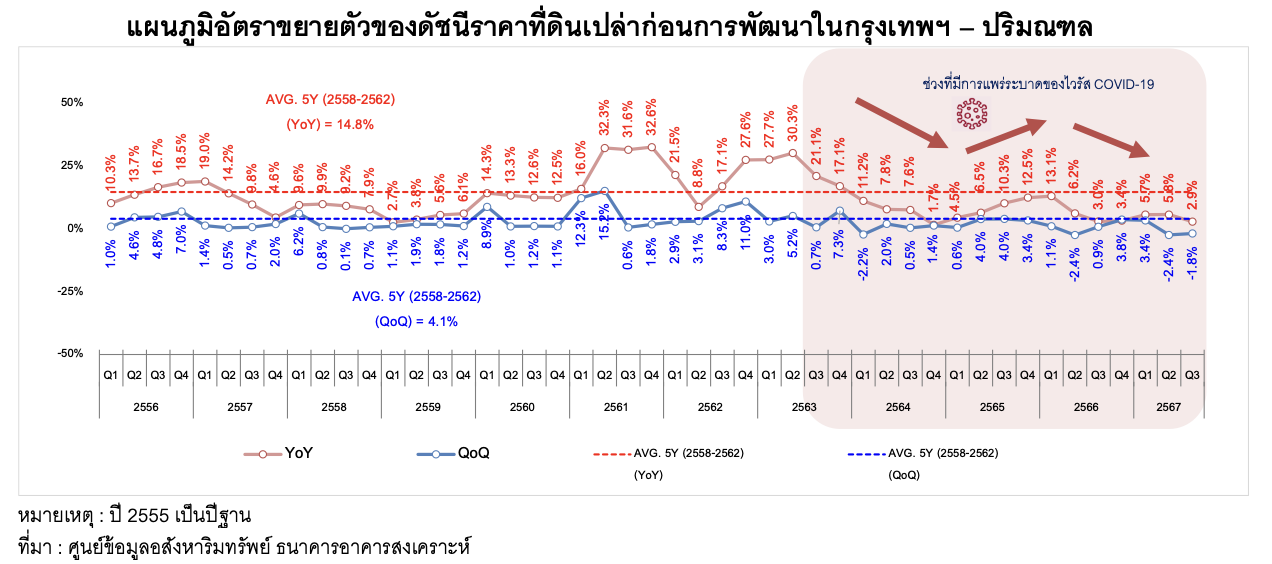
The Real Estate Information Center (REIC) of the Government Housing Bank (GHB) reports the index of land prices before development in Bangkok – the surrounding areas for the 3rd quarter of 2024 shows that the price of vacant land in the Bangkok - surrounding areas, covering 6 provinces, has an index value of 391.1, an increase of 2.9% compared to the same period last year (YoY). This is particularly evident along the electric train lines and nearby areas, reflecting a recovery in real estate investment. It is anticipated that in 2025, prices will rise further as developers are confident in launching new residential projects to meet the increasing housing demand along the electric train lines in the future.
The Real Estate Information Center (REIC) of the Government Housing Bank (GHB) reports the index of land prices before development in Bangkok - surrounding areas for the 3rd quarter of 2024 shows that tracking the changes in land prices before development (excluding buildings, with land sizes of 200 square wah or more) in the Bangkok - surrounding areas, which include 6 provinces: Bangkok, Nonthaburi, Pathum Thani, Samut Prakan, Samut Sakhon, and Nakhon Pathom, has an index value of 391.1, an increase of 2.9% compared to the same period last year (YoY). This is considered lower than the average index of land prices before development over the past 5 years prior to the COVID-19 crisis, reflecting that developers are confident that the real estate business is beginning to recover. Although it is still not high compared to the pre-COVID-19 crisis period, signs of increased land purchases for investment in construction projects along the electric train lines are becoming more apparent, as seen from rising land prices in various areas due to their investment potential. Additionally, the surrounding areas benefit from the development of intercity highways, such as the Nakhon Pathom province zone, which saw the highest increase of 22.7%, the Pathum Thani zone of Lam Luk Ka and Sam Khok increased by 18.3%, and the Taling Chan, Bang Khae, Phasi Charoen, Nong Khaem, Taling Chan, Thon Buri, Khlong San, Bang Phlat, Bangkok Noi, Bangkok Yai areas increased by 7.0%. The areas in Chatuchak, Huai Khwang, Yan Nawa, Wattana, Khlong Toei, Phaya Thai, Bang Kho Laem, Pom Prap Sattru Phai, Bang Sue, Din Daeng, Ratchathewi, and Bang Rak, or inner Bangkok, increased by 6.2%, and the Samut Sakhon province zone increased by 5.9%.
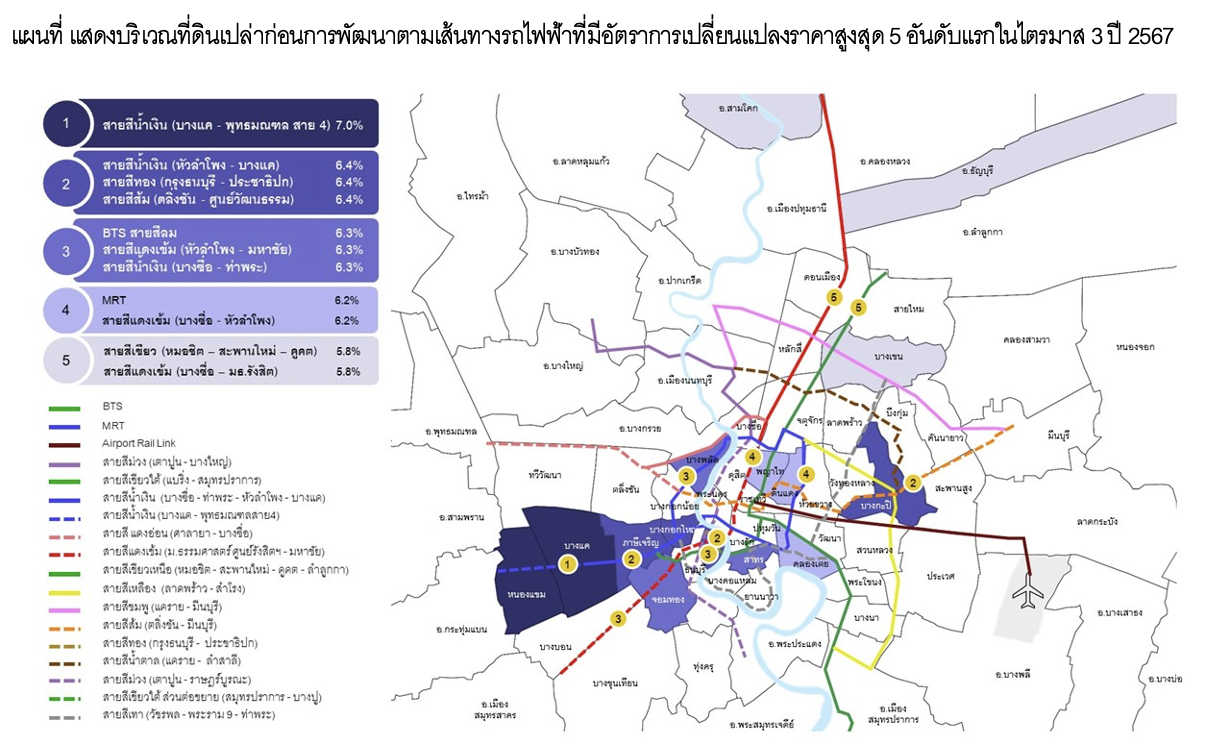
Additionally, it was found that the price of vacant land before development along the mass transit electric train routes is considered to be highly potential locations. In the 3rd quarter of 2024, the index of land prices before development saw the highest increase. The top 5 areas compared to the same quarter last year (YoY) are mostly lands where the electric train services have already commenced and lands that connect to two or more electric train lines, which include:
- Blue Line (Bang Khae - Phutthamonthon Sai 4) has an index value of 458.8, an increase of 7.0% compared to the same period last year (YoY), with rising land prices in the Bang Khae and Nong Khaem districts.
- Blue Line (Hua Lamphong - Bang Khae) has an index value of 534.5, Gold Line (Thon Buri - Prachathipok) has an index value of 526.8, and Orange Line (Taling Chan - Cultural Center) has an index value of 518.7, with a land price increase rate of 6.4% compared to the same period last year (YoY), with most of the significant land price increases occurring in Phasi Charoen, Bangkok Yai, and Bang Kapi districts.
- Silom Line has an index value of 503.6, Blue Line (Bang Sue - Tha Phra) has an index value of 495.9, and Dark Red Line (Hua Lamphong - Mahachai) has an index value of 501.4, with a land price increase rate of 6.3% across all three lines compared to the same period last year (YoY), with rising land prices in Phasi Charoen, Sathorn, and Bangkok Yai districts.
- Subway along the entire route has an index value of 552.4, and Dark Red Line (Bang Sue - Hua Lamphong) has an index value of 543.8, with a land price growth rate of 6.2% for both lines compared to the same period last year (YoY), particularly in Sathorn, Khlong Toei, and Din Daeng districts.
- Green Line (Mo Chit - Saphaan Mai - Khu Khot) has an index value of 508.2, and Dark Red Line (Bang Sue - Thammasat University Rangsit) has an index value of 500.3, with a land price growth rate of 5.8% compared to the same period last year (YoY), with significant land price increases in Sam Khok, Thanyaburi, and Bang Khen districts.
Thus, the growth rate of land prices along the electric train routes, which have seen significant price changes, reflects an increasing demand for land in these areas due to the existing electric train network and future development projects. The trend of rising land prices in areas along the electric train routes that positively impact the index of land prices before development is particularly evident in areas with connections to multiple electric train lines (Interchange) and significant station areas.
Therefore, REIC predicts that land prices along the electric train routes will continue to grow, especially in areas under project development or newly opened services, as these routes are locations with ongoing demand for housing and commercial use. If the economic conditions improve as forecasted by the Ministry of Finance, which expects growth of more than 3%, partly due to government measures to stimulate the real estate sector, such as reducing transfer and mortgage fees to 0.01% and providing low-interest loans from GHB, along with the reduction of the policy interest rate by the Monetary Policy Committee (MPC), a decrease in household debt issues, and the development of new electric train infrastructure and other infrastructure projects, this is an opportune time for real estate developers to accelerate the development of new housing projects to meet the housing demand along the electric train routes, as it is still a period where land prices are slowing their increase before rising significantly in the future.