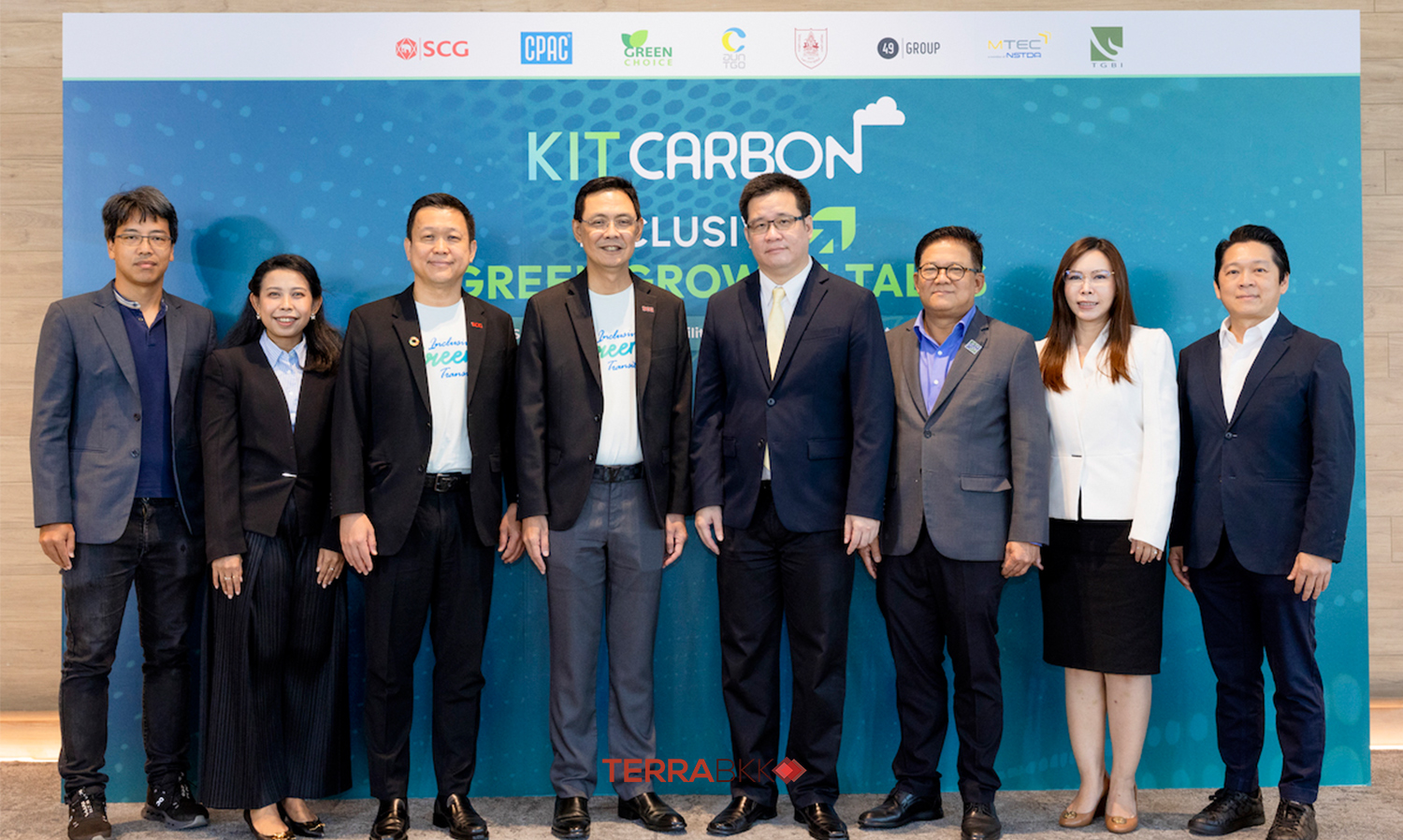
KITCARBON Partners with TGO to Drive the Industry Towards Net Zero with Green Data, Connecting All Sectors to a Low-Carbon Society
“KITCARBON” is the first CO2 emission processing platform for construction projects in Thailand, designed to support the country's goal of achieving net-zero greenhouse gas emissions. By leveraging digital technology and collaborating with environmentally-focused organizations, government agencies, designers, construction material manufacturers, and research institutions, it shares knowledge on the topic of “Data-Driven Toward Net Zero.” The platform promotes the concept of 'Think Before Build' and partners with TGO to propel the industry towards Net Zero using Green Data, connecting all sectors to a low-carbon society during the event “KITCARBON Inclusive Green Growth Talks: Sustainability as a possibility, Data-Driven Toward Net Zero” at the Queen Sirikit National Convention Center.
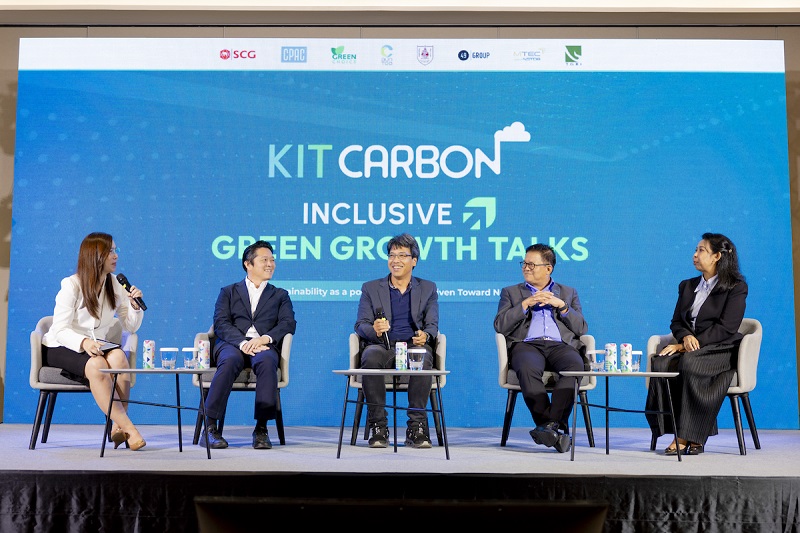
Mr. Surachai Nimlaor, the CEO of SCG Cement and Green Solutions, opened the event by stating that SCG, as a construction material manufacturer, not only delivers Green Products but also utilizes digital technology to ensure that all construction projects for its clients are low-carbon buildings through the KITCARBON platform. This platform helps assess carbon emissions in construction projects before actual construction begins, supported by carbon label data from the Greenhouse Gas Management Organization (TGO), which is crucial for enhancing the completeness of the KITCARBON platform. This will also benefit Thailand's construction industry and align with the country's NET ZERO Roadmap.
The event featured Mr. Rongpetch Boonchuaydee, Deputy Director of the Greenhouse Gas Management Organization (TGO), who shared insights on “Sustainability as a possibility,” discussing the direction of Thai businesses towards sustainable Net Zero goals. He highlighted the mechanisms of Carbon Pricing for reducing greenhouse gas emissions, primarily through Emission Trading Schemes (ETS) and carbon taxes, which are considered the most effective methods to encourage the development of clean technology in the country.
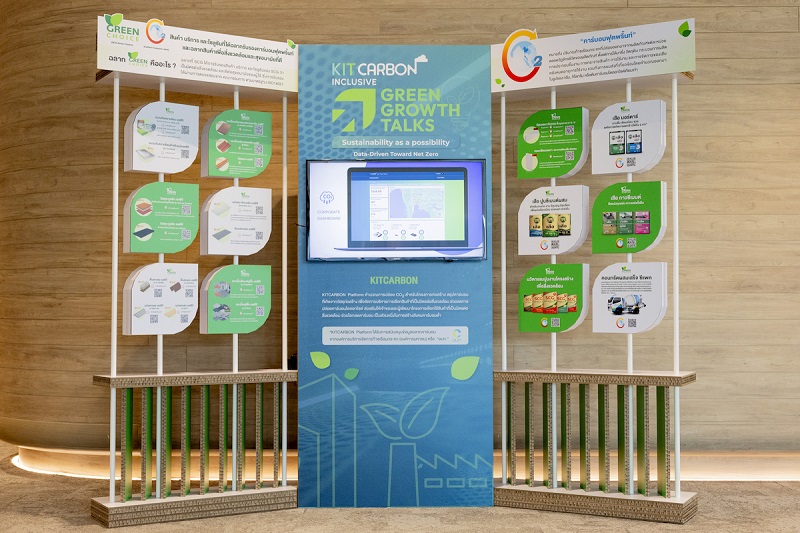
During the panel discussion on “Inclusive Green Growth Talks: Data-Driven Toward Net Zero,” four esteemed experts participated in knowledge exchange.
Mr. Nopporn Keerathibhan, Chief Marketing Officer of Construction Products and Materials Co., Ltd., stated that reducing carbon credits must consider the entire supply chain, which is divided into three parts: 1) Green Process focuses on reducing carbon from the production process, minimizing coal energy use, and shifting to alternative fuels, as well as reducing electricity consumption by using renewable energy in cement production; 2) Green Products aims to develop low-carbon cement generation 2, targeting a 90% sales ratio of low-carbon cement to replace traditional cement this year, and promoting the use of SCG Green Choice products, which currently has 318 items certified with carbon footprint labels, with plans to register an additional 210 items this year; 3) Green Solutions emphasizes developing environmentally friendly construction innovations, such as 3D concrete printing technology that can reduce on-site waste by up to 70%, and the carbon assessment platform KITCARBON, which uses Digital & BIM technology to calculate the Embodied Carbon of projects, providing valuable insights for construction process design and material selection to minimize environmental impact.
Dr. Narongwit Areemit, Executive Director of Architect 49 Co., Ltd. (A49) and Regional Manager of A49 Khon Kaen, as an architect and designer, stated that the company has established a Sustainability department for 20 years. However, to comprehensively address the process today, data-driven initiatives are essential. Therefore, the company has set up a new department called Integrated Research to integrate sustainability, data, and technology. Nevertheless, the most crucial aspect of sustainable design is the mindset, whether it is Build Less to create less and increase green spaces, Build Light to reduce construction waste and use recyclable materials, Build Low Carbon to utilize existing materials without adding wasteful materials, and Build for The Future to focus on reducing Operational Carbon, such as designing to decrease future electricity usage. To achieve maximum carbon reduction efficiency, considerations must begin at the design stage, making tools for calculating Embodied Carbon and Operational Carbon vital for the future.
Dr. Tosaporn Sriaem, Director of the Building Information Modeling Institute of Thailand and Carbon Neutrality Working Group of the Engineering Institute of Thailand stated that the Engineering Institute is responsible for developing Building Information Modeling Standards to align with international standards and disseminating them to various organizations to elevate the construction industry’s readiness for the transition from the Analog to the Digital era. Additionally, the institute has 200,000 engineers and 50,000 architects ready to support organizations in effectively reducing carbon dioxide emissions.
Dr. Nongnuch Poonsawat, Director of the Research Group at the Sustainable Technology and Information Institute (MTEC), stated that currently, everything is moving towards Net Zero, with the global implementation of 18,000 environmental trade measures, increasing by an average of 16% per year, not including the growing demand for carbon labels. Therefore, the institute's role is to support data for both public and private sectors, as well as businesses operating domestically and internationally. However, even with Thailand's own database, businesses often face challenges when registering abroad due to differing databases. Thus, developing databases that align with the context or type of business is essential.
Therefore, moving towards a low-carbon society in the construction industry requires planning from upstream to downstream, starting from mindset, design, material selection, transportation, to construction. The KITCARBON platform serves as a tool that meets the needs and helps operators access construction material data, calculate the Embodied Carbon of each material, reduce overall costs, and lower carbon dioxide emissions.