Deloitte Reveals Small Multinational Companies in Asia-Pacific View Digital Trade Positively, with Technology and Branding as Key Success Factors
- Asia-Pacific trade continues to grow rapidly, accounting for approximately 40% of global trade activity in 2023.
- 71% of small multinational companies view cross-border digital trade positively.
- 88% prioritize and are implementing digital technologies such as big data, AI, and online payment systems to expand their businesses.
- Thailand is heading towards digital transformation by investing in cloud computing, AI, and 5G, attracting global technology companies and driving the digital ecosystem and cross-border e-commerce.
Deloitte has released the latest survey report, revealing that small multinational companies in the Asia-Pacific region are rapidly adapting to a fully digital era by increasingly adopting digital technologies and enhancing investments in branding, while viewing cross-border e-commerce and digital trade positively.
The report “Going-Global: Seizing the Next Great Opportunity in Digital Trade” produced by Deloitte in collaboration with WorldFirst indicates that Asia-Pacific remains a key driver of global economic growth amid various challenges, such as global economic slowdown, geopolitical tensions, and increasing trade protectionism. The import and export of goods in Asia-Pacific account for about 40% of global trade activity, valued at nearly $18 trillion, a 30% increase from $13.7 trillion in 2013. WorldFirst is a comprehensive digital payment and financial service platform for businesses worldwide, especially small and medium-sized enterprises (SMEs) engaged in international trade.
71% of small multinational companies in Asia-Pacific participating in the survey, which operate cross-border e-commerce and digital trade, view the future of cross-border e-commerce positively, indicating that most companies are confident in market demand, government policies, and technological advancements, expecting the market to continue expanding with noticeable increases in sales and profits.
Meanwhile, 88% of surveyed companies stated that branding is crucial for maintaining long-term business growth. Branding not only helps businesses gain a competitive edge in the market but also enhances customer loyalty and market share. Consequently, 68% of all companies indicated they would increase investments in branding.
The report also highlights Thailand's rapid digital transformation, supported by strong infrastructure and investments in cloud computing, AI, and 5G, which drive the digital ecosystem's expansion. These efforts are promoting cross-border e-commerce and encouraging Thai businesses to adopt AI tools and automation technologies to reduce operational costs and address other challenges.
Thailand's digital industry is supported by robust internet infrastructure and significant investment potential. The country is developing a digital environment by expanding PromptPay services to 8 countries and developing QR codes for payments in collaboration with countries like China. Additionally, the Thai government aims to expand the e-commerce sector to exceed 7.1 trillion baht by 2027, with an annual growth rate of 10%. The National E-commerce Development Action Plan Phase 2 (2023-2027) will focus on developing digital skills, data sharing, transaction security, and expanding online trade both domestically and internationally.
Money Expo Bangkok 2024 has demonstrated Thailand's commitment to digital finance development, with over 320 million digital accounts and efforts to enhance financial literacy. These initiatives support financial integration in the region, with Southeast Asia's digital payment market expected to exceed $287 billion this year.
Cross-border businesses are seeking platforms for comprehensive payment and financial services.
The Deloitte-WorldFirst report found that small multinational companies are starting to operate multiple types of businesses in more than one e-commerce market and are establishing businesses abroad. The increasing competition in cross-border e-commerce is part of the reason for this shift, leading cross-border businesses to seek comprehensive payment and financial service providers.
As a result, cross-border payment companies, including WorldFirst, have developed comprehensive platforms that provide payment services, trade financing, and other financial services. Additionally, these companies have integrated pre-production supply chain services and logistics, tax collection, and advertising to support various business scenarios for these merchants.
Clara Shi, CEO of WorldFirst, stated, “We are proud to collaborate with Deloitte to explore the opportunities and challenges that small multinational companies face today. The findings of this report are compiled to support SMEs across Asia-Pacific in better leveraging the high potential of cross-border digital trade.”
Key Research Findings from the Report ‘Going Global: Seizing the Next Great Opportunity in Digital Trade’:
- Big data analytics will lead to the application of digital technologies in small multinational companies. Currently, big data analytics (75%) is the most recognized and widely adopted technology, followed by artificial intelligence (AI) (47%), as these technologies are directly related to improving business efficiency and customer experience. Meanwhile, the use of technology in payments/debt (20%) and risk management (18%) shows that organizations prioritize safety and stability.
- Digital trade in Asia-Pacific is growing significantly. From 2017 to 2022, the annual growth rate of service exports delivered digitally in Asia-Pacific was 10.3%, higher than the global average of 7.1%. Major export markets in this region include China, Japan, Singapore, and Australia, while the European Union (EU) and North America are key external trade partners, accounting for 27% and 20% of Asia-Pacific's export market, respectively.
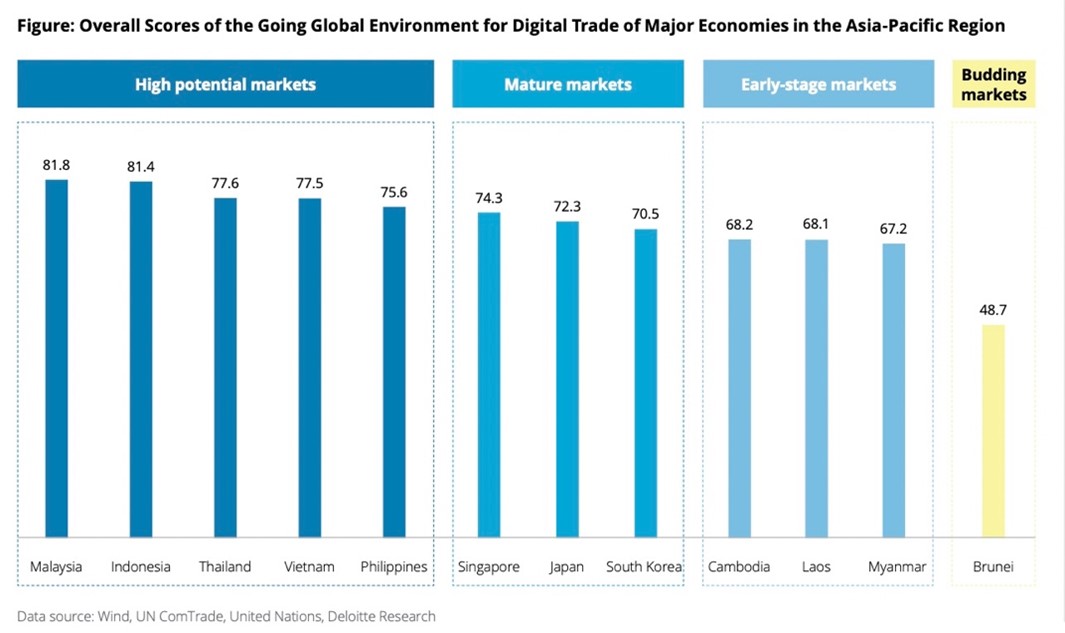
The Deloitte-WorldFirst report developed a new index to assess the digital trade environment and growth trends for each country.
- High-potential markets: Indonesia, Malaysia, Vietnam, Thailand, and the Philippines.
- Mature markets: Singapore, Japan, and South Korea.
- Emerging markets: Cambodia, Myanmar, and Laos.
- Markets beginning to show potential: Brunei.
Deloitte's research surveyed approximately 300 SMEs engaged in cross-border business, generally employing fewer than 500 people and primarily based in East Asia and Southeast Asia.
Cheng Zhong, managing partner of Technology, Media and Telecommunications Industry, Deloitte China, stated, “Digital trade businesses are leveraging cutting-edge digital technologies such as big data analytics, artificial intelligence, the Internet of Things (IoT), and cloud computing to create better business models and value chains, resulting in a more diverse range of products and services in the global market. Furthermore, digital platforms, especially cross-border e-commerce, facilitate seamless real-time collaboration across the global value chain.”
Lydia Chen, Deloitte China Research partner, stated, “Most SMEs are undergoing significant transformations towards cross-border e-commerce by leveraging platform organizations, extensive international service networks, and digital technologies.”