KASIKORN Wisdom Identifies 3 Major Issues for Q4 This Year: Watch European Politics – US Elections - Federal Reserve Interest Rates
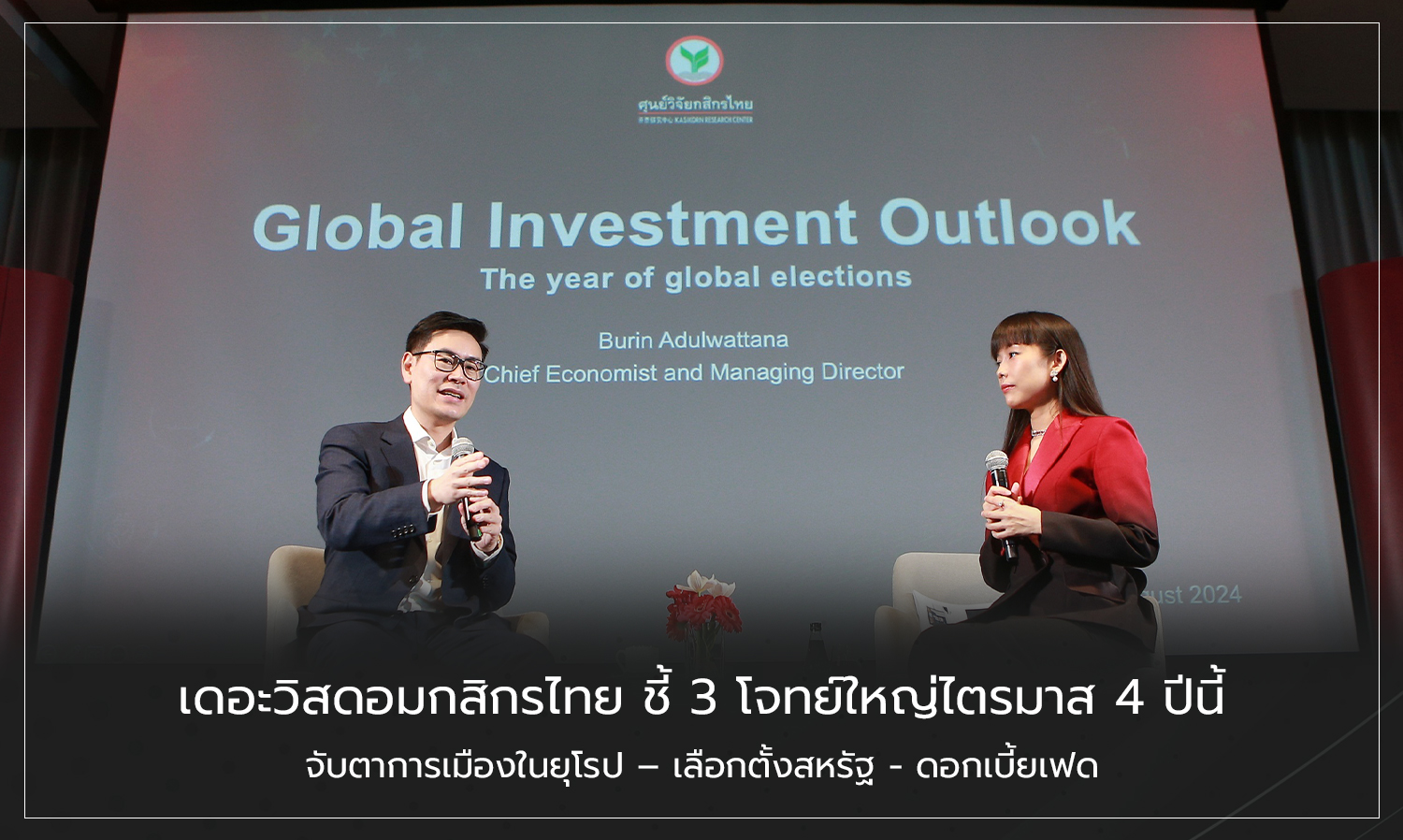
KASIKORN Wisdom held a seminar titled “THE WISDOM Wealth Decoded: Global Elections 2024 - Monitoring Investments and Upcoming Challenges”. Mr. Burin Adulwattana, Managing Director and Chief Economist of KASIKORN Research Center, focused on the elections in major economic countries such as the UK, France, and the United States, as well as monitoring economic and trade policies in preparation for global repercussions. He advised investing in mega-trend stocks including aging society, AI technology, pharmaceuticals, and tourism.
Monitoring Politics in the UK and France: A Turning Point for Economic and Foreign Policies
Mr. Burin stated: The elections in both France and the UK are causing a shift in political dynamics, affecting politics, economics, foreign policy, and fiscal policy, which is trending towards increased government spending to support household living costs.
In the UK, the Labour Party's landslide victory under Sir Keir Starmer marks a political shift from the Conservative Party to a more left-leaning stance. The Labour Party opposes the previous government's proposed cuts to public spending, focusing instead on increasing investment in infrastructure and healthcare, as well as addressing the issues of inadequate and expensive housing.
Meanwhile, France is facing political uncertainty as the results of the second round of elections show the “New Popular Front” (NPF), a leftist coalition, winning first place, while Emmanuel Macron's centrist coalition came in second. Currently, no political party or coalition has a decisive majority in parliament. One of the NPF's key plans is to abolish Macron's pension reform, which proposed raising the retirement age from 62 to 64 and increasing the minimum pension for those who have worked the required period. Amidst this political uncertainty, France is also grappling with high debt levels and a budget deficit, which could impact monetary and fiscal policy.
Monitoring the Policies of US Presidential Candidates: Impact on Global Trade and Investment
The US presidential election in November this year is a focal point for global attention, with the question of who will be the new president of the United States between Kamala Harris and Donald Trump.
Mr. Burin remarked: Trump emphasizes economic policies, immigration at the Mexican border, and reducing support for the security of allied nations. If Trump wins, it could escalate trade wars, strengthen the dollar due to a proposed 10% import tariff on all countries, particularly China, which would face a 60% import tax, potentially weakening the yuan and the Thai baht, while Harris focuses on public health and supports environmental technology.
According to The Economist Intelligence Unit (EIU), if Trump wins, the top five trading partners of the US that would be affected due to trade surpluses with the US include Mexico, China, Canada, Vietnam, and Germany, with Thailand ranked 11th. It is projected that if Trump raises tariffs, it could impact Thailand's GDP by approximately -0.3% over the next two years.
Impact of Federal Reserve Interest Rates: Carry Trade Pressuring Multiple Currencies Worldwide
The Federal Reserve's interest rate hike is the most significant in 23 years. “Many countries are affected by the Fed's rate increase and central banks worldwide, particularly currencies with low interest rates or those that have reduced rates, such as the yuan and yen, which are experiencing depreciation. This creates an interest rate gap known as “Carry Trade,” where investors borrow in low-interest currencies to invest in higher-yielding assets, hoping to profit from the interest rate differential, especially with the yen.
Due to Japan's very low interest rates for many years, investors tend to borrow to invest in other assets, such as using yen to buy dollars yielding 5% or Mexican pesos yielding 10%. If a significant amount of Carry Trade occurs, it could pressure the yen to weaken against a strengthening dollar, impacting the Thai baht and several other currencies worldwide.
Investment Recommendations in Mega-Trend Stocks to Strengthen Long-Term Portfolios
-
Aging Society (Silver Economy): The number of elderly individuals is continuously increasing across continents, while birth rates are declining, making the healthcare business a future growth sector.
<\/li> -
AI Technology: Currently, investment in AI accounts for 3% of total technology investments, projected to rise to 11% by 2032. It is recommended to invest in upstream businesses such as semiconductors.
<\/li> -
Pharmaceuticals: The development of more effective cancer treatments, obesity medications, and weight loss solutions is driving increased popularity in this investment sector.
<\/li> -
Tourism: Global travel is increasing, but spending is decreasing as people focus on experiential travel rather than shopping, leading to reduced per capita spending among tourists. Conversely, industries such as aviation and machinery are benefiting from this trend.
<\/li> <\/ol>K-FIXEDPLUS (K Fixed Plus Fund for General Investors) - This fund invests in government and private debt securities and deposits both domestically and internationally, with no limit on foreign investment ratios, while hedging against exchange rate risks for at least 90% of the value of foreign investments.
K-GINFRA-A(D) (K Global Infrastructure Equity Fund-A Dividend Paying) - This fund invests in the Morgan Stanley Investment Funds Global Infrastructure, Class Z (core fund), which invests at least 70% of its assets in stocks and REITs related to global infrastructure.
K-HIT-A(A) (K Global High Impact Thematic Equity Fund-A Accumulating Value) - This fund invests in global equities, focusing on creating a diversified investment portfolio through thematic investment strategies, industry sectors, and stocks, with the core fund investing at least 70% of its assets in equities and a maximum of 30% in non-core investments.
KGHRMF (K Global Healthcare Equity Fund) - This fund invests at least 67% of its assets in companies engaged in healthcare worldwide.
*Investors should understand the product characteristics, return conditions, and risks before making investment decisions.