The Wisdom of Kasikorn Thai: In-Depth Look at 4 Modern Estate Tax Management Strategies to Enhance Investment and Sustain Wealth Transfer
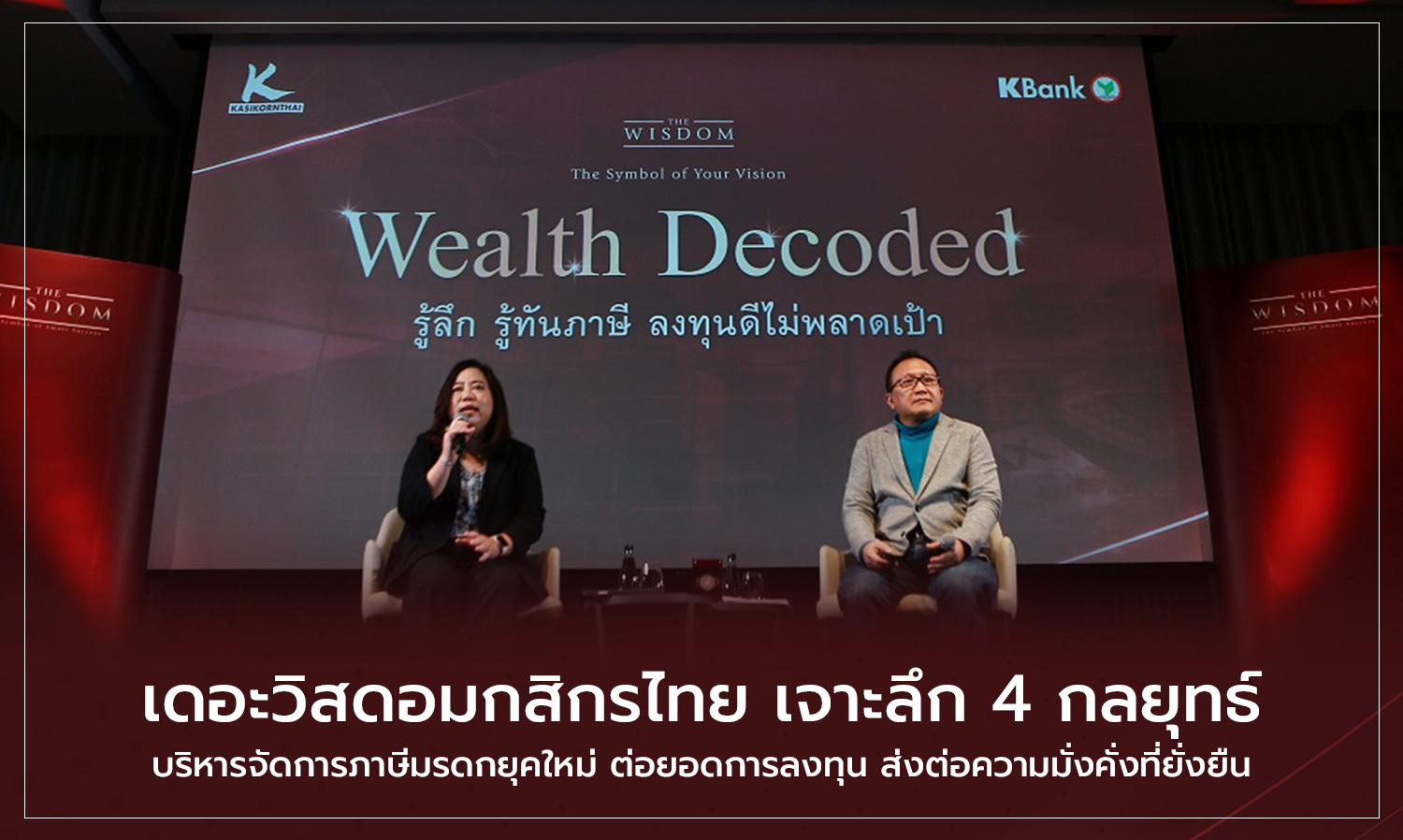
The Wisdom of Kasikorn Thai held the 4th seminar ‘THE WISDOM Wealth Decoded’ focusing on modern tax management strategies. The session featured Professor Chinapat Visutthiphat, Partner at One Law Office, an expert in asset management and tax planning, alongside Ms. Umapan Charoenying, Deputy Managing Director of Muang Thai Life Assurance Public Company Limited, who shared insights on managing estate taxes and wealth transfer, which have become increasingly complex due to changes in regulations, requirements, and laws both domestically and internationally. They delved into 4 ‘Exit Strategy’ approaches for managing estate taxes and planning for inheritance: 1) Holding Companies 2) Life Insurance 3) Wills 4) Family Constitutions, aimed at maximizing the benefits of wealth transfer for future generations.
Addressing International Financial Account Information Exchange Agreements - CRS for Cross-Border Tax Compliance
Professor Chinapat stated that Thailand has signed a cooperation agreement with the Organisation for Economic Co-Operation and Development (OECD) to prevent cross-border tax evasion, establishing an international framework for automatic financial account information exchange known as the Common Reporting Standard (CRS) with partner countries under international agreements.
Tax authorities in over 150 member countries will send financial information about Thai tax residents to their respective partner countries. Simultaneously, Thai individuals investing abroad will have their financial information automatically sent back to Thailand by the tax authorities of those countries. For instance, individuals or entities with “tax residency in Thailand” that invest or establish companies abroad without repatriating income may be affected and need to plan their taxes accordingly. Singapore, for example, has laws promoting the establishment of Singapore Variable Capital Companies (VCC), designed for wealth management businesses, which must comply with CRS requirements for reporting foreign investor financial information to Singapore's tax authorities and exchanging data among various countries' tax agencies.
4 ‘Exit Strategy’ Approaches for Secure Estate Tax Planning and Wealth Transfer
Professor Chinapat advised that estate tax planning is a crucial part of financial planning and asset succession. Property owners and heirs can plan to effectively utilize tax benefits, categorizing inherited assets into 4 types: 1) Real estate, land, buildings 2) Stocks or securities, including digital assets 3) Bank deposits 4) Registered vehicles. Several asset types are exempt from estate tax, such as life insurance payouts, gold bars, banknotes, jewelry, and collectibles like paintings and watches.
Estate tax management and wealth transfer can be achieved through 4 methods, which can be combined with financial products to meet the needs and maximize benefits for beneficiaries. Method 1 is Establishing a Holding Company, a popular structure for family businesses, where a company is set up to hold shares in subsidiaries or assets, primarily generating income through dividends from shares in other companies rather than operating its own business. This can involve investments in both domestic and foreign companies, with income in the form of dividends, which are exempt from corporate income tax since this income has already been taxed at the subsidiary level, avoiding double taxation.
Ms. Umapan continued discussing wealth transfer, stating that Method 2 is Life Insurance, another tool for estate planning and crucial for risk management, designating beneficiaries in the policy as heirs to receive the final assets. The death benefit from life insurance is tax-exempt. Additionally, beneficiaries receive funds quickly upon the policyholder's death, as insurance proceeds are not included in the estate, allowing for immediate distribution without waiting for estate settlement.
One aspect often overlooked by business owners is using life insurance in business planning by insuring key executives. The insurance premiums can be deducted as business expenses for corporate income tax calculations, reducing business risk in unforeseen events.
Recommendations for using life insurance for tax management can be done in 4 ways:
1) Transferring taxable excess assets involves converting the taxable portion into a life insurance policy while investing the non-taxable portion elsewhere, utilizing maximum tax deductions. For example, if one has assets worth 200 million baht, they can claim a 5% tax deduction for 100 million baht of estate and use the other 100 million baht to purchase a life insurance policy with a coverage amount of 100 million baht, effectively transferring 100 million baht in inheritance to the beneficiary since the insurance payout is not considered part of the estate and thus not subject to estate tax.
2. Using life insurance to fund future estate taxes, particularly suitable for those with substantial land holdings.
3) Equal inheritance distribution means creating an inheritance for heirs who do not receive business interests by using insurance to compensate those who receive smaller shares or have no ownership rights.
4) Creating a large inheritance with minimal investment involves using insurance to provide equal inheritances for each child by paying relatively low premiums while retaining significant funds for personal use.
Method 3 is Creating a Will to allocate existing assets before death to desired individuals, which is crucial and must be clearly articulated to prevent future disputes. Wills are subject to estate tax, and under Thai inheritance law, there are 5 types of wills: 1) Ordinary Will 2) Holographic Will 3) Notarized Will 4) Secret Will 5) Oral Will (though not practically applicable due to lack of witnesses). Wills can be made for any “individual,” whether statutory heirs or testamentary heirs, and can be adjusted as circumstances change.
Method 4 is Family Constitution, which should answer the questions of purpose and beneficiaries, as it governs the assets of the family business. It is a family document that establishes clear principles, rules, and regulations for family members. While a family constitution is not legally binding, it must “link” to the law and “relate” to taxes to be practically applicable, defining concrete management processes to reduce family conflicts and ensure stable growth for the family business.
All 4 strategies serve as Exit Plans for effective estate and estate tax management, maximizing benefits from inception to conclusion, ensuring sustainable wealth transfer to future generations.
For insurance products that assist in estate planning as described above, The Wisdom of Kasikorn Thai recommends the Premier Legacy Life Insurance, which facilitates seamless wealth transfer across generations, ensuring that you can effectively provide family security to loved ones while enhancing wealth and alleviating concerns about potential estate taxes. This product addresses inheritance transfer needs well, with coverage starting from 10 million baht and going up to 500 million baht. Additionally, it offers the following advantages:
· High life coverage from the first day the policy is approved, lasting until age 99.
· Flexible premium payment options allowing choices for single payment, 5 years, 10 years, or payments until age 99.
· Ensures family security according to your intentions.
· Efficient tax management as death benefits are not considered part of the estate and carry no tax burden.
· Premiums are tax-deductible up to 100,000 baht as per the regulations set by the Revenue Department.
Planning for wealth transfer to children or loved ones is a personal matter that should be addressed to ensure that, in our absence, those we care about can continue to benefit from what we have built or utilize the assets we intend to leave for them.
Disclaimer
- Buyers should understand the details of coverage and conditions before deciding to purchase insurance.
- In cases where the policy does not specify a beneficiary or if the beneficiary dies before or simultaneously with the insured, the benefits under the policy will be included in the insured's estate.