Deloitte Reveals Consumer Survey Results on the Future of Automotive Industry for 2024: Thai Perspectives Shift, Intensifying Competition
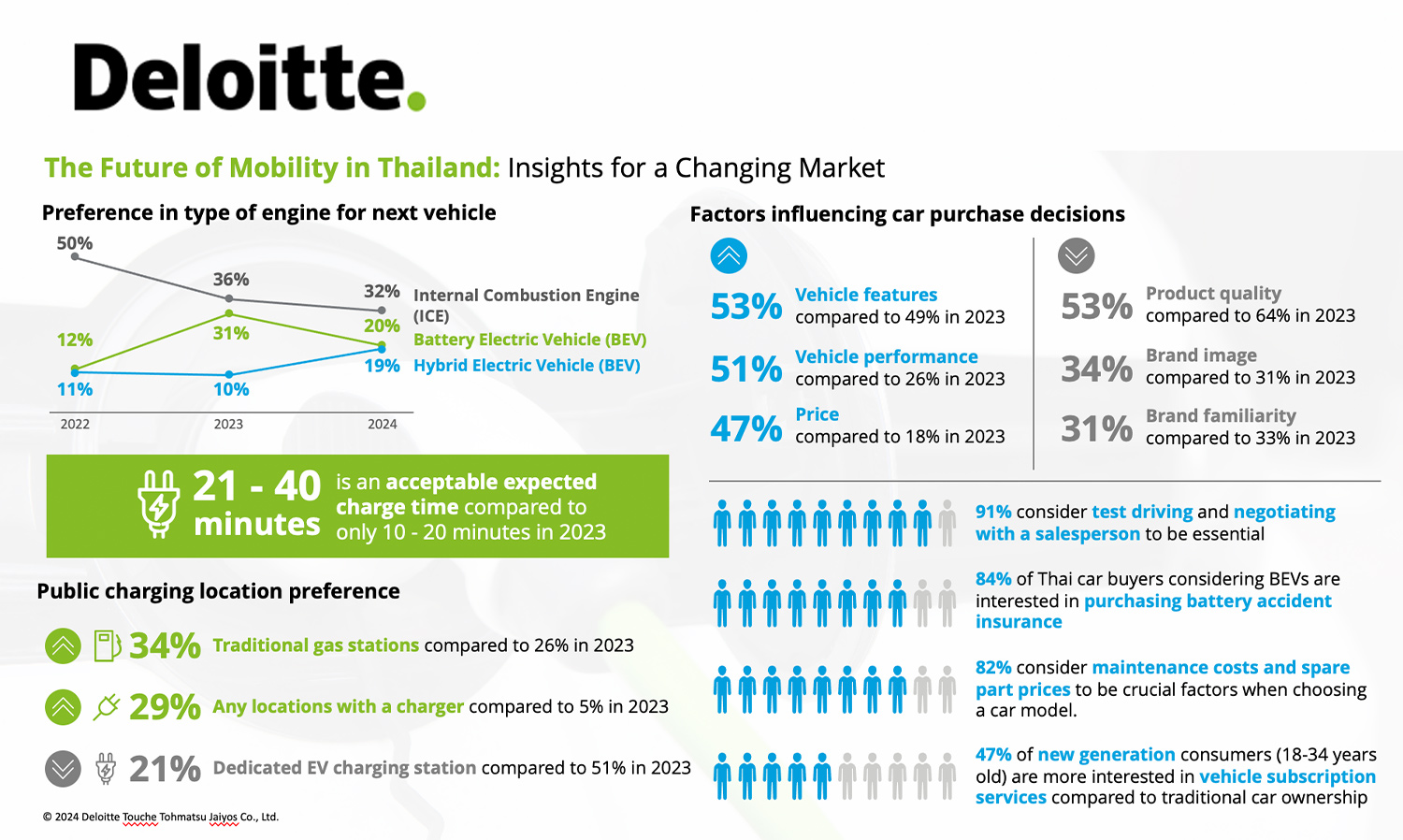
- The popularity of Battery Electric Vehicles (BEV) among Thais has decreased from last year, dropping from 31% to just 20%. Internal Combustion Engine (ICE) vehicles remain the top choice but are also on a downward trend, while Hybrid Electric Vehicles (HEV) have gained popularity, rising to 19%, nearly matching BEV.
- Product quality remains the most significant factor influencing purchasing decisions at 53%. Factors that consumers are increasingly prioritizing include vehicle features, performance, and price, at 53%, 51%, and 47%, respectively.
- The primary reason Thais choose BEV is to save on fuel costs, with 73% citing this reason, which is the same for HEV/PHEV (Plug-in Hybrid Electric Vehicle) at 73%. In contrast, the main reason for choosing ICE is to alleviate concerns about range and charging, at 78%.
Deloitte Thailand has released the results of the 2024 Global Automotive Consumer Study, which surveyed over 27,000 consumers from 26 countries worldwide between September and October 2023. The survey gathered insights on key issues impacting the automotive sector, including 5,939 consumers from Southeast Asia, with approximately 1,000 from Thailand. This analysis was complemented by the Thailand Automotive Consumer Survey 2024, conducted by Deloitte Thailand in April 2024, involving another 330 Thai consumers, highlighting two interesting perspectives:

Trends and Consumer Perspectives on Electric Vehicles
The 2024 survey indicates that the popularity of Battery Electric Vehicles (BEV) among Thais has decreased from 31% last year to just 20%. Internal Combustion Engine (ICE) vehicles remain the top choice but are on a downward trend, dropping from 36% to 32%. Meanwhile, Hybrid Electric Vehicles (HEV) have surged in popularity, rising from 10% in 2023 to 19%, nearly matching BEV. The trend in Thai preferences for ICE aligns with Indonesia, the Philippines, and China, but contrasts with the United States, Japan, and Singapore, where ICE popularity has increased. In the Thai used car market, ICE remains the top choice at 54%, followed by hybrids and PHEVs at 38%, with BEV trailing at 9%.
When analyzing the reasons for choosing BEV, 73% of Thais cite the desire to save on fuel costs, 71% are concerned about environmental impacts, and 49% are worried about their health and that of their families, as well as maintenance costs. For those choosing HEV/PHEV, 73% want to save on fuel, 68% wish to alleviate range anxiety, and 37% aim to reduce dust, smoke, and greenhouse gas emissions. Among ICE users, 78% want to eliminate concerns about range and charging, 67% are worried about unexpected costs (e.g., battery or related systems), and 52% seek flexibility in maintenance and customization.
The survey reveals that Thais are becoming more receptive to BEV, with concerns about BEV decreasing across all dimensions from 2023 to 2024. The highest concern remains the insufficient number of public charging stations, which dropped from 48% to 46%. Concerns about driving range decreased from 44% in 2023 to 39%. The survey found that Thais are now more willing to accept longer charging times, with the most acceptable duration shifting to around 21-40 minutes, increasing from 25% in 2023 to 38%.
Home charging remains the most desired option in Southeast Asia, with significant changes in preferences for charging outside the home. The popularity of charging at gas stations increased from 26% last year to 34% this year. Interestingly, the preference for charging anywhere rose from 5% to 29%, while charging at dedicated BEV stations decreased from 51% to just 21%. The expected driving range per charge has slightly increased, with 44% of respondents in 2024 believing that the range should be between 300 and 499 kilometers.
Factors Influencing Thai Consumers' Vehicle Purchases
Factors influencing the decision to purchase the next vehicle have also changed. The importance of price has increased from 18% in 2023 to 47%. Performance has risen from 26% to 51%, and vehicle features have increased from 49% to 53%. Product quality remains the top decision factor in 2024 but has decreased from 64% to 53%. Familiarity with brands has dropped from 33% to 31%, and brand image has decreased from 37% to 34%. The survey found that 64% of Thai respondents are interested in trying new brands, ranking high in the region, on par with Malaysia but behind Vietnam and the Philippines, citing reasons such as the desire for new technology (52%), wanting to try something new (49%), and looking for affordable vehicles (36%).
Regarding the vehicle purchasing experience, despite the availability of modern technologies like VR or AR for selecting various features and the convenience of online financial transactions, 92% of Thais still prefer to physically experience the vehicle before making a decision, with 91% wanting to test drive. This preference is equal to negotiating details with sales staff. Additionally, 74% of Thais prefer to pay through installment plans, 21% wish to buy with cash, and 5% prefer balloon payments. However, younger Thais (aged 18-34) show a 47% interest in subscription services (Vehicle Subscriptions) over vehicle ownership. Furthermore, 82% of Thai respondents indicated that maintenance costs and spare parts prices significantly influence their vehicle model choices, with 63% willing to purchase a comprehensive maintenance package covering oil changes, consumables, and service fees, and 84% willing to buy accident insurance for batteries when using BEV.
"Collecting data from consumers worldwide allows us to gain new perspectives both globally and regionally, leading to integrated solutions that open new avenues for enhancing value in the automotive industry. In 2024, hybrid electric vehicles (HEV) are gaining significant popularity among Thai consumers due to fuel savings, reduced range anxiety, and lower emissions. This exemplifies the importance of understanding consumer needs in each region, enabling automotive manufacturers to adapt to changing customer demands and effectively adjust their sales strategies," said Mr. Song Jin Lee, Automotive Sector Leader, Deloitte Southeast Asia.
Mr. Mongkol Somphol, Automotive Sector Leader at Deloitte Thailand, commented, "Understanding consumer perspectives allows us to better see the direction of industry adaptation, which will also connect to related businesses such as charging stations, financing, communication, or related technologies that must adapt simultaneously. Manufacturers that can offer value-driven options and assure customers regarding long-term excess costs will gain trust, becoming a competitive advantage in the long run. Consumers will benefit from fierce competition, having a wider array of choices than ever before, including the vehicles themselves, products, and other related services in the automotive industry."
Dr. Chodak Panyawaranant, Manager of Clients & Market at Deloitte Thailand, added, "We are witnessing rapid changes in the automotive market in Thailand. Analysis of trends and data collection from various Deloitte reports confirm that Thais are no longer thinking the same way, leading to increasingly intense competition."
###
Research Methodology
2024 Global Automotive Consumer Study explores key issues impacting the automotive sector, surveying over 27,000 consumers across 26 regions worldwide, including 5,939 respondents from Southeast Asia, with 1,000 participants from Thailand. This survey was conducted between September and October 2023.
Thailand Automotive Consumer Survey 2024 surveyed 330 Thai consumers in April 2024, focusing specifically on the automotive behaviors of Thai consumers.
Both reports were conducted online, inviting consumers of driving age to participate in the survey via email.