Home Prices Rise Amidst Rising Costs, Demand Remains Weak
DDproperty, Thailand's leading real estate platform, reveals that the overall real estate market continues to grow slowly due to various challenges affecting consumers' financial status. These include the economic situation, high household debt, elevated interest rates, and inflation driven by external geopolitical and global economic factors. As a result, nationwide purchasing demand decreased by 7% in the latest quarter, affecting all types of housing. Meanwhile, the national housing price index rose slightly by 1% due to increased construction costs, reflecting that the purchasing power of real demand buyers has not yet recovered, leading them to postpone their buying or relocation plans. Consequently, the overall rental demand nationwide dropped by 10%, with the rental index for high-rise properties increasing by 5% and for low-rise properties by 4%.
It is anticipated that measures to reduce transfer fees and mortgage fees for residential properties priced below 7 million baht will help improve absorption rates for larger housing groups in Bangkok. If economic stimulus measures to enhance purchasing power are introduced, they will further fuel significant growth in the real estate sector in the second half of the year.
According to the latest report from DDproperty Thailand Property Market Report Q1 2024, which analyzes data from property listings on the DDproperty website between January and March 2024, the national housing price index increased by 1% from the previous quarter (QoQ) and by 5% from the same period last year (YoY). This increase is primarily driven by ongoing rising costs, including construction material prices, wage increases, current land prices, and fuel price volatility, forcing property developers to raise prices.
When considering housing types, the price index for condominiums and single-detached houses increased equally in the last quarter, with condominiums rising by 1% QoQ (up 9% YoY) and single-detached houses by 1% QoQ (up 3% YoY), indicating positive signs for the growth of the real estate market this year. Townhouses remained stable compared to the previous quarter and the previous year.
However, amid financial challenges, especially for low- to middle-income consumers who have been affected since the COVID-19 pandemic, the sluggish economic situation has led consumers to delay their home purchasing plans. This is evident from the overall purchasing demand nationwide, which decreased by 7% QoQ and 31% YoY, continuing to decline since Q1 2023 across all housing types.
Condominiums remain the most abundant housing type in the market, accounting for 59% of all housing nationwide, followed by single-detached houses at 25% and townhouses at 17%. Additionally, properties priced between 1-3 million baht dominate the market, making up 30% of all housing nationwide, reflecting that middle- to lower-income consumers still lack sufficient purchasing power to absorb this supply. Following this are properties priced between 5-10 million baht (22%) and those over 15 million baht (19%) in similar proportions.
Rental Prices Continue to Rise for Both High-Rise and Low-Rise Properties
The overall rental market for housing nationwide continues to grow in terms of price, with the rental index for high-rise properties like condominiums and apartments increasing by 5% QoQ and 22% YoY, while the rental index for low-rise properties like single-detached houses and townhouses rose by 4% QoQ and 28% YoY. However, this is contrary to the nationwide rental demand, which decreased by 10% QoQ (down 25% YoY).
Despite the decline in rental demand from the previous quarter, it represents a slowdown from the significant drop seen in the past (in Q4 2023, there was a 27% decrease from the previous quarter), indicating a slight recovery in rental demand, aligning with the Generation Rent trend that favors renting over buying and offers better financial solutions.
Condominiums account for a high rental share of 87% of all rental housing nationwide, followed by single-detached houses at 9% and townhouses at 4%. The overall rental housing market in the 10,000-30,000 baht/month range dominates with a share of 41%, reflecting a price range that is accessible and meets the needs of most consumers.
When categorized by housing type, condominiums and townhouses in the 10,000-30,000 baht/month rental range are the most prevalent (43% and 39%, respectively), contrasting with single-detached houses, which are predominantly in the rental range of over 100,000 baht/month (41%).

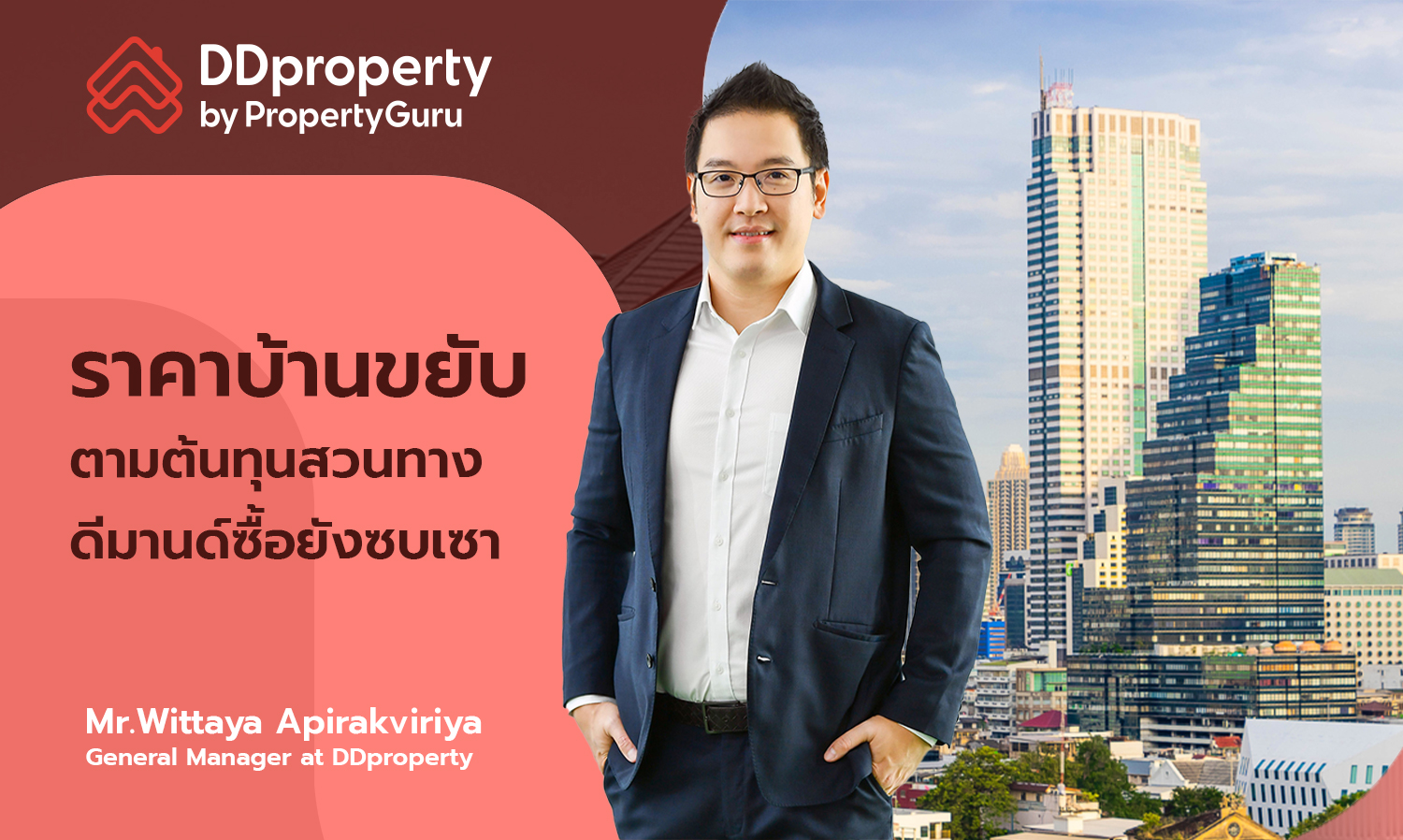
Mr. Witthaya Apirakviriya, General Manager of Think of Living and DDproperty (Developer Side) stated, "The Thai economy is growing, supported by the recovery of the tourism sector and government economic stimulus policies, all of which are positive factors that could drive the real estate market to grow this year.
It is predicted that property prices and purchasing demand will trend upward in the second half of 2024, with government economic stimulus measures through the real estate sector facilitating financially ready consumers to make housing purchases more easily, increasing opportunities for homeownership during this period of sluggishness in the Thai real estate market.
However, the real estate market still faces numerous challenges, such as persistently high interest rates, the highest in a decade, which keeps the financial cost of purchasing housing high compared to consumers' purchasing power. Data from the National Credit Bureau indicates that by the end of 2023, non-performing loans (NPL) from housing loans reached 180 billion baht, with overdue housing loans of 30-90 days increasing by 31% YoY to 178 billion baht, mostly for homes valued at no more than 3 million baht. Additionally, the strict lending criteria of banks at this time require buyers to be more financially prepared.
Moreover, real demand consumers may still postpone their housing purchase plans to monitor the policy interest rate adjustments from the Monetary Policy Committee (MPC), which will meet again in June 2024, as well as closely observe economic growth trends to mitigate the risk of increasing debt burdens beyond their capacity.
At the same time, as home/condo prices continue to rise, the resale market or second-hand homes, which have lower original costs, may become another option for consumers who need to purchase housing at this time," Mr. Witthaya concluded.
Currently, the situation in the real estate market presents challenges to watch closely: as purchasing demand for housing declines while prices continue to rise, if the gap between the purchasing demand index and the price index continues to widen, at some point, if the purchasing demand index does not show signs of recovery, the price index will likely need to adjust downward according to market mechanisms to attract consumers back to make housing purchases and drive overall market growth across all price levels in the future.
Monitoring the Capital's Real Estate Market: Bangkok Residents Reluctant to Buy Homes, Driving Up Rental Prices Across All Types
The DDproperty Thailand Property Market Report Q1 2024 provides in-depth insights into the real estate market in Bangkok in the latest quarter, summarizing the overall price index, rental index, as well as purchasing and rental demand for housing, along with updates on promising locations that show interesting growth potential.
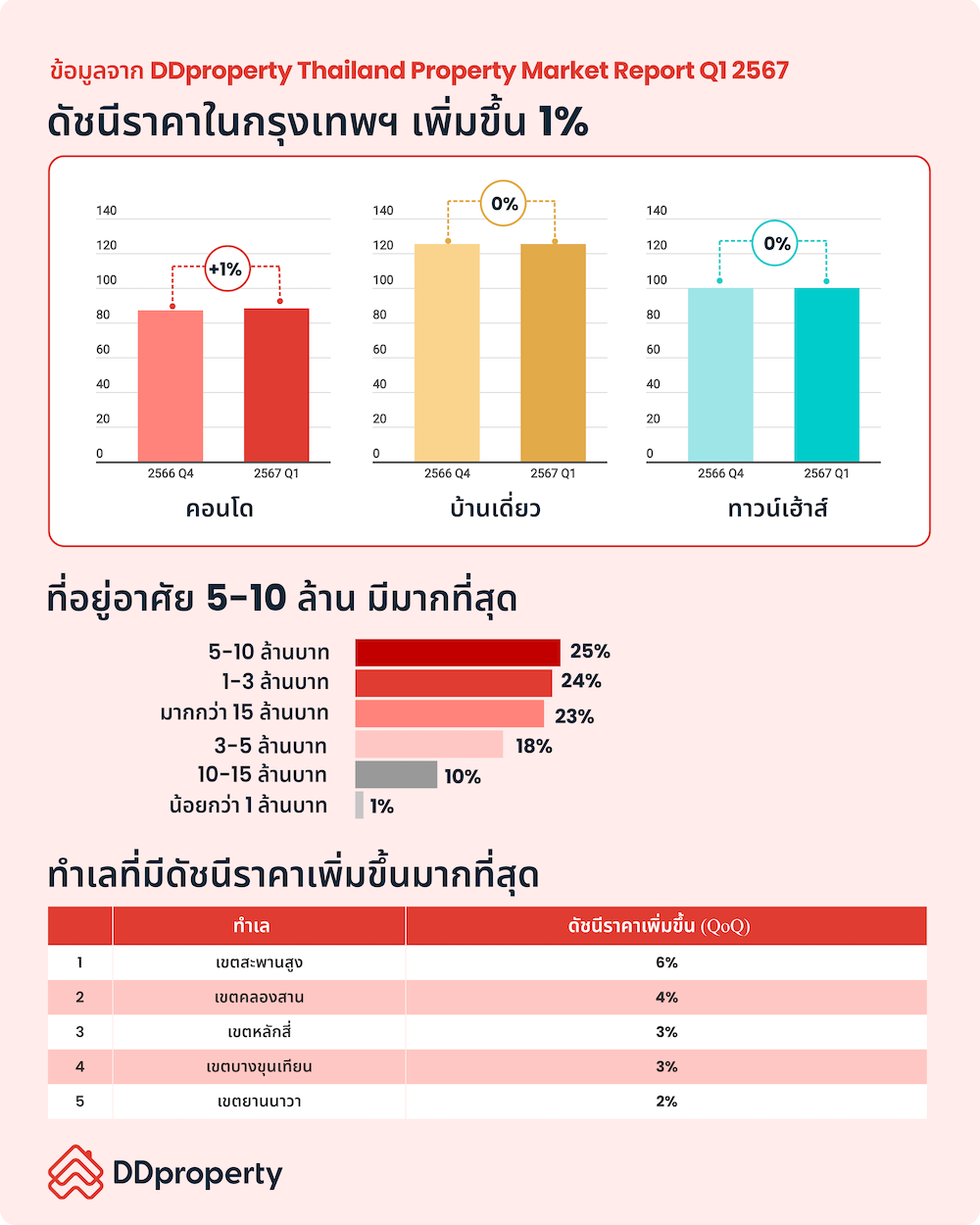
Condominium prices are starting to rise, while buyer demand has decreased by 8%. The overall housing prices in Bangkok have been on an upward trend since Q2 2023, with the housing price index in Bangkok increasing by 1% QoQ and 8% YoY. Condominiums are the only property type that saw a price index increase in the last quarter, rising by 1% and 11% YoY. Meanwhile, the price index for low-rise housing, such as single-detached houses and townhouses, remained stable from the previous quarter but increased by 8% and 3% YoY, respectively.
At the same time, purchasing demand in Bangkok has continuously decreased since Q2 2022, with overall purchasing demand down 8% QoQ (down 31% YoY). When categorized by property type, townhouses experienced the most significant drop in demand, down 13% QoQ (down 38% YoY), followed by single-detached houses down 8% QoQ (down 37% YoY), and condominiums down 6% QoQ (down 26% YoY), reflecting the ongoing sluggish purchasing power in the capital.
Additionally, after property developers began launching more low-rise projects and consumers with low-rise products in hand started selling in line with living trends during the pandemic, the decrease in purchasing demand has led to an increase in available low-rise products for sale, with single-detached houses up 7% QoQ and townhouses up 8% QoQ. However, it is anticipated that measures to reduce transfer fees and mortgage fees for residential properties priced below 7 million baht will help improve absorption rates for larger housing groups in Bangkok.
Condominiums still dominate the market, accounting for 80% of all housing in Bangkok, while single-detached houses and townhouses have similar proportions at 11% and 9%, respectively. The most prevalent housing price range is between 5-10 million baht, making up 25%, followed by 1-3 million baht (24%) and over 15 million baht (23%). When categorized by housing type, most condominiums in the 5-10 million baht range have the highest proportion at 26%, while single-detached houses priced over 15 million baht have the highest proportion at 44%, and townhouses priced between 1-3 million baht have the highest proportion at 39%.
However, while the overall housing price index in Bangkok has not seen explosive growth, there are still many locations where the price index has increased significantly. The top five locations with the highest price index increases in Bangkok in the latest quarter are:
- 1st: Saphan Sung District, with an average price of 39,000 baht/sqm, up 6% QoQ and 11% YoY.
- 2nd: Khlong San District, with an average price of 143,000 baht/sqm, up 4% QoQ and 7% YoY.
- 3rd: Lak Si District, with an average price of 54,000 baht/sqm, up 3% QoQ and 12% YoY.
- 4th: Bang Khun Thian District, with an average price of 29,000 baht/sqm, up 3% QoQ and 2% YoY.
- 5th: Yan Nawa District, with an average price of 91,000 baht/sqm, up 2% QoQ and 3% YoY.
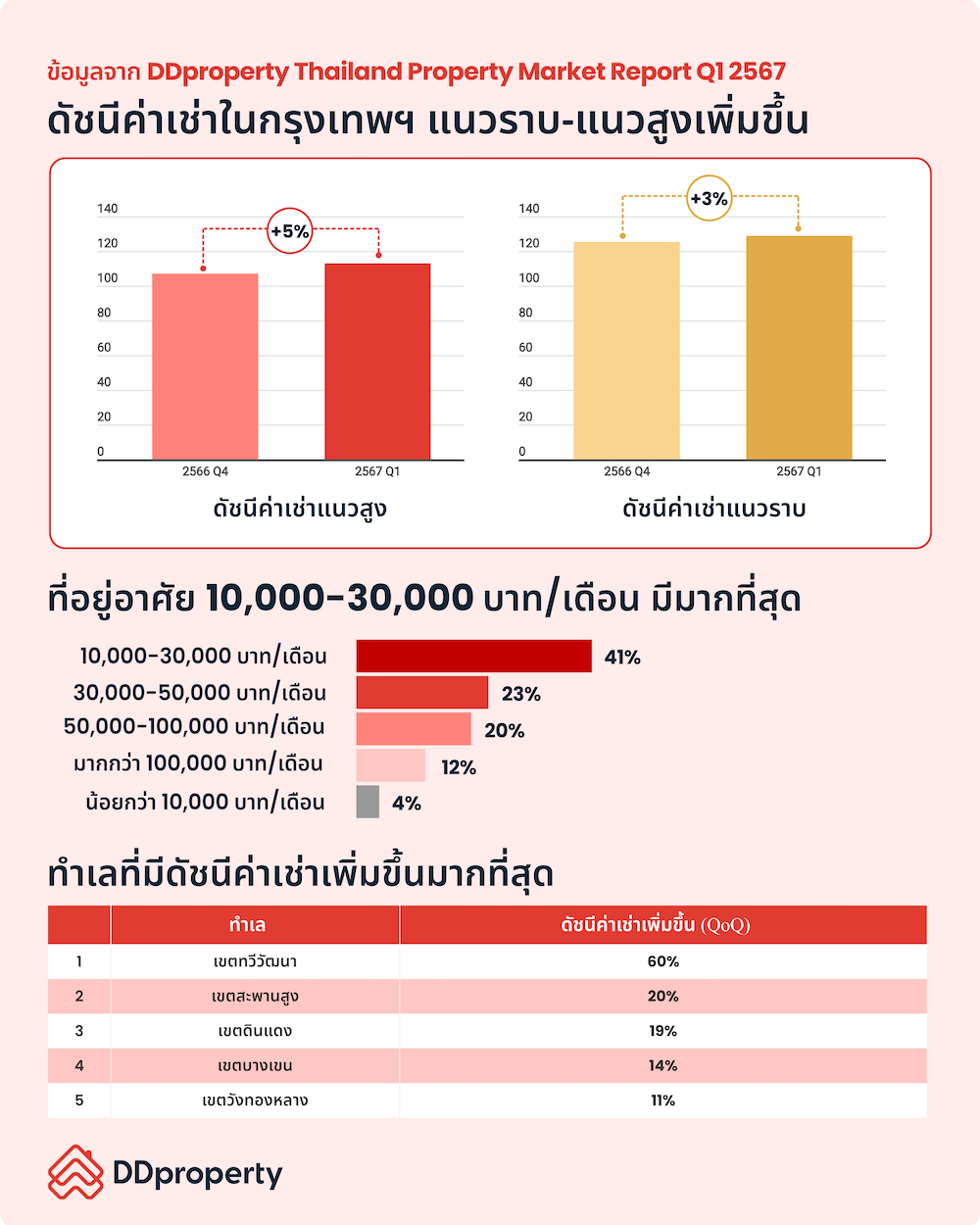
Rental Prices Continue to Rise, Condominiums Dominate the Rental Market with a 92% Share The rental market in Bangkok continues to grow interestingly, as evidenced by the rental index in Bangkok, which has consistently increased across all types. Rental prices for high-rise properties like condominiums and apartments increased by 5% QoQ and 22% YoY, while rental prices for low-rise properties like single-detached houses and townhouses rose by 3% QoQ and 18% YoY, reflecting a trend of price growth. However, overall rental demand for housing in Bangkok remains sluggish, similar to the national trend, decreasing by 4% QoQ (down 24% YoY).
At the same time, condominiums account for the largest share of the rental market at 92% of all rental housing in Bangkok, making them the housing type that best meets urban living needs. Single-detached houses account for 5%, and townhouses account for 3%.
Moreover, it was found that most rental housing is in the 10,000-30,000 baht/month range, accounting for the highest share at 41%. When categorized by property type, condominiums in the 10,000-30,000 baht/month rental range are the most prevalent at 43%, while townhouses in the same rental range and those between 50,000-100,000 baht/month each hold a 30% market share. Single-detached houses are mostly found in the rental range of over 100,000 baht/month, with a share of 56%.
For locations with the highest rental index increases in Bangkok in the latest quarter, most are in the outskirts of Bangkok and areas outside the central business district, including:
- 1st: Taling Chan District, with an average rent of 207 baht/sqm/month, up 60% QoQ and 40% YoY.
- 2nd: Saphan Sung District, with an average rent of 458 baht/sqm/month, up 20% QoQ but down 10% YoY.
- 3rd: Din Daeng District, with an average rent of 137 baht/sqm/month, up 19% QoQ and 29% YoY.
- 4th: Bang Khen District, with an average rent of 131 baht/sqm/month, up 14% QoQ and 21% YoY.
- 5th: Wang Thonglang District, with an average rent of 103 baht/sqm/month, up 11% QoQ and 15% YoY.
Note: The DDproperty Thailand Property Market Report is a quarterly report on housing market trends, compiled using data from property listings on the DDproperty website, calculated using statistical methods, analyzed, and presented as indices reflecting price movements, the number of properties available in the market, and demand for housing during that period. This report includes the price index and demand index from both the buying-selling and rental markets, showing the trends of the housing market in Thailand, particularly in Bangkok and its vicinity over the quarter. Since Q1 2022, the price and demand indices in this report have used Q1 2018 as the base year.
Read and study the latest real estate market trend information in the report DDproperty Thailand Property Market Report Q1 2024.