Trends in Gold Demand: Thailand's Consumer Gold Demand in 2023 Grows Strongest in ASEAN
The Gold Demand Trends report from the World Gold Council indicates that in 2023, Thailand experienced the highest growth in consumer gold demand in the ASEAN region, increasing by 9% compared to the previous year, from 38.4 tons in 2022 to 42.1 tons in 2023. This growth is attributed to the rising demand for gold bars and coins, which outweighed the decline in demand for gold jewelry.
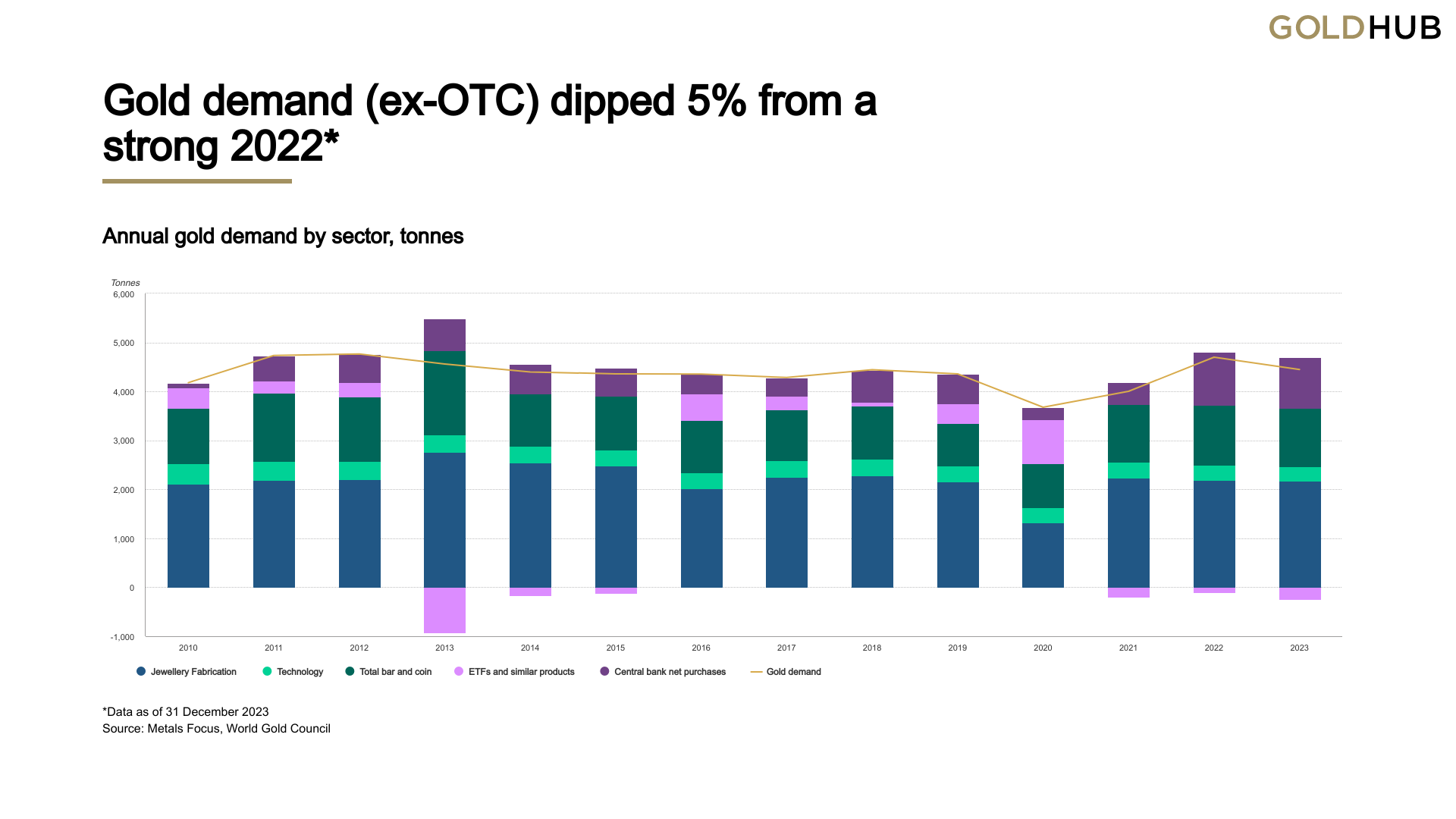
The report also revealed that global gold demand, excluding over-the-counter (OTC) trading, totaled 4,448 tons in 2023, a slight decrease of 5% from 2022, which was a particularly strong growth year. When considering demand from OTC markets and other sources, the overall demand for 2023 reached a record high of 4,899 tons. Investments from these unidentified sources of gold demand supported the average gold price throughout 2023, which soared to a historic peak.
Central banks worldwide continued to purchase gold at high levels, with demand reaching 1,037 tons last year, making it the second-highest annual total on record, down only 45 tons from the previous year.
In contrast to the strong demand in OTC trading and from central banks, outflows from gold exchange-traded funds (ETFs) continued in 2023, decreasing by 244 tons, marking the third consecutive year of decline, with outflows in Europe influencing the overall picture.
Regarding gold bars and coins for investment, global demand fell by 3%, although strength in some regional markets helped offset declines in others. Conversely, Thailand saw the strongest growth in ASEAN in 2023, being the only country in the region to experience positive growth last year. Demand for gold bars and coins in Thailand increased by 13%, from 29 tons in 2022 to 32.9 tons in 2023. However, demand remains low compared to pre-COVID levels, which averaged 63 tons per year from 2015 to 2019.
Shaokai Fan, Head of the Asia Pacific region (excluding China) and Head of Global Central Banks at the World Gold Council, stated, "The continuous depreciation of the Thai baht in 2023 supported gold demand in Thailand, especially amid a fragile economic situation. However, the decline in demand compared to the past may be due to the rising popularity of online gold investment platforms, leading to more short-term trading and a reduction in long-term 'buy and hold' investments."
In other ASEAN countries, including Vietnam, Malaysia, Indonesia, and Singapore, demand for gold bars and coins decreased by 2%, 4%, 5%, and 8%, respectively, compared to the previous year. Similarly, demand from Europe continued to decline, dropping by 59% year-on-year. This decline was offset by a strong recovery from China post-COVID, which increased by 28% to 280 tons, supported by significant growth from India (185 tons), Turkey (160 tons), and the United States (113 tons).
The global gold jewelry market saw an increase in demand of 3 tons compared to the same period last year, demonstrating strong market resilience despite record-high gold prices. China played a significant role, with jewelry demand rising by 17% following a recovery from COVID-19 lockdowns, which helped offset a 9% decline in India.
In Thailand, jewelry gold demand showed recovery in the fourth quarter of last year (from 2.5 tons in Q3 2023 to 3.0 tons in Q4 2023), but was not enough to achieve positive growth for the entire year, with total demand down 2% to 9 tons, despite a rapid increase in October and November due to falling gold prices.
Shaokai further explained, "In the fourth quarter, rising agricultural prices in Thailand stimulated demand from rural areas, which had previously been lower than in urban areas throughout the year. However, the volume of recycled gold in Thailand's jewelry market increased in 2023 as high gold prices prompted the release of held gold."
Gold production from mines remained relatively stable in 2023, increasing by 1%, while recycling volumes rose by 9%, which was below expectations due to high gold prices, leading to an overall supply increase of 3%.
Louise Street, Senior Market Analyst at the World Gold Council, commented, "The steady demand from central banks has once again supported gold demand this year, compensating for weakness in other market sectors, keeping gold demand in 2023 above the 10-year moving average. Besides monetary policy, geopolitical uncertainty often serves as a significant driver of gold demand, and in 2024, we expect this to have a clear impact on the market. Ongoing conflicts, trade tensions, and over 60 upcoming elections worldwide are likely to encourage investors to turn to gold, which has proven to be a safe asset."
Louise added, "We know that central banks often cite gold investment during crises as a reason for buying, indicating that demand from this sector will remain high this year and may help offset reduced consumer demand due to higher gold prices and slowing economic growth."
For more details, you can read the Gold Demand Trends Q4 and FY 2023 report, which includes detailed information from Metals Focus here.
[1] This figure includes demand in the OTC market (for which data is insufficient for reference) along with changes in inventory in the commodities trading market and unidentified changes in production inventory and statistical residuals, which differ from the total demand and supply volume of gold..
[2] The average gold price in 2023 was $1,940.54 per ounce, a new record, up 8% from 2022.