Homebuyers Need to Know! Urban Planning: A Relevant Issue When Considering Buying a Home in Today's Era
The Bangkok Metropolitan Administration, through the Bureau of Urban Planning and Development, has been implementing the Bangkok Comprehensive Urban Planning Project (4th Revision) from 2017 to 2019 to create an urban plan that aligns with changing circumstances, environments, and urban development. The current urban plan has been in use since 2013, and it is expected that the new draft will be announced for use by 2025. Recently, the Bangkok Metropolitan Administration has extended the deadline for stakeholders to submit comments on the new comprehensive urban plan draft until February 29, 2024, resulting in increased awareness among both consumers and businesses to study and understand the details to protect their interests.
Clarifying Doubts: What Are the Benefits of Each Color in the Urban Plan?
The new draft of the Bangkok comprehensive urban plan considers all dimensions to support urban expansion and utilize the routes of both existing and under-construction railways, leading to more development in suburban areas. This will benefit both consumers and businesses in the future. DDproperty (DDproperty) the number one real estate marketplace website in Thailand, invites you to understand the colors of the urban plan and the purposes of land use, so consumers can be informed about the benefits they receive when the urban plan changes. According to the ministerial regulations regarding the comprehensive urban plan of Bangkok, land is categorized based on its use and activities as follows:
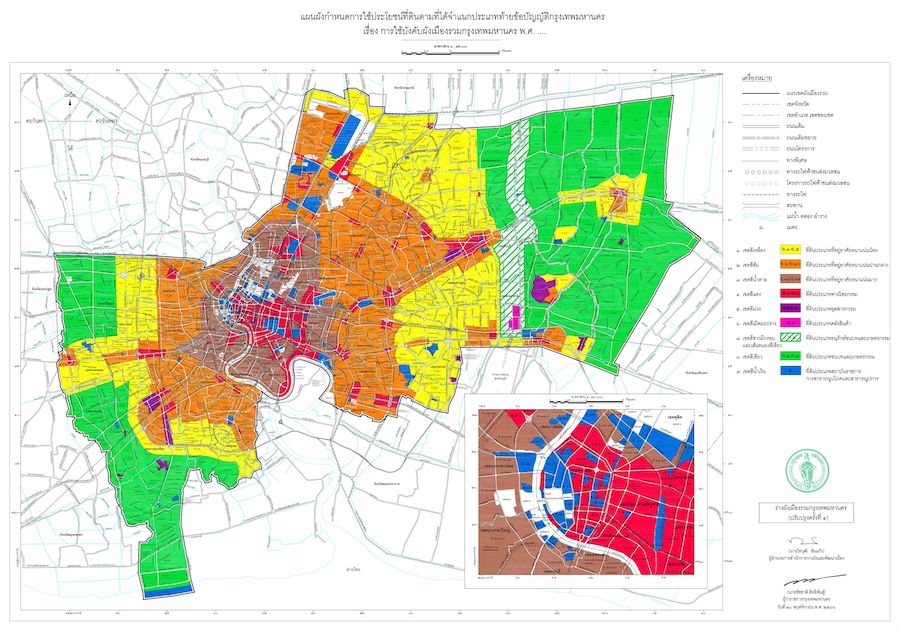
1. Residential Land is primarily intended for residential use, divided into three shades based on the density of residence in the area, with each shade further subdivided under specific codes, as detailed below:
- Yellow Zone: Low-density residential land located in suburban areas, coded Y.1-Y.4, aimed at promoting a good living environment for residential construction.
- Land codes Y.1 and Y.3 have similar purposes of promoting and maintaining a good living environment, but Y.1 land can only be developed for single-family homes, while small to medium-sized condominiums can be built starting from Y.3 land.
- Land code Y.2 focuses on accommodating residential expansion in suburban areas, allowing for townhouse construction starting from Y.2 land.
- Land code Y.4 emphasizes suburban areas within the service area of the mass transit system.
- Orange Zone: Medium-density residential land found in areas adjacent to the inner city, coded Y.5-Y.7, allowing for all types of residential construction. If a condominium exceeds 10,000 square meters, it must be located on a road with a right-of-way of at least 30 meters or within 500 meters of a mass transit station.
- Land code Y.5 focuses on accommodating residential expansion in areas adjacent to the inner city.
- Land code Y.6 is concerned with suburban community areas, industrial zones, and industrial estates.
- Land code Y.7 is designated for residential use specifically in areas adjacent to the inner city within the mass transit service area.
- Brown Zone: High-density residential land or inner-city areas, coded Y.8-Y.10, allowing for all types of residential construction. Due to the high value of this land, it is often used for developing vertical housing projects like condominiums in the city center.
- Land code Y.8 emphasizes maintaining the landscape and natural environment.
- Land code Y.9 focuses on the inner city and is within the mass transit service area.
- Land code Y.10 is in the inner city, adjacent to the commercial center, and also within the mass transit service area.
2. Commercial Land is represented by red, primarily for commercial purposes, coded P.1-P.5, categorized based on location characteristics.
- Land codes P.1 and P.2 are located in suburban areas, intended for community commercial centers, distributing trade activities, business centers, services, and recreation, facilitating daily life for residents in the area.
- Land code P.3 is intended for commercial use targeting the general public, not limited to local residents.
- Land code P.4 aims to be a business, trade, service, and recreation center, including tourism, as it is located within the mass transit service area, making it easily accessible.
- Land code P.5 focuses on being a regional business, trade, service, recreation, and tourism center in Southeast Asia. This red land can also accommodate residential development with fewer restrictions than other colors.
3. Industrial Land is represented by purple, intended for industrial activities, coded I.1-I.3. This type of land can accommodate residential development, such as single-family homes, dormitories, or small condominiums, and can also have shops, but cannot have high-rise buildings or large condominiums.
- Land code I.1 is for low-pollution industries.
- Land code I.2 focuses on manufacturing industries.
- Land I.3 is designated as orange for use as a warehouse area for transportation in Southeast Asia.
4. Conservation Land for Rural and Agricultural Use (G.1-G.3) and land for rural and agricultural use (G.4-G.5) in the urban plan are represented by white frames and green diagonal lines, with codes G.1-G.3 or shown as green areas with codes G.4 and G.5, emphasizing land use for conserving natural resources in rural areas and agricultural sources, promoting aquaculture, and supporting agricultural economies. Additionally, it serves as a buffer between Bangkok and the provinces and plays a role in water retention for Bangkok.
5. Land for Promoting Thai Identity and Culture in the urban plan is represented by light brown, with codes S.1 and S.2, typically found in inner Bangkok, clustered around the Rattanakosin Island area. The purpose of this land use is to conserve and promote the identity and culture of the nation, including commercial and tourism activities.
6. Land for Government Institutions, Utilities, and Public Services is represented by blue, with code S. This type of land is state-owned, used for government institutions or state operations related to utilities and public services, or for public benefit, such as land for educational institutions, temples, and religious sites. Blue land is distributed throughout all districts of Bangkok, and some areas not utilized by the state are leased to private entities for various operations, resulting in shopping malls, offices, or condominiums being located on blue land as well.
Why the New Urban Plan is Important When Buying a Home
At first glance, many may think that urban planning is a distant issue and not pay much attention to it. However, urban planning is more relevant than one might think. In addition to laying the foundation for urban development and distributing prosperity, it directly impacts consumers planning to purchase real estate, as well as those planning to build homes on their own land. DDproperty (DDproperty) reveals the importance of the Bangkok comprehensive urban plan for choosing a residence, providing guidance for consumers to plan their home or condominium purchases in locations that meet long-term living needs.
- Avoid Living Near Factories to Alleviate Concerns: Although industrial land (purple urban plan) can accommodate residences, it must be considered alongside the Factory Act, which prohibits factories from being established in residential subdivisions, residential condominiums, and row houses, while also setting distance regulations from factories to public places. However, it can be observed that there are still factories mixed within community areas in many locations today, as some factories were established before the urban plan was created, or due to changes in the new urban plan that have led to urban expansion closer to factories, allowing those factories to continue utilizing the land. If it contradicts the urban planning policy, the urban planning committee can order the factory to make improvements within a specified time or suspend operations, or relocate to another area with compensation.
Therefore, consumers should investigate whether the location they wish to buy a home or condominium is on industrial land or has previously been industrial land that has been reclassified as residential and commercial. There may still be existing factories that were established before the housing project or condominium was built. It is advisable to avoid choosing residences in these areas to reduce the risk of impacts from chemical leaks or various accidents that may occur in the future. This is the best preventive measure and creates comfort both physically and mentally in the long term.
- Prevent Purchasing Homes in Areas at Risk of Expropriation: The government's development planning primarily focuses on transportation routes, whether new roads, expressways, or railways, leading to the announcement of several land expropriation zones to prepare for the construction of various public utility projects. The announcement of expropriation zones serves as a guideline only and does not mean that all areas within that zone will be expropriated. Citizens can check their land title numbers with two relevant agencies: the Mass Rapid Transit Authority of Thailand and the Expressway Authority of Thailand for further confirmation.
It cannot be denied that this issue causes significant concern for landowners and residents, as historically, land expropriation has compensated based on the government's or the Treasury Department's assessed value, which is often lower than the actual market price. If only part of the land is expropriated, it may cause the remaining land's value to drop. Therefore, consumers should thoroughly check the details of the urban plan to see if the residential project they are interested in is within the expropriation zone. However, the Bangkok Metropolitan Administration recently clarified that the new urban plan does not include expropriation of existing structures to build new roads, but rather maintains distance from existing roads according to established regulations since the 2013 urban plan to ensure new constructions have setbacks and reduce congestion on various side streets.
- Floodway Water Plan - Areas at Risk of Flooding: The new urban plan has created a water plan aimed at developing the drainage system to prevent and solve flooding and drought issues in Bangkok, which benefits consumers planning to buy residences by avoiding flooding problems during the rainy season. They can check from the urban plan whether the residential project is in a drainage area or canal that may be affected by flooding or which locations have previously experienced flooding issues.
The water plan will detail the locations of pumping stations, sluice gates, drainage improvement projects, canal expansion projects, canal excavation projects, drainage tunnels, flood protection embankments, and floodwater retention areas, indicating areas at risk of flooding over the past 10, 25, and 100 years. Additionally, the Bangkok Metropolitan Administration plans to expand the size of canals from the current 14-15 meters to 30-40 meters to enhance water retention capacity in the future and comprehensively address flooding issues.
- Railway Metropolitan System Promotes Development: TOD (Transit Oriented Development) is the concept of developing areas around train stations and public transport stations within an 800 meter radius. This global concept integrates urban development with transportation infrastructure development, focusing on maximizing land use benefits to create quality communities around stations, promoting public transport use, emphasizing non-motorized travel, and creating pedestrian and bicycle-friendly cities. This not only alleviates pollution issues but also improves the quality of life for the population.
Although Thailand currently lacks clear TOD urban development like other countries, there are positive signs from the comprehensive urban planning of Bangkok (4th revision) that has increased land use in many areas according to the development of new railway projects to support economic expansion in those locations. The Bureau of Urban Planning and Development has studied and planned to develop potential areas around public transport stations beyond the new urban plan study to align with the government's upcoming rail system development plans. The development of cities under the TOD concept requires cooperation from various sectors, including government, private, and public participation, as well as legal amendments to help realize this concept, which is expected to become clearer in the future.
- Red Urban Plan Meets the Needs of Homebuyers Near Development: Consumers looking to purchase residences for relaxation in quiet areas and who dislike chaos may not find it suitable to buy properties in commercial land (red urban plan) as this zone supports the development of business, trade, service, recreation, and tourism centers. Thus, in the future, residential projects in this area may be surrounded by shopping malls, restaurants, and bustling bars, which will cater to consumers wanting to live in well-facilitated locations.
At the same time, if one owns land or residences in areas where the urban plan color has changed to red, it can be beneficial if development promotes it as a business center in the future. However, not all land in the red zone will benefit or have opportunities for buyouts by investors, as there are still building control laws that set building setbacks measured from the center of public roads to control condominium construction. Only certain plots of land adjacent to major roads will gain more business benefits.
Additionally, the new urban plan has increased the FAR Bonus (Floor Area Ratio Bonus) or measures to incentivize the private sector to participate in urban development by creating projects beneficial to the public under conditions set by the Bangkok Metropolitan Administration, in exchange for the right to construct additional building space as legally permitted. Previously, the FAR Bonus had only 5 conditions, which have now increased to 10 conditions to encourage operators, real estate developers, or landowners to participate in higher-quality urban development. They will be able to build taller buildings if they allocate land for public use, such as for pedestrian bridges, transformer stations, motorcycle taxi stands, or expanding sidewalk areas to address narrow sidewalk issues. The private sector will still retain ownership of that land, and the general public will benefit as well.
However, the recent meetings to gather public opinions and consultations regarding the new urban plan draft have generated significant criticism, both from citizens affected by land being in expropriation zones or losing development rights, while the reclassification of commercial land (red) remains concentrated in the city center, failing to distribute prosperity to outer areas, raising questions about whether it benefits investors. If the private sector has already bought land and then requests a change in the urban plan color to gain more benefits, the construction of high-rise buildings will inevitably change the ecosystem and impact neighboring communities.
Additionally, it is necessary to monitor the progress of discussions by Governor Chatchart Sitthiphan with the government to push for an increase in land and building tax rates for agricultural land categorized by the urban plan in the red, brown, purple, and orange zones to address agricultural issues in these urban plans, which is a way to avoid paying higher land taxes, even though the Ministry of Finance has previously rejected this idea.
The creation of this new urban plan draft is a significant agenda that will help develop Thailand's capital to grow to its full potential and sustainably in all dimensions, requiring cooperation from all sectors to provide feedback to build the city together. Consumers, in particular, should study, understand, and participate to protect their housing rights for themselves and their families. The number one real estate marketplace website in Thailand, DDproperty (www.ddproperty.com), has compiled news and articles related to the real estate sector in the “Real Estate Guide”, a comprehensive knowledge repository offering useful content for consumers planning to buy/sell/rent residences and invest, to help everyone confidently embark on their real estate journey and prepare before deciding on the most suitable residence.
For more details, visit PropertyGuruGroup.com; PropertyGuru Group on LinkedIn.
1 Data reference from SimilarWeb during April - September 2023.
2 Data reference from Google Analytics during April - September 2023.
3 Data from July - September 2023.
4 Data from April - September 2023.