Fiscal Policy Office (FPO) Weekly Economic Report as of March 4, 2022
Fiscal Policy Office (FPO) Weekly Economic Report as of March 4, 2022 is as follows:
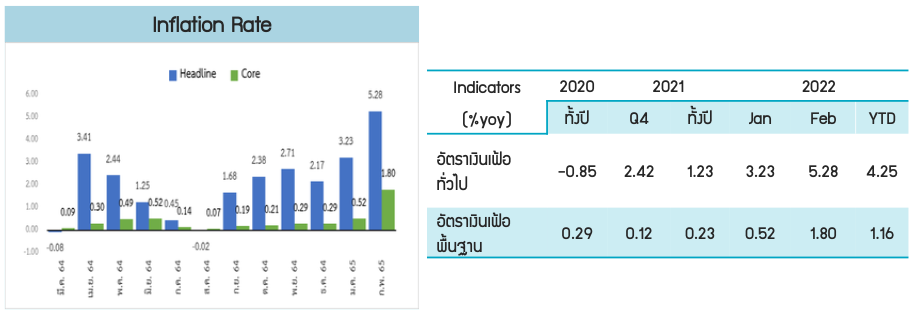
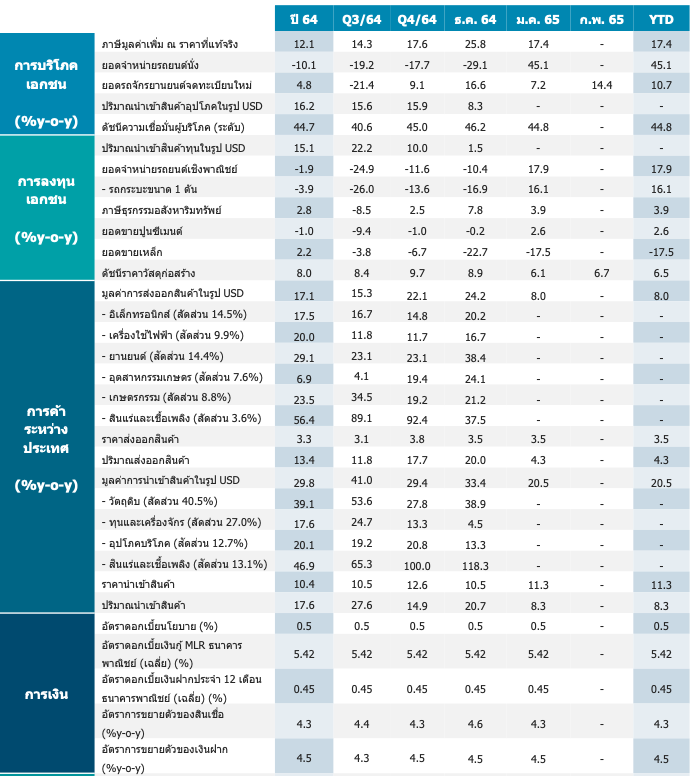
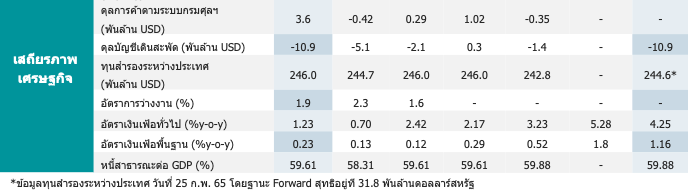
1. The inflation rate in February 2022 grew by 5.28% year-on-year, while the core inflation rate grew by 1.80% year-on-year.
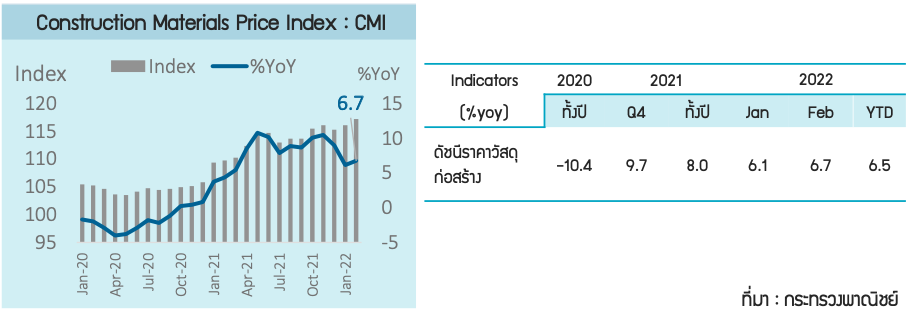
2. The construction materials price index in February 2022 increased by 6.7% compared to the same period last year.
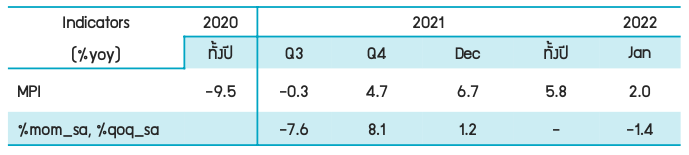
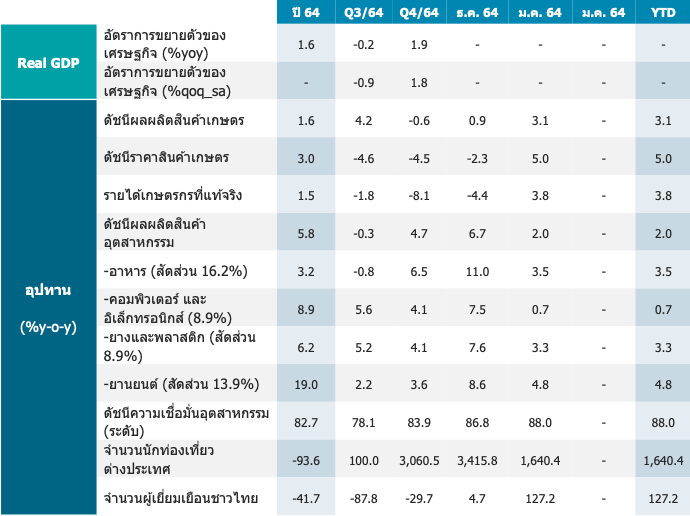
3. The Manufacturing Production Index (MPI) in January 2022 grew by 2.0% year-on-year.
4. The domestic sales volume of steel and steel products in January 2022 contracted by -17.5% year-on-year.
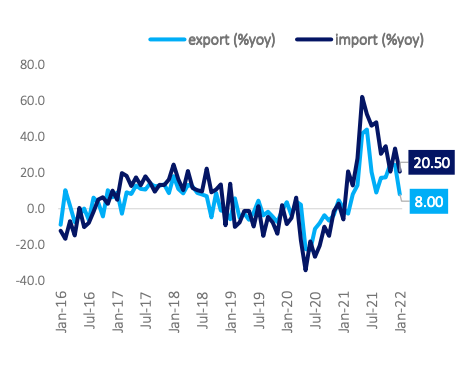
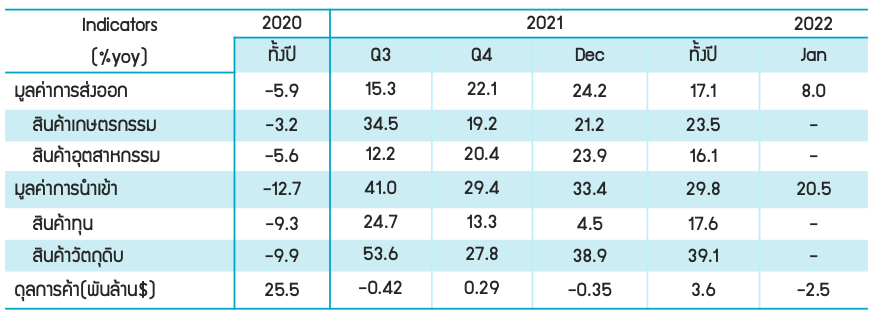
5. The export value in January 2022 grew by 8.0% compared to the same period last year, while the import value grew by 20.5% year-on-year.
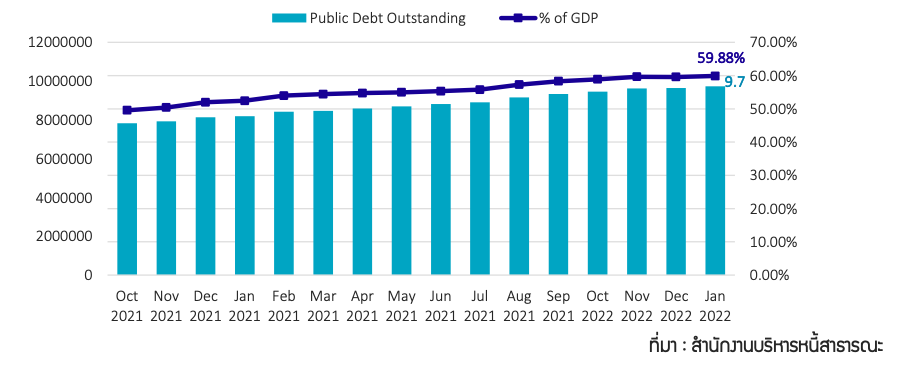
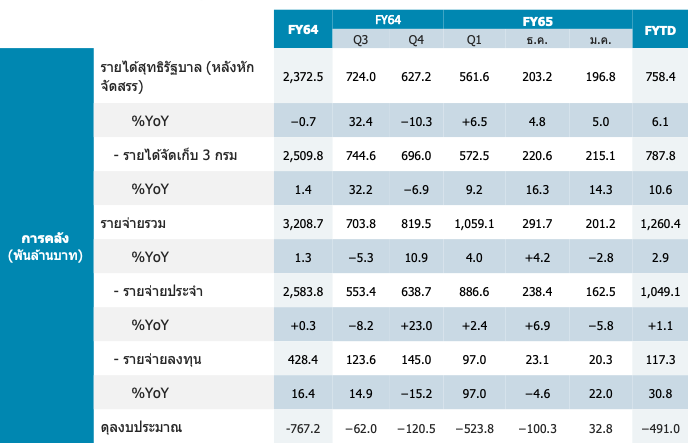
6. The public debt outstanding at the end of January 2022 was 59.88% of GDP.
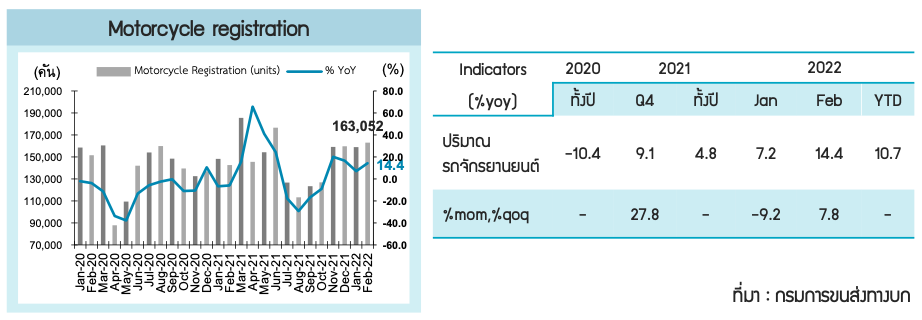
7. The number of newly registered motorcycles in February 2022 grew by 14.4% compared to the same period last year.
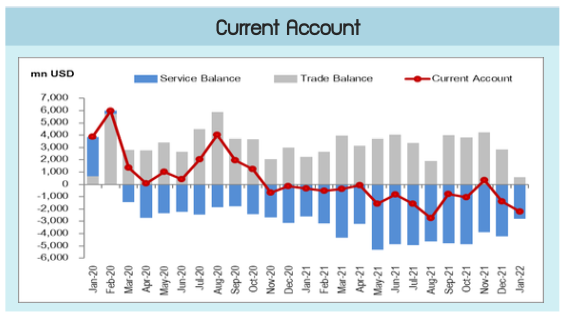
8. The current account balance in January 2022 recorded a deficit of -2,204.4 million USD.
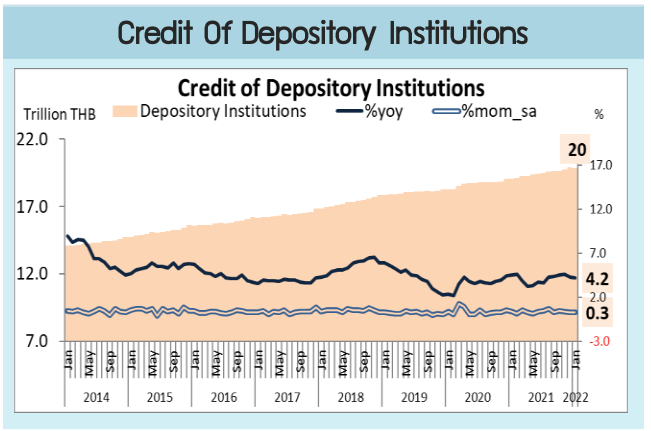
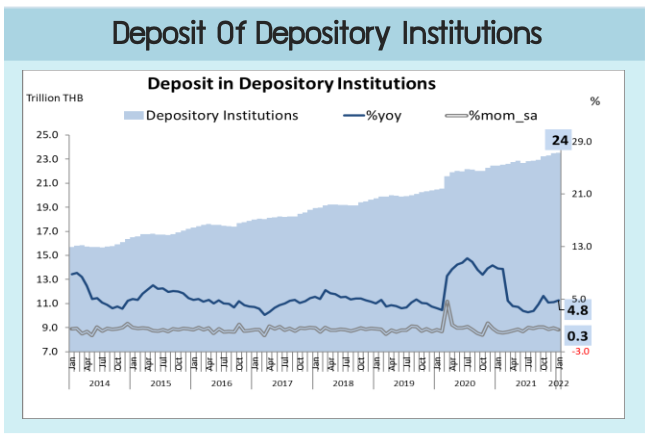
9. Loans in financial institutions in January 2022 grew by 4.2% year-on-year, while deposits in financial institutions grew by 4.8% year-on-year.
10. Australia's GDP in Q4 2021 grew by 4.2% year-on-year.
11. South Korea's GDP in Q4 2021 grew by 4.2% year-on-year.
12. India's GDP in Q4 2021 grew by 5.4% year-on-year.
Thai Economic Indicators
The inflation rate in February 2022 grew by 5.28% year-on-year.
This was primarily due to rising prices in the energy sector, including electricity and fuel prices, which have been continuously increasing in the global market. Additionally, food prices, especially for home-cooked and restaurant meals, such as instant dishes, takeout, and boxed meals, have increased in almost all areas due to rising raw material costs. Although the prices of pork and fresh vegetables remain high compared to last year, they have decreased significantly from the previous month. However, some key items have seen price reductions, including jasmine rice, sticky rice, and clothing. Meanwhile, prices of other goods and services mostly remained stable and moved in line with production volumes and consumer demand. Excluding fresh food and energy, core inflation grew by 1.80%.
Source: Ministry of Commerce
The construction materials price index in February 2022 grew by 6.7% compared to the same period last year.
The construction materials price index in February 2022 has increased for 17 consecutive months, primarily due to rising raw material costs, including oil, coal, and steel. This has led to growth in all categories of the index, particularly in steel and steel products, which grew by 14.1% year-on-year (continuing for 17 months). This trend indicates that construction costs for contractors are likely to remain high, potentially leading to delays in investment in some projects. In the near future, construction material prices are expected to remain high in line with global oil prices due to the ongoing conflict between Russia and Ukraine.
Financial Sector Indicators
The current account balance in January 2022 recorded a deficit of -2,204.4 million USD, an increase from the previous month's deficit of -1,378.0 million USD.
The trade balance (BOP system) significantly decreased from the previous month to a surplus of 596.3 million USD, while the service, income, and transfer balance recorded a deficit of -2,800.7 million USD.
Loans in financial institutions in January 2022 totaled 19.8 trillion THB, representing a growth of 4.2% year-on-year.
This reflects a stable growth of 0.3% from the previous month (seasonally adjusted). When categorized by loan type, business loans and consumer loans grew at a slower rate of 5.9% and 3.2% year-on-year, respectively.
Source: Bank of Thailand
Deposits in financial institutions in January 2022 totaled 23.5 trillion THB, representing a growth of 4.8% year-on-year.
When seasonally adjusted, this reflects a slower growth of 0.3% from the previous month. Deposits from commercial banks and specialized financial institutions increased from the previous month, growing by 4.4% and 6.1% year-on-year, respectively.
Source: Bank of Thailand
The Manufacturing Production Index (MPI) in January 2022 grew by 2.0% year-on-year but contracted by -1.4% compared to the previous month after seasonal adjustment.
The growth of the MPI in January 2022 was driven by significant industrial sectors, including petroleum refining, electronic components and circuit boards, automotive, other rubber products, and malt and beer production, which grew by 9.2%, 16.8%, 5.1%, 9.4%, and 24.7% year-on-year, respectively. In contrast, sectors that contracted included computers and peripherals, basic iron and steel, clothing, air conditioning, and motorcycles, which contracted by -20.0%, -16.4%, -18.3%, -7.2%, and -15.5% year-on-year, respectively.
Source: Office of Industrial Economics
The export value in January 2022 was 21,259 million USD, representing a growth of 8.0% compared to the same period last year, marking the 11th consecutive month of growth.
Thailand's exports in the mentioned month to major markets continued to grow in line with the global economic recovery trend, although the growth rate has slowed somewhat due to the rapid spread of the Omicron variant of COVID-19 in many countries, which may impact demand from trading partners. Nevertheless, exports to various markets continued to perform well, such as the US market growing by 24.1%, China by 6.8%, ASEAN-5 by 13.2%, India by 31.9%, the UK by 29.7%, and South Korea by 26.8%.
The import value in January 2022 was 23,785 million USD, growing by 20.5% compared to the same period last year.
In that month, the trade balance recorded a deficit of 2,526.4 million USD. This was due to the Customs Department's adjustment of commodity statistical codes according to the Harmonized System (AHTN) 2022, and the Ministry of Commerce is currently updating and processing detailed data on the structure of exports and imports to align with the current customs code. It is expected that comprehensive international trade data will be published in the first quarter of 2022.
Source: Ministry of Commerce
The public debt outstanding at the end of January 2022 totaled 9,734,420 million THB, or 59.88% of GDP. Compared to the previous month, the public debt outstanding increased by a net of 90,163 million THB.
This indicates that Thailand's public debt status is stable, as reflected in the public debt to GDP ratio, which remains below the fiscal discipline threshold of 70% of GDP. Most of the public debt is long-term, with 85.69% of the total public debt being long-term and 98.2% being domestic debt.
The number of newly registered motorcycles in February 2022 grew by 14.4% compared to the same period last year, and when compared to the previous month after seasonal adjustment, it grew by 7.8%.
This marks the fourth consecutive month of growth since November 2021, attributed to the easing of the COVID-19 situation in the country, alongside improving incomes for farmers and government spending stimulus measures that began in February 2022, resulting in continuous improvement in purchasing power.
Foreign Economic Indicators
United States
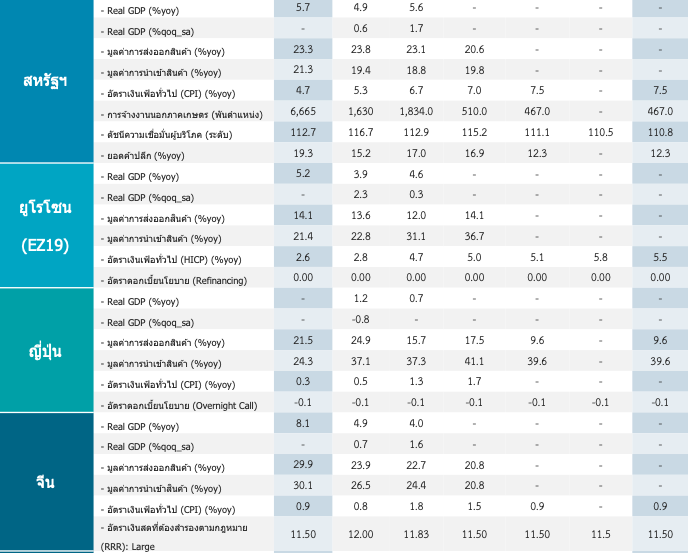
- The PMI index for the manufacturing sector (ISM) in February 2022 was at 58.6 points, up from 57.5 points in the previous month.
- The PMI index for the non-manufacturing sector (ISM) in February 2022 was at 56.5 points, down from 59.9 points in the previous month.
- The number of initial jobless claims for the week of February 20-26, 2022, was at 215,000, down from 233,000 in the previous week, consistent with the four-week moving average of initial jobless claims, which has decreased for four consecutive weeks to 230,000.
China
- The PMI index for the manufacturing sector (NBS) in February 2022 was at 50.2 points, up from 50.1 points in the previous month, marking the fourth consecutive month of growth in factory activity amidst seasonal impacts from the Chinese New Year holiday and a slowdown in production during the Winter Olympics.
- The PMI index for the manufacturing sector (Caixin) in February 2022 was at 50.4 points, up from 49.1 points in the previous month, driven by export growth for the third time in four months, with new orders growing at the highest rate since June 2021.
- The services PMI index (Caixin) in February 2022 was at 50.2 points, down from 51.4 points in the previous month, reflecting the impact of COVID-19 outbreaks and measures to control the spread of the virus, with slight increases in production while new orders decreased for the first time in six months.
Eurozone
- The preliminary inflation rate in February 2022 was at 5.8% year-on-year, up from 5.1% in the previous month, driven mainly by rising energy prices.
- The unemployment rate in January 2022 was at 6.8% of the total labor force, down from 7.0% in the previous month due to the easing of COVID-19 control measures.
Malaysia
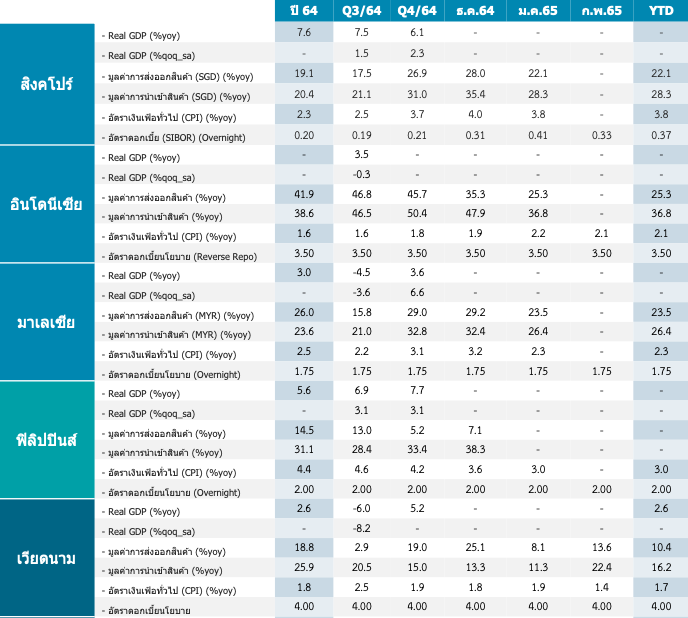
- The PMI index for the manufacturing sector in February 2022 was at 50.9 points, down from 50.5 points in the previous month.
- The Bank Negara Malaysia announced to maintain the policy interest rate at 1.75% per annum.
Australia
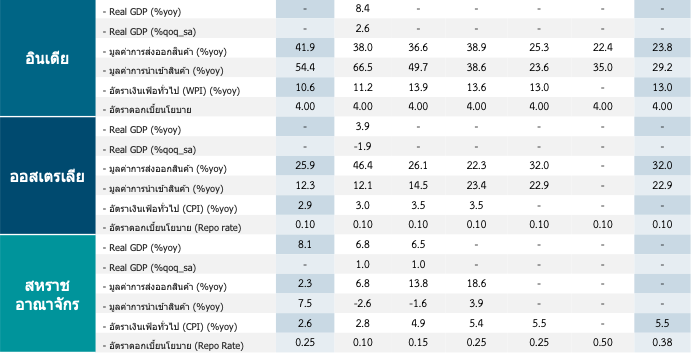
- The Reserve Bank of Australia decided to keep the policy interest rate at 0.1% during the March 2022 meeting, stating that it will not raise the policy interest rate until inflation numbers rise to the target range of 2-3% in the medium term.
- GDP in Q4 2021 grew by 4.2% year-on-year, accelerating from the previous quarter's growth of 3.9% year-on-year.
- The export value in January 2022 grew by 32.0% year-on-year, accelerating from the previous month's growth of 22.3% year-on-year.
- The import value in January 2022 grew by 22.9% year-on-year, slowing from the previous month's growth of 23.4% year-on-year.
- The trade balance in January 2022 recorded a surplus of 12.3 billion AUD, up from a surplus of 9.5 billion AUD in the previous month.
Vietnam
- The PMI index for the manufacturing sector in February 2022 was at 54.3 points, up from 53.7 points in the previous month.
- The industrial production in February 2022 grew by 8.5% year-on-year, up from 2.8% in the previous month, driven by electricity and gas production.
- The inflation rate in February 2022 was at 1.4% year-on-year, slowing from 1.9% in the previous month, primarily due to housing and construction material prices.
- The retail sales in February 2022 grew by 3.1% year-on-year, up from 1.3% in the previous month, driven by sales in accommodation and food services.
Singapore
- The PMI index for the manufacturing sector in February 2022 was at 52.5 points, down from 54.4 points in the previous month.
- The retail sales in February 2022 grew by 11.8% year-on-year, up from 6.7% in the previous month, driven by sales of cosmetics and pharmaceuticals.
Philippines
- The PMI index for the manufacturing sector in February 2022 was at 52.8 points, up from 50.0 points in the previous month.
- The inflation rate in February 2022 was at 3.0% year-on-year, unchanged from the previous month.
Indonesia
- The PMI index for the manufacturing sector in February 2022 was at 51.2 points, up from 53.7 points in the previous month.
- The inflation rate in February 2022 was at 2.1% year-on-year, slowing from 2.2% in the previous month, primarily due to food, beverage, and tobacco prices.
South Korea
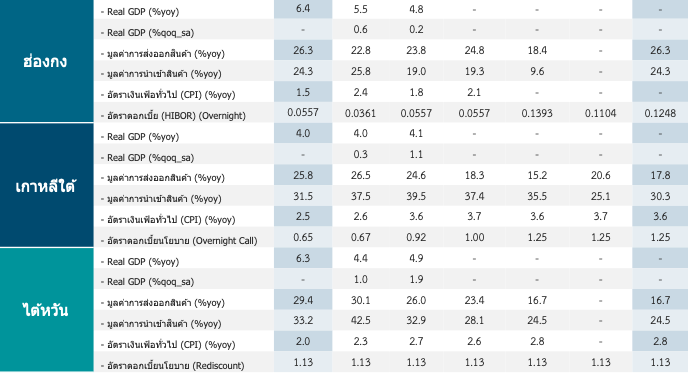
- GDP in Q4 2021 grew by 4.2% year-on-year, accelerating from the previous quarter's growth of 4.0% year-on-year, or a growth of 1.2% compared to the previous quarter (after seasonal adjustment), resulting in a full-year growth of 4.0% for 2021.
- The industrial production in February 2022 grew by 4.3% year-on-year, slowing from the previous month's growth of 7.4% year-on-year and below market expectations of 6.5% year-on-year.
- The retail sales in February 2022 grew by 4.5% year-on-year, slowing from the previous month's growth of 6.8% year-on-year.
- The inflation rate in February 2022 was at 3.7% year-on-year, up from 3.6% in the previous month and higher than market expectations of 3.5%, driven by rising energy costs due to tight supply.
- The PMI index for the manufacturing sector in February 2022 was at 53.8 points, up from 52.8 points in the previous month, supported by automotive and semiconductor production.
- The export value in February 2022 grew by 20.6% year-on-year, accelerating from the previous month's growth of 15.2% year-on-year, due to increased exports of chips, automobiles, and other key products amidst the global economic recovery.
- The import value in February 2022 grew by 25.1% year-on-year, slowing from the previous month's growth of 35.3% year-on-year, with domestic demand remaining stable in line with the acceleration of COVID-19 vaccinations.
- The trade balance in February 2022 recorded a surplus of 0.84 billion USD, up from a deficit of -4.83 billion USD in the previous month, as imports grew faster than exports.
Taiwan
- The PMI index for the manufacturing sector in February 2022 was at 54.3 points, down from 55.1 points in the previous month, as production growth slowed to the lowest in three months, while new order growth slowed to the lowest in five months.
- The consumer confidence index in February 2022 was at 73.19 points, down from 73.67 points in the previous month, reflecting households' expectations regarding prices decreasing over the next six months.
India
- GDP in Q4 2021 grew by 5.4% year-on-year, slowing from the previous quarter's growth of 8.5% year-on-year, or a growth of 12.7% compared to the previous quarter (after seasonal adjustment), resulting in a full-year growth of 8.2% for 2021.
- The PMI index for the manufacturing sector in February 2022 was at 54.9 points, up from 54.0 points in the previous month, as production and new orders grew at a higher rate, with demand from foreign customers increasing the most in three months, and purchasing activity continued to expand.
Exchange Rate Market Indicators
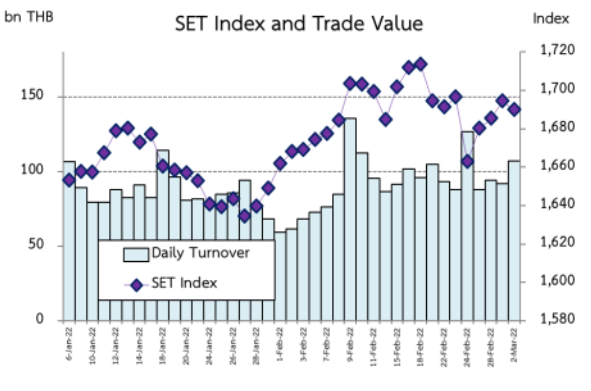
The SET index increased from the previous week, in line with other stock markets in the region that declined from the previous week, such as Nikkei225 (Japan), HSI (Hong Kong), and DJIA (USA). On March 3, 2022, the index closed at 1,696.08, with an average trading value between February 28 and March 3, 2022, of 101,655.79 million THB per day, with foreign investors being net buyers, while domestic retail investors, domestic institutional investors, and brokerage accounts were net sellers. During February 28 to March 3, 2022, foreign investors purchased a net of 14,131.95 million THB.
The overall yield on government bonds decreased by -1 to -9 bps. During this week, investors participated in the auction of 11-year government bonds, with demand at 2.17 times the auction amount. Between February 28 and March 3, 2022, foreign investor capital outflow from the bond market was -28,853.85 million THB, and since the beginning of the year until March 3, 2022, foreign investor capital inflow into the bond market was 100,308.09 million THB.
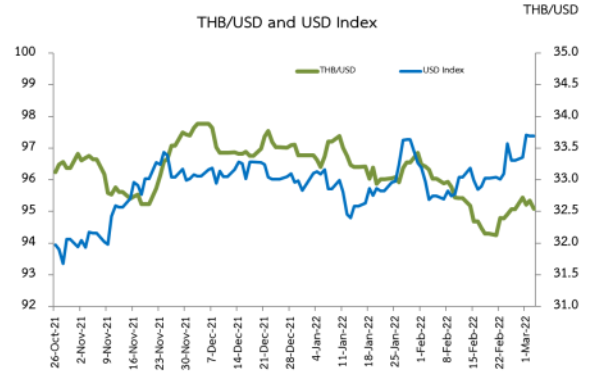
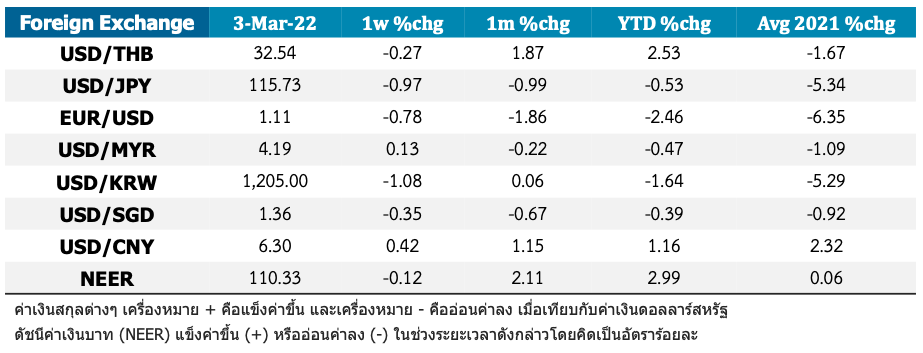
The Thai Baht depreciated from the previous week, closing at 32.54 THB per USD on March 3, 2022, a depreciation of -0.27% from the previous week. This trend is consistent with other currencies in the region, such as the Yen, Euro, Won, and Singapore Dollar, which also depreciated against the USD, while the Ringgit and Yuan appreciated against the USD. The Baht depreciated more than other currencies in the region, resulting in the Nominal Effective Exchange Rate (NEER) index declining by -0.12% from the previous week.
Economic Indicators
Global Economic Indicators
Thank you for the information from the Macroeconomic Policy Bureau, Fiscal Policy Office, Ministry of Finance, 02-273-9020 Ext. 3259