The Housing Market Outlook for 2022 Remains Challenging Despite Increased Support Factors
The housing market in 2022 is still a year of business preservation. Although there are supportive factors that are likely to improve trading activities compared to 2021, the recovery of the housing market still depends on critical factors such as the COVID-19 outbreak in the country. Currently, the situation regarding the Omicron variant needs to be monitored closely. If a new wave of infections occurs and lasts for an extended period, it will impact the recovery of economic activities and the purchasing power of the public, prolonging the recovery process and putting pressure on housing purchase and investment activities. In this high-risk and volatile environment, Kasikorn Research Center predicts that in 2022, the transfer of property ownership in Bangkok and its vicinity is expected to grow by approximately 1.8%-7.3%, recovering from a contraction anticipated in 2021, while new housing project investments in Bangkok and its vicinity are expected to remain cautious.
The housing market in 2022 benefits from government measures, positively impacting the market and stimulating purchasing decisions among financially capable buyers. However, due to weak purchasing power and the ongoing risk of a new COVID outbreak, housing transactions are likely to experience limited growth.
• Housing transaction activities in 2022 are positively influenced by government measures. On December 21, 2021, the government extended the measures to reduce transaction fees for housing purchases, including the property transfer fee and mortgage fee at a rate of 0.01% for properties priced up to 3 million baht, effective until December 31, 2022. This extension is considered another positive factor for the housing market, following the Bank of Thailand's relaxation of LTV measures in October 2021. Both measures will help enhance the purchasing power of home buyers.
The fee reduction measure will alleviate the financial burden on buyers, saving approximately 2.98% or about 29,800 baht for every 1 million baht spent. Meanwhile, the LTV measure will enhance the potential for home purchases by allowing 100% loan amounts. In addition to government measures, marketing campaigns and promotions by property developers to expedite the sale of completed and upcoming housing projects in 2022 are also expected to stimulate purchasing decisions among financially capable consumers.
• However, Kasikorn Research Center believes that the surrounding environment for consumers remains highly fragile, with weak purchasing power and ongoing risks of a new COVID outbreak. Currently, the situation regarding the Omicron variant needs to be closely monitored. If the outbreak expands significantly and the number of infections rises, it will impact the continuity of economic recovery and public income. This may lead financially capable groups to delay their housing purchase decisions, resulting in limited growth in domestic housing transactions. Similarly, the demand for condominiums from foreign buyers is expected to remain stable compared to 2021 due to the ongoing COVID situation hindering travel and confidence among foreign buyers.
• Kasikorn Research Center maintains a cautious outlook on housing purchase activities, especially in the first half of 2022, where trading is expected to slow down. If the COVID situation improves, housing purchase activities are anticipated to gradually improve in the second half of the year. Therefore, under these circumstances, it is expected that the transfer of property ownership in Bangkok and its vicinity in 2022 will be around 168,000 to 177,000 units, growing by approximately 1.8%-7.3% from an expected contraction of about 16.1% in 2021. Meanwhile, housing reservations in Bangkok and its vicinity are expected to be around 63,000 to 69,000 units, growing by approximately 0.0%-9.5% from an expected contraction of about 3.5% in 2021. The lower end of the estimate considers the risk of a severe resurgence of COVID, but the situation is expected to be better than in 2021 due to the rapid management and control of the situation by authorities, along with the comprehensive vaccination rollout.
Investment in new housing projects in 2022 is expected to gradually recover but will still be below pre-COVID levels due to high accumulated unsold supply in the market. It is anticipated that developers will focus more on community locations while primarily targeting mid to upper-income customers.
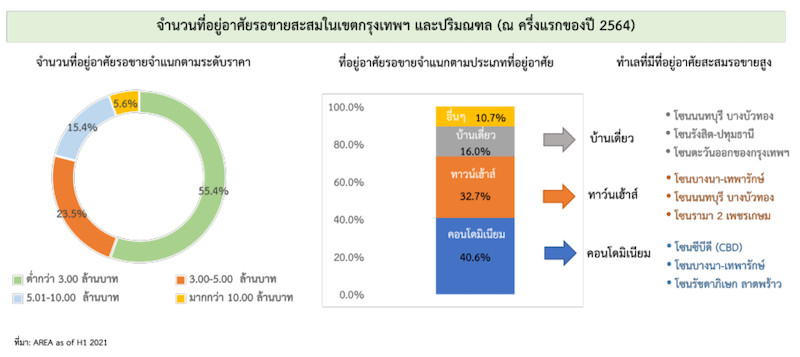
• The direction of new housing project investments in 2022 is viewed by Kasikorn Research Center as showing increased investment from property developers compared to 2021. However, the market still faces high challenges due to trading activities not returning to normal. The accumulated unsold housing units in Bangkok and its vicinity remain high at over 200,000 units. Therefore, under the gradual recovery of housing demand, Kasikorn Research Center predicts that the accumulated unsold housing units in Bangkok and its vicinity in 2022 will remain at around 211,000 to 223,000 units, compared to an estimated 227,000 units in 2021 (including completed, under construction, and launched but not yet started projects), particularly in the segment priced below 3 million baht, which accounts for 55.4%. Although this segment benefits from government measures, the majority of accumulated unsold housing units are still condominiums, followed by townhouses.
• Additionally, intense competition in the market necessitates caution in investing across all price segments and types of housing, along with liquidity challenges and rising business costs, such as construction material prices, labor costs, and expenses related to COVID prevention measures for employees and construction. At the same time, some developers may face increased costs related to land and building taxes, which will need to be monitored further from authorities after the decision to maintain the tax rates for land and buildings in 2022-2023 at the same levels as in 2020-2021.
Given the high uncertainty in the market environment, Kasikorn Research Center believes that in 2022, the launch of new housing projects in Bangkok and its vicinity will likely remain below pre-COVID levels, estimated at around 60,000 to 66,000 units, compared to an estimated 56,000 units in 2021. New projects launched in 2022 are expected to focus on the mid to upper market segment, targeting customers with high purchasing power, particularly in the single-family home segment, as this group has a demand for self-occupation and can generate income quickly, with projects being more adaptable than high-rise projects. Meanwhile, condominium projects are expected to see a return to increased launches but still below pre-COVID levels, focusing more on community locations at around 3 million baht, unlike before when the emphasis was on projects along the subway lines.
• Nevertheless, the development of housing still faces specific market challenges ahead that will impact future housing development, whether it be adjusting housing formats to meet consumer needs, the quantity and location of housing development, such as balancing supply and demand in specific areas. Developers will need to pay more attention to demographic changes in each area (Demographic Change), such as birth rates, the actual population residing in the area, and the migration patterns in and out of the area. Additionally, consumer behavior and lifestyles have changed during the COVID outbreak, with trends like hybrid work from home and new freelance professions, such as selling products online. Furthermore, progress in developing transportation infrastructure connecting cities and high-speed rail linking provinces will lead to urban expansion and the creation of new jobs.
In summary, Kasikorn Research Center believes that in 2022, the residential real estate market is likely to recover, supported by government measures that will facilitate housing purchase decisions. However, the recovery will remain limited due to the significant impact of the COVID-19 outbreak over the past two years on household economies, which will take time for purchasing power to return to its potential level. Meanwhile, new project investments are expected to remain limited due to high accumulated unsold supply in the housing market, increased competition, and changes in consumer lifestyles resulting from the COVID outbreak. Therefore, developers will need to focus more on targeting customer segments based on behavior rather than solely on location.