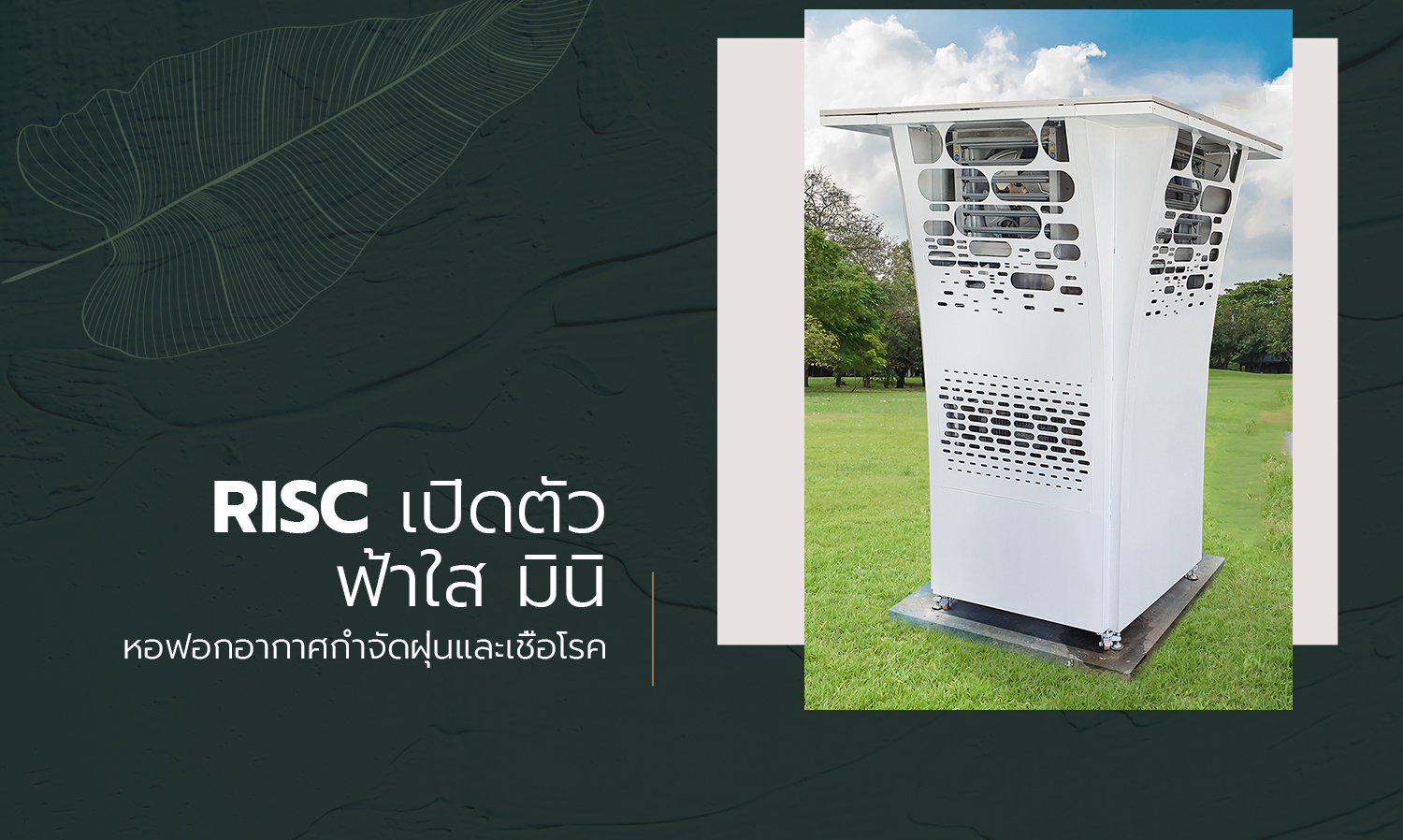
RISC Launches Fahsai Mini Air Purifier to Eliminate Dust and Germs
Assoc. Prof. Dr. Sing Intarachuto, Head of the Advisory Committee at the Research and Innovation for Sustainability Center (RISC by MQDC) revealed that RISC is tirelessly advancing research under the principle of “innovation for sustainability” to improve the quality of life for all beings. This reinforces the success of the hybrid automatic city air purifiers, “Fahsai”, in both models, now developed into the “Fahsai Mini”, a smaller air purifier that is easy to move and install yet packed with efficiency. It will be available for sale through Dsupreme, a company focusing on Wellbeing Innovation, starting from December 2021, to help address widespread air pollution issues, particularly PM 2.5 dust and various airborne germs that we are currently facing.
_1.jpg)
Assoc. Prof. Dr. Sing Intarachuto, Head of the Advisory Committee at the Research and Innovation for Sustainability Center (RISC by MQDC)
“RISC aims to be a center for research and innovation to create sustainable well-being for all lives. The research outcomes have been applied in various real estate projects, universities, and public areas like Makkasan to benefit society and national development. Since the development of the city-level air purifier ‘Fahsai I’ in 2020, we have advanced to ‘Fahsai II’, which can manage bacteria and viruses more effectively since early 2021. Now, we have developed the ‘Fahsai Mini’, which is smaller and can access crowded urban areas. We are committed to continuously improving its efficiency to be part of the solution to air pollution, expanding to more areas,” said Assoc. Prof. Dr. Sing.
Fahsai Mini is one of the many research outputs in RISC's seven main strategies for health and wellness, aligning with the United Nations Sustainable Development Goals (UN SDGs) regarding Good Health and Well-Being, Sustainable Cities and Communities, and Life on Land.
.jpg)
Mr. Wichit Apapas, Chairman of Dsupreme Co., Ltd. stated that Dsupreme is very pleased that RISC has entrusted them to represent the distribution of Fahsai Mini, which will be part of alleviating air pollution issues, PM 2.5 dust, and various germs that often occur at the end of each year. It also promotes air quality in all areas, creating a better environment and well-being for Thai people, with sales expected to start from December 2021 onwards.
For organizations, agencies, and interested parties, Fahsai Mini can be inquired about further information at
Phone number: 061 789-2687
or visit the website https://deessupreme.co.th/
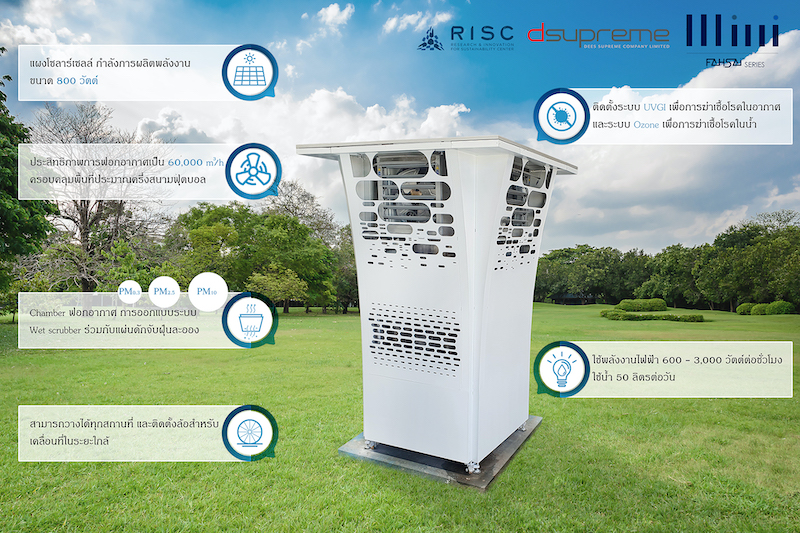
The “Fahsai Mini” air purifier is based on the principle of a wet scrubber industrial pollution control tower, creating a prototype of a hybrid automatic air purifier tower. It operates using energy from an 800-watt solar panel combined with conventional electrical power to reduce electricity consumption during the day. Designed to achieve health and environmental sustainability goals, it aims to improve human living conditions. The Fahsai Mini is unique compared to the two previous models due to its smaller size, making it easier to move and install, while its air purification efficiency for PM2.5 dust and its ability to kill bacteria, fungi, and viruses remain comparable to the two models.
Fahsai Mini has reduced the machine's height to just 3.20 meters and a base width of 1.35 meters for easier installation access. The intake fan size is 30,000 cubic meters per hour with two blades, totaling 60,000 cubic meters per hour, while the exhaust fan size is 15,000 cubic meters per hour with four blades, also totaling 60,000 cubic meters per hour, covering an area of approximately half a football field.
The operational principle of Fahsai Mini begins with drawing air from the side walls using an intake fan into a cylindrical chamber through a spray nozzle system, creating a cyclonic pattern. The air passes through high-speed mist nozzles in two layers, combined with a dust-catching structural design that enhances the surface tension of water for better efficiency, capable of capturing particles as small as 0.3 microns, smaller than PM 2.5 and PM 10 dust. The outgoing air undergoes disinfection through a UVGI system to ensure clean air, released at the user’s position, with fans assisting in achieving the desired volume. The hybrid energy system uses 600-3,000 watts per hour, depending on daily dust levels, and consumes only 50 liters of water per day, with part of the water being recycled through ozone disinfection technology and a water filtration system.