If COVID-19 Does Not Resurge Heavily, the Thai Domestic Tourism Market is Expected to Return to Recovery in 2022 (Kasikorn Research Center)
After the government eased COVID-19 control measures and interprovincial travel restrictions, along with increased vaccination coverage and domestic tourism stimulus measures, Thai people have begun to travel more within the country. A survey on domestic travel demand reflects that over 73.7% of Bangkok respondents want to travel significantly. This suggests that in the last two months of 2021, more Thais are likely to travel domestically, continuing into the next year. Initially, the Kasikorn Research Center estimates that if there is no severe resurgence of the virus, the Thai domestic tourism market in 2022 could reach approximately 109-155 million trips, recovering from about 66.71 million trips in 2021.
Under a favorable atmosphere for domestic travel, it is expected that in the last two months of 2021, Thai people will increase their travel, while the total for 2021 is projected to be around 66.71 million trips.
The Kasikorn Research Center conducted a survey on the travel behavior and preferences of Bangkok residents for the remainder of 2021. The findings from October 2021 revealed several interesting points:
- Among the Bangkok respondents, 73.7% expressed a strong desire to travel domestically after facing severe COVID-19 outbreaks, interprovincial travel restrictions, curfews, and prolonged work-from-home situations. This is an increase from the survey conducted in September, indicating that as conditions improve, respondents are more confident about traveling.
- The preferred travel destinations for respondents during this period remain natural attractions such as mountains and high peaks, including Chiang Mai, Kanchanaburi, and Phetchabun, as well as coastal destinations like Chonburi (Pattaya), Prachuap Khiri Khan (Hua Hin), and Rayong. Additionally, Bangkok residents are also interested in historical and cultural community attractions such as Samut Songkhram, Ayutthaya, and Uthai Thani. However, the survey indicates that respondents are willing to change their travel destinations if there is an outbreak in the area. Therefore, amidst the ongoing high-risk COVID-19 situation, all sectors must collaborate intensively to control outbreaks to avoid losing opportunities for tourism revenue.
- The decision-making time for travel has shortened, with over 30.3% of respondents booking hotels only 2-5 days in advance (down from the previous average of about 15 days to a month) due to rapidly changing circumstances. Most respondents continuously seek travel information, leading to quicker travel decisions when COVID-19 conditions improve.
- Bangkok residents primarily travel by private car (60.8%), followed by air travel (25.7%). Other modes include renting cars with drivers and using public transport like trains.
- Most respondents prioritize price when booking accommodations, with the average price range they are willing to pay being around 1,500-2,000 THB per night, followed by 2,001-2,500 THB. Factors influencing hotel selection include cleanliness and COVID-19 safety standards, as well as proximity to tourist attractions.
- The average spending for Bangkok residents planning domestic travel is around 4,500 THB per person per trip. Some anticipate reducing expenses during travel, such as spending less on souvenirs, partly due to still recovering purchasing power and the ability to buy local souvenirs online. Additionally, most tourists prioritize visiting natural attractions while spending time relaxing at hotels, which affects their tourism spending.
- Fuel prices have a minimal impact on travel decisions for the remainder of the year, as those wanting to travel are generally in a better financial position. The average travel frequency is about 1.3 trips, and tourists benefit from government tourism stimulus measures.
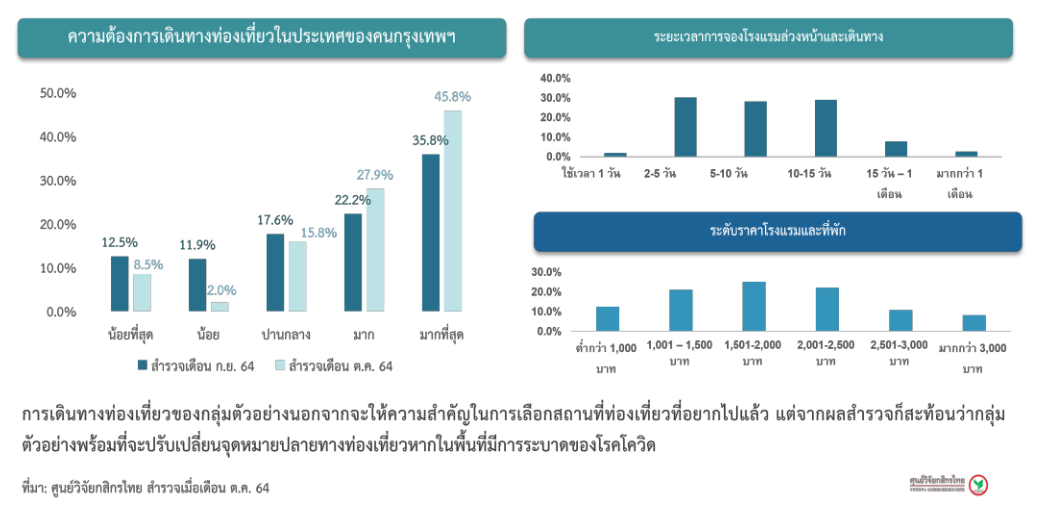
The survey results indicate that most Bangkok residents have a strong desire to travel domestically. If the government can control the outbreak and prevent another severe wave affecting travel, it could positively influence the Thai domestic tourism market in the upcoming travel season. However, recovery is expected to be gradual, as some tourist areas still face high risks, and many provinces have COVID-19 control measures in place. Thai tourists traveling to these areas must be vaccinated according to specified conditions, or those who are not fully vaccinated may need to undergo ATK testing.
In this business environment, the Kasikorn Research Center predicts that during the last two months of 2021, domestic travel among Thais may reach 29.1 million trips, a decline of 14.2% from the same period last year. However, this is an improvement from the monthly average of 3.8 million trips from January to October 2021, leading to an estimated total of 66.71 million domestic trips for the entire year, a decrease of about 26.3% from 2020, marking a consecutive decline for the second year. The total spending for domestic travel in 2021 is expected to be around 296.895 billion THB, down approximately 38.2% from 2020.
If COVID-19 does not resurge heavily, the Thai domestic tourism market in 2022 is expected to continue its recovery, with an estimated 109-155 million domestic trips.
Regarding the recovery direction of the Thai domestic tourism market in 2022, the Kasikorn Research Center assesses the situation under various conditions, with key factors including the COVID-19 outbreak in the country, stimulus measures for purchasing power and tourism, and household economic factors affecting tourism spending. This can be divided into two scenarios:
Scenario 1: Under conditions where the COVID-19 situation in the country continues to improve from late 2021 and no new outbreaks disrupt domestic travel, and energy prices do not rise significantly to affect transportation costs like airfare, the recovery of the Thai domestic tourism market is expected to gradually return.
If the situation unfolds as assessed, the Kasikorn Research Center anticipates that in 2022, domestic travel among Thais could reach 155 million trips, an increase of 133.1% from 2021. However, this recovery will still be below the 172.7 million trips recorded in 2019, as it is expected that in the first 2-3 months of 2022, the COVID-19 situation may still impact travel for certain groups of tourists, while the economy has not fully recovered and purchasing power for some groups remains below potential, leading to a reduction in travel frequency.
In terms of spending, domestic tourism expenditure for Thai tourists is expected to be around 698 billion THB, an increase of 134.9% from 2021. The spending per person per trip in this scenario is expected to rise slightly from 2021, as more tourist attractions are likely to reopen, and tourists may feel less anxious about COVID-19, returning to dine in local restaurants and participate in more tourism activities.
Scenario 2: The risk of COVID-19 outbreaks may still occur, potentially affecting the continuity of tourism recovery during certain periods of outbreaks. However, it is anticipated that the level of COVID-19 outbreaks will not be severe, allowing authorities not to implement strict control measures as seen in 2021, leading to continued growth in domestic tourism.
The Kasikorn Research Center predicts that domestic travel among Thais in 2022 could reach 109 million trips, an increase of 63.4% from 2021, while spending by Thai tourists is expected to be around 479.6 billion THB, an increase of 61.5% from 2021.
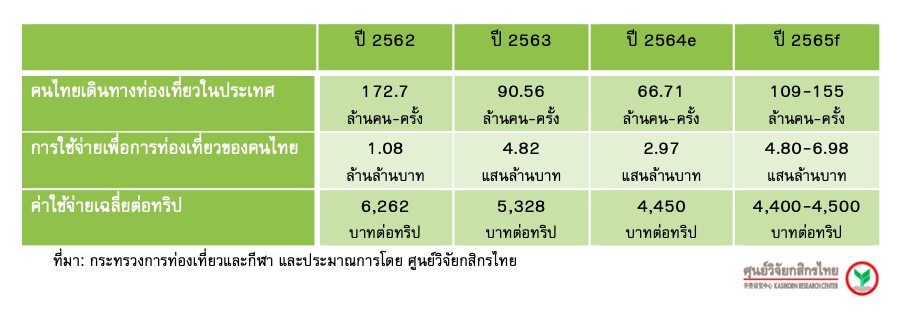
Source: Ministry of Tourism and Sports and estimates by Kasikorn Research Center