
BIM and the New Era of Real Estate in 4 Dimensions During the COVID-19 Era
Lumpini Wisdom states that the development of BIM combined with digital technology and AI is a process used in the real estate business development across 4 dimensions: hygiene, analysis and design, construction site management, and waste reduction.
Mr. Prabhan Sak Raksaiwan, Managing Director of Lumpini Wisdom and Solutions Co., Ltd. (LPN Wisdom or LWS), a research and consulting company in real estate development under the LP.N. Development Public Company Limited (LPN), said that under the circumstances of the COVID-19 pandemic, various business sectors, including real estate, must adapt to meet the changing consumer behaviors. This includes design work that must respond to lifestyle changes and the increased demand for space, as well as emphasizing hygiene and environmental concerns. Therefore, it is essential to incorporate the BIM (Building Information Modeling) process to support design and construction work.
1.jpg)
Mr. Prabhan Sak Raksaiwan, Managing Director of Lumpini Wisdom and Solutions Co., Ltd. (LPN Wisdom or LWS)
“It is well known that BIM is a working process that aids in the design and construction of the real estate business in terms of reduced working time (Time), effective cost management (Cost), and improved design quality (Quality). In addition to these three dimensions, BIM has now developed processes that address real estate development in another four dimensions:
- Safety and hygiene
- Analysis and design
- Construction site management
- Waste reduction from work processes
These align with the current situation where consumers prioritize hygiene and environmental issues,” Mr. Prabhan Sak stated.
On Safety and Healthy Environment
Currently, design can incorporate technology with BIM systems to adjust work processes both on-site and in the office to reduce risks from workplace accidents and health impacts, as well as limit the spread of infections that may occur during work processes.
Mr. Prabhan Sak stated that on construction sites, work can be adjusted to a semi-automated format, as there still needs to be workers present. However, technology can assist in safety inspections, such as using sensors to detect temperature, health metrics, and monitor the movements of workers near hazardous areas to ensure workplace safety and screen at-risk individuals. Simultaneously, supervisors can monitor work in real-time and alert workers immediately. Moreover, issues arising during construction can be effectively addressed using VR technology, which supports architects, engineers, or specialists in assessing problems and finding solutions quickly without needing to be on-site, thus reducing congestion and saving both time and resources.
Meanwhile, in the office, work can be automated using BIM systems, which are data-centric, helping to reduce data errors and work redundancies. Collaboration can occur seamlessly through a cloud platform, allowing for efficient coordination and data exchange among departments, supporting new work concepts such as work from home or remote working.
Reducing Document Waste
Mr. Prabhan Sak mentioned that sustainable development considering the environment is a priority for operators in all industries, including real estate. Although real estate impacts the environment through dust and noise during construction, implementing project management systems using BIM can help manage resource use on construction sites, including reducing paper usage for documents and construction plans.
“BIM is in the form of digital files replacing traditional paper formats, making it easier to track documents and conserve paper resources. Currently, many countries are beginning to implement regulations requiring designers and builders to comply, such as Singapore, which mandates that all permit applications be submitted as digital files. This not only helps reduce unnecessary paper use as a side benefit but also allows inspectors to gain direct benefits from using BIM across various dimensions, ensuring accurate data checks and reducing errors in work,” Mr. Prabhan Sak stated.
Analyzing and Developing Designs with AI: Artificial Intelligence
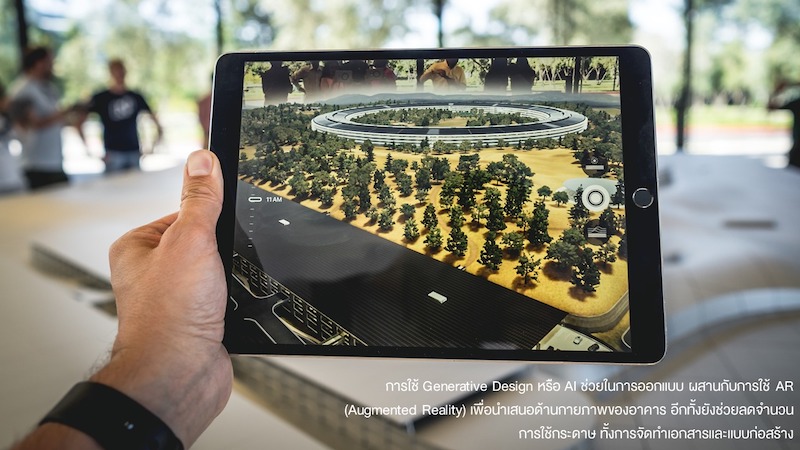
Currently, BIM has integrated AI (Artificial Intelligence) to enhance and improve work efficiency, similar to other industries. By utilizing AI to gather, learn, analyze, and manage problem-solving in design, the more data available, the more effectively it can be processed. The key to managing resources efficiently lies in AI's ability to improve work processes, reduce costs, minimize time and risks, which are factors in enhancing project quality. For instance, using Generative Design or AI-assisted design with algorithms allows for the design of projects with numerous design criteria, as AI can learn and analyze large amounts of data in a short time, enabling designers to identify requirements, building codes, sunlight direction, and various usable spaces. By inputting this data into the system, AI can generate design options that meet specified criteria while analyzing the pros and cons and effectiveness of those options, allowing designers to select the most suitable alternatives for further development. Additionally, Generative Design can be applied in engineering design to reduce material volume or weight while maintaining safety and load-bearing capacity.
Managing Construction Sites
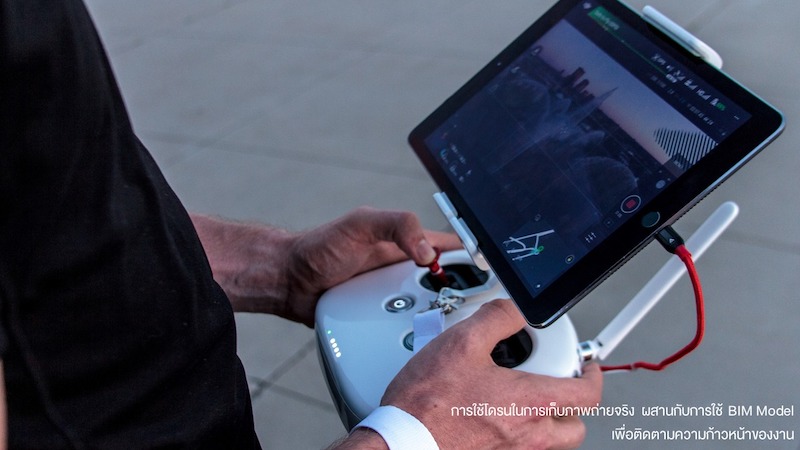
Currently, construction during the COVID-19 era faces limitations compared to normal situations, necessitating a reduction in the number of workers to decrease congestion as part of health measures. Moreover, on-site work has restricted hours and access areas, leading to high discrepancies in data collection and transfer. Utilizing technology, such as drones for capturing construction images combined with BIM models to track construction progress, helps alleviate management issues. The system can compare drone image data with the construction plan, using management software to assess construction risks.

Furthermore, all data can be stored on the cloud, addressing data storage issues to prevent loss, ensuring complete and accurate data that can be updated in real-time to monitor work progress continuously. It also allows for managing multiple construction sites simultaneously. Studies have shown that using drones for on-site data collection can reduce the time spent inspecting construction sites by up to 400 times and cut data collection costs by 40%.
“The integration of BIM processes with current technologies enables real estate operators to develop design and construction work efficiently, while also providing homebuyers with quality residences that meet their needs,” Mr. Prabhan Sak concluded.