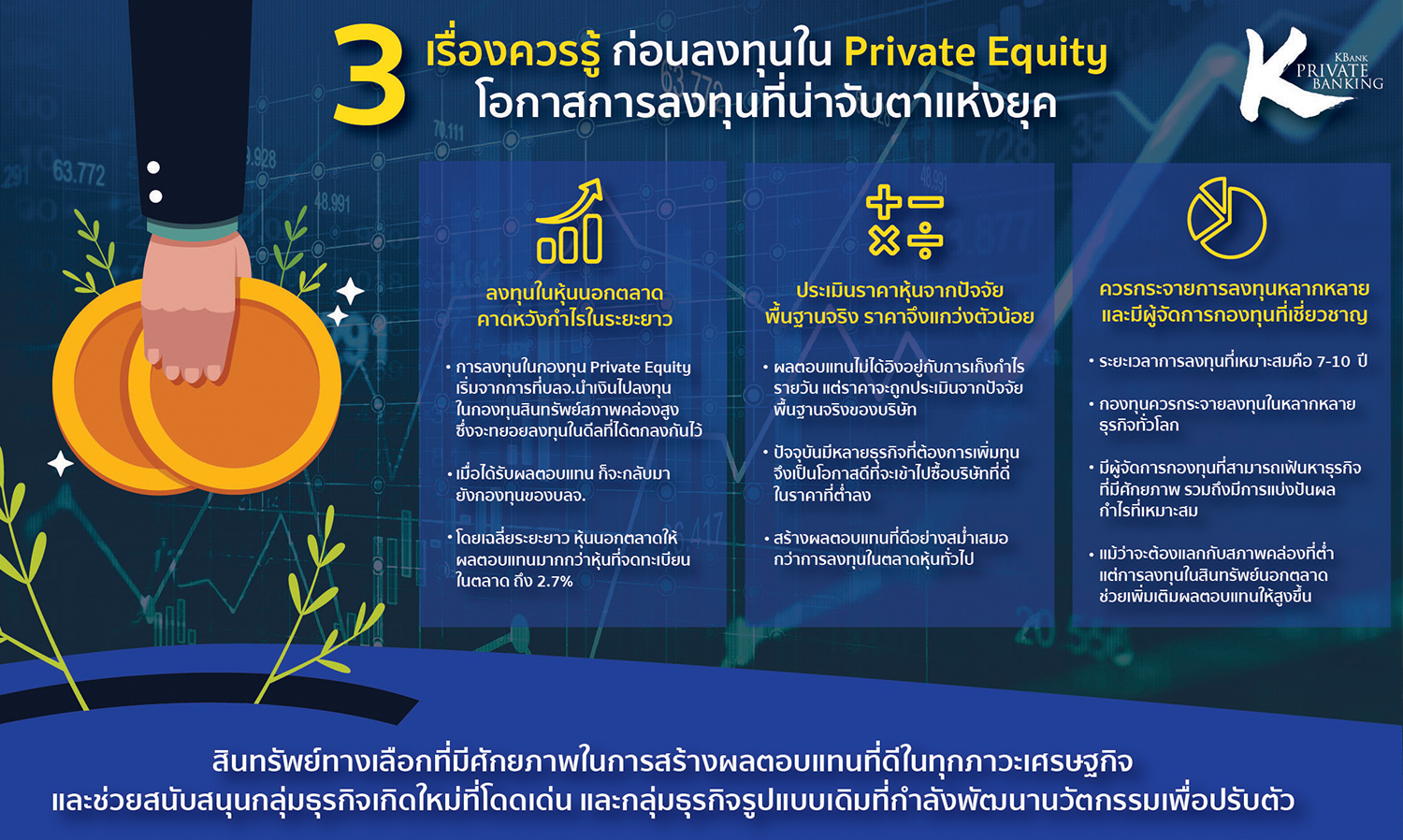
3 Key Things to Know About Private Equity: An Investment to Watch in This Era, An Alternative Asset That Enhances Portfolio Returns
The economic volatility caused by the COVID-19 pandemic continues to impact global investment financial markets. Investors are still facing investment risks and changing expected returns that differ from normal conditions. Assets in the stock market are yielding lower returns than they did 2-3 years ago. Investing in alternative assets, such as private equity, is therefore an interesting option. On average, over the long term, global private equity can provide returns that exceed those of publicly listed stocks by 2.7% over the past several years, with even higher returns in emerging markets and China.
Dr. Triphon Phumiwasana, Head of Private Banking Business, Private Banking Group, Kasikornbank, stated, "In addition to having the potential to grow investment portfolios and provide good returns in all economic conditions, private equity also opens opportunities for businesses outside the stock market, including emerging businesses with growth potential that can adapt to the new economy. These businesses receive funding support from institutional investors or large investors to strengthen their operations, which benefits the overall economy. Traditional businesses will also receive support in terms of advice and fundraising from investors and partners to help develop innovations and return to growth."

Dr. Triphon Phumiwasana, Head of Private Banking Business, Private Banking Group, Kasikornbank
A Deloitte report predicts that by 2025, global assets under management in private equity will reach $5.8 trillion, making private equity an increasingly important alternative asset in investors' portfolios worldwide. KBank Private Banking therefore recommends three key points that investors should know about this asset class before making investment decisions.
1. Invest in Private Equity with Long-Term Profit Expectations
Investing in private equity involves purchasing shares of companies that are not yet publicly listed. These are often relatively new companies that may not yet be profitable or have revenue but require funding through private share sales to investors seeking high returns and willing to lock in their investments for the long term. Investors anticipate future profits when these private companies go public or sell shares to other investors.
Dr. Triphon explains, "The investment approach in private equity funds in Thailand begins with asset management companies (AMCs) placing funds in high liquidity asset pools. When the timing is right, these funds will gradually be drawn from the high liquidity pool to invest in the main funds, which will then invest in various companies. The funds have a predetermined investment period in various companies until they sell those companies when appropriate returns are achieved. The main funds will then return profits to the AMCs, which will subsequently distribute profits to investors."
2. Assess Stock Prices Based on Real Fundamentals, Resulting in Less Price Fluctuation
Private equity investments generally yield better returns with less volatility compared to other assets over the long term. With less price fluctuation, this helps reduce portfolio risk. Since private equity investments are not subject to daily speculation by investors, prices are assessed based on the actual fundamentals of the companies, with specialized advisors providing investment guidance and selecting deals or companies that stand out for investment, thus enabling more consistent returns than traditional stock market investments.
Dr. Triphon adds, "In the current economic slowdown, private equity investments are becoming attractive again as many businesses are facing liquidity issues and declining profits, leading to numerous companies looking to sell and raise capital. Therefore, this presents a good opportunity for private equity investments to acquire quality companies at lower prices, enhancing their potential for growth and enabling them to be sold at higher prices later."
3. Diversify Investments and Have Experienced Fund Managers
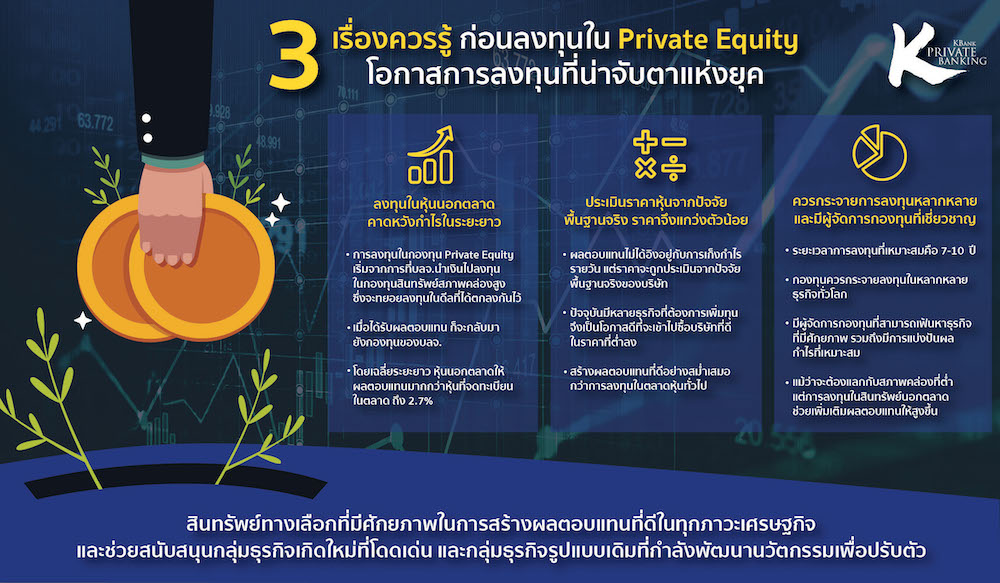
Successful investment in private equity funds requires various components. Dr. Triphon recommends that "investors should have an investment horizon of about 7-10 years, and the funds should diversify investments across various businesses. Additionally, since private equity involves investing in companies outside the stock market, access to information can be limited. Therefore, having fund managers with the knowledge and capability to identify businesses with growth potential and good relationships with business leaders is crucial. Furthermore, funds should also ensure a fair profit-sharing arrangement between the fund managers and investors."
“Investing in private equity funds is something to watch closely, especially now that global stock prices are rising. Diversifying risk by investing in companies with potential but still receiving limited investment can help create growth in investment portfolios. Moreover, such investments also support both old and new businesses in obtaining capital for development, adaptation, and innovation to drive economic recovery after the crisis,” Dr. Triphon concluded.