Thai Baht Recovers Slightly After Hitting Lowest Level in Over 4 Years, While Thai Stocks Decline Following Global Markets
Summary of Thai Baht Movements
- The Thai Baht hit its weakest level in over 4 years at 33.97 Baht per Dollar but managed to recover slightly towards the end of the week. The Baht weakened amid strong demand for Dollars at the end of the quarter, compounded by net selling pressure from foreign investors in Thai bonds. Meanwhile, the Dollar gained strength following expectations regarding the Fed's potential tapering of easing measures in the coming months. However, the Baht strengthened again towards the end of the week after the Dollar faced negative factors from higher-than-expected weekly jobless claims, while the market closely monitored the U.S. debt ceiling issue.
- On Friday (October 1), the Baht was at 33.63 compared to 33.25 Baht per Dollar on the previous Thursday (September 23).
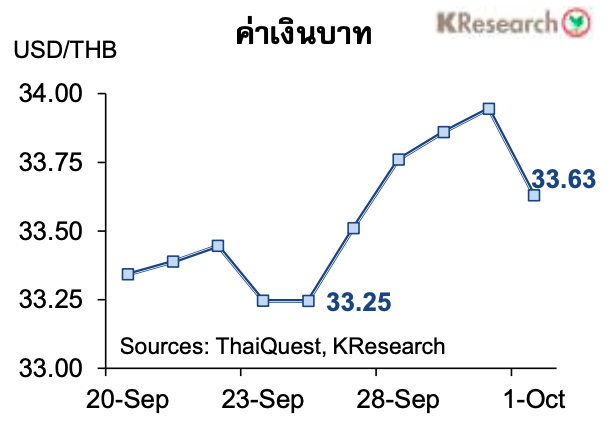
For the upcoming week (October 4-8), Kasikorn Bank forecasts the Baht's movement range at 33.20-34.00 Baht per Dollar. Meanwhile, the Kasikorn Research Center assesses key factors to watch, including the U.S. debt ceiling issue, the situation of Chinese real estate companies, foreign investment in Thailand's financial markets, and the COVID-19 situation. Important U.S. economic data includes non-farm payroll figures, labor market indicators such as unemployment rates, wage figures, private sector employment data, the PMI/ISM services index for September, factory orders for August, and weekly jobless claims. Additionally, the market is also awaiting the PMI services index for September from China, the Eurozone, and the UK.
Summary of Thai Stock Market Movements
- Thai stocks fell sharply from the previous week but remained above the 1,600-point mark, with the SET index closing at 1,605.17 points, down 1.59% from the previous week. The average daily trading value was 98,836.76 million Baht, up 1.77% from the previous week, while the mai index decreased by 2.19% to close at 543.41 points.
- Thai stocks experienced significant declines throughout the week amid concerns over flooding in several provinces that could impact the Thai economy, along with selling pressure from institutional investors, possibly due to window dressing before the close of Q3/64. Furthermore, worries regarding the situation of Chinese real estate companies, inflation risks, and the U.S. debt ceiling issue also pressured the investment atmosphere in regional stock markets, including Thailand, towards the end of the week.
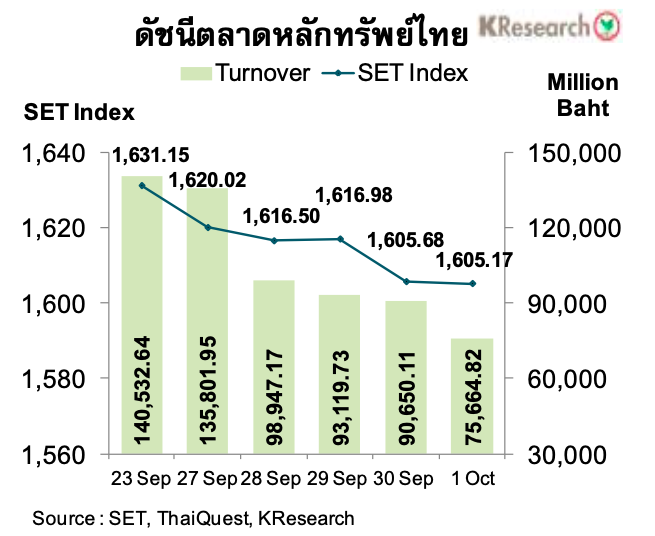
For the upcoming week (October 4-8), Kasikorn Securities Co., Ltd. sees support levels for the Thai stock index at 1,590 and 1,580 points, while resistance levels are at 1,610 and 1,620 points, respectively. The Kasikorn Research Center assesses key factors to monitor, including the COVID-19 situation both domestically and internationally, the flooding situation in the country, the OPEC+ meeting (October 4), foreign investment trends, and the situation of Chinese real estate companies. Important U.S. economic data includes non-farm payroll figures, unemployment rates, and the PMI index for September. Other foreign factors include the PMI index for September from the Eurozone, Japan, and China, as well as the producer price index and retail sales figures for August from the Eurozone.
This research report is prepared by Kasikorn Research Center Co., Ltd. ("KResearch") for general dissemination, relying on publicly available or deemed reliable information at the time of preparation, which may change over time. KResearch does not guarantee the accuracy, reliability, suitability, completeness, or timeliness of the information and does not intend to solicit, recommend, or persuade any decision-making actions. Therefore, you should study the information carefully and exercise caution and discretion before making any decisions. KResearch will not be liable for any damages arising from the use of such information.
Any information contained in this research report is the property of KResearch and/or third parties (as applicable). The use of such information (in whole or in part) must acknowledge the ownership rights of KResearch and/or third parties (as applicable) or the source of that information. You may not reproduce, modify, adapt, alter, distribute, publish, or engage in any similar activities for commercial purposes without prior written permission from KResearch and/or third parties (as applicable).