August Export Value Grows at a Slower Rate Due to Significant Decline in Gold Exports and COVID-19 Pandemic
Analysis from EIC
The export value in August expanded at a noticeably slower rate compared to the previous month, primarily due to a significant decline in gold exports and the global COVID-19 pandemic, which has led to a slowdown in the global economy and supply chain disruptions in many countries.
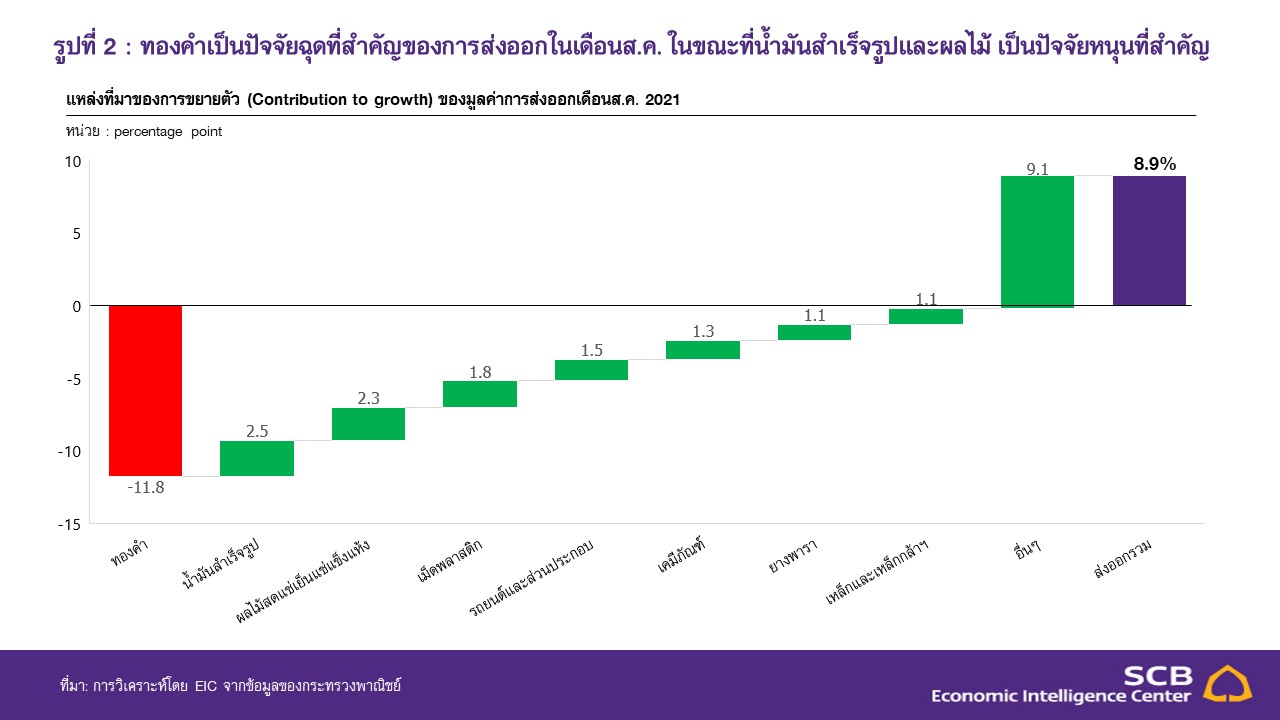
- The export value in August grew by 8.9% year-on-year (YOY), continuing to expand (YOY %) across all major products. However, when compared to the previous month on a seasonally adjusted basis, exports decreased significantly by -9.1% month-on-month (MoM_sa), partly due to a drastic decline in gold exports, which fell by -85.8% YOY.
- Even excluding gold exports, overall exports still decreased from the previous month due to the impact of the Delta variant outbreak, which has slowed the global economy, as reflected in the Manufacturing PMI, which has declined across all groups of countries, especially in emerging markets (EM). Additionally, supply chain disruptions have occurred due to factory closures domestically and production halts in partner countries within the same supply chain. It has been observed that the export of Thailand's major products has been declining since July, particularly in the automotive sector.
- EIC anticipates that exports for the remainder of the year will likely slow down from last year's elevated base, the downward trend in the global economy, ongoing supply chain disruptions, and the increasing impact of chip shortages. However, in 2022, exports are expected to continue growing, albeit at a slower rate than this year, as the global economy is projected to expand due to progress in vaccination efforts, especially in developing countries. Nevertheless, the ongoing container shortage, which keeps shipping costs high, and the semiconductor shortage are likely to continue to pressure exporters next year.
* Key points
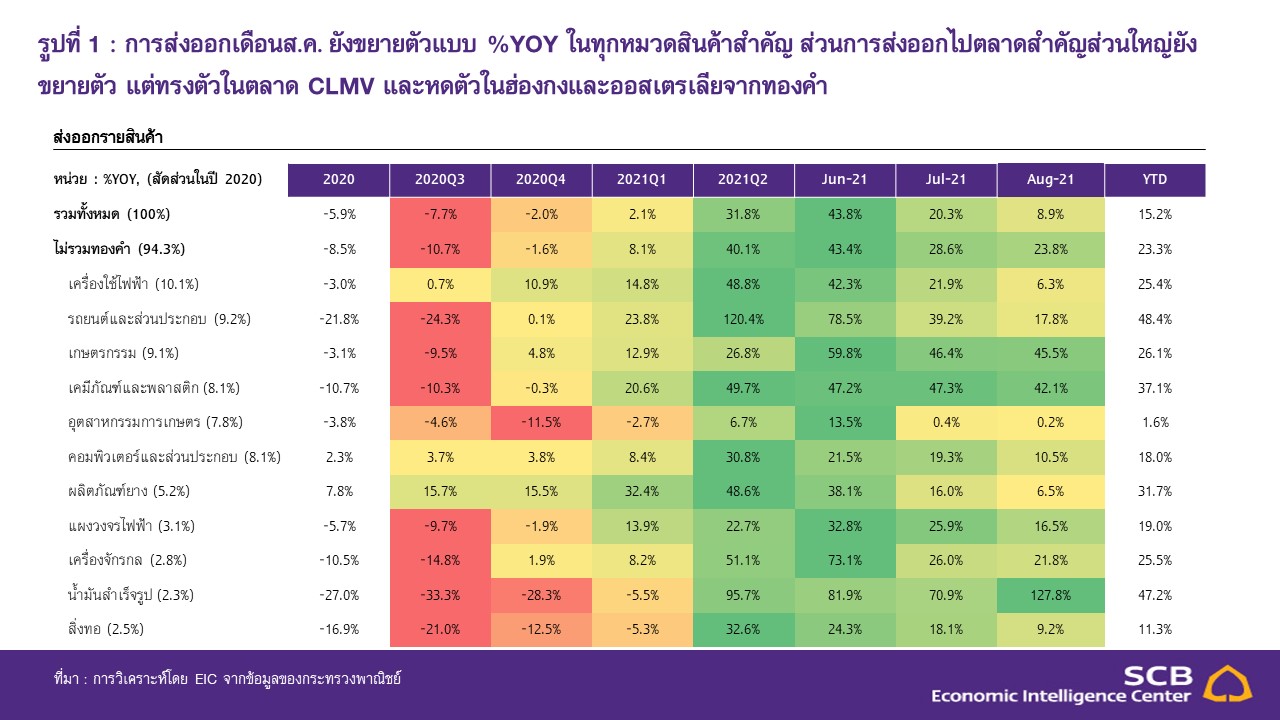
The export value in August 2021 grew by 8.9% YOY, a slowdown from the previous month’s 20.3% YOY. However, excluding gold, exports would have expanded by 23.8% YOY, slightly down from the previous month’s 28.6% YOY, resulting in an export growth of 15.2% YOY in the first eight months of 2021, and 23.3% YOY when excluding gold.
- In terms of exports by product, exports continued to grow YOY.
- Refined oil exports grew by 127.8% YOY, continuing for six months, driven by high energy demand and oil prices, expanding in all major markets including Cambodia (117.6% YOY), Singapore (199.4% YOY), and the Philippines (1,746.8% YOY).
- Fresh, chilled, frozen, and dried fruits grew by as much as 125% YOY, with exports to China expanding by 163.8% YOY, accounting for 89.8% of Thailand's total fruit exports.
- Plastic pellets grew by 55.7% YOY, continuing for nine months, with growth in all major markets such as China (32.3% YOY), India (92.6% YOY), and the United States (238.8% YOY).
- Automobile and component exports grew by 17.8% YOY, continuing for ten months, with pickups, buses, and trucks growing by 64.9% YOY, while passenger car exports declined for the first time in six months by -16.5% YOY.
- Chemical exports grew by 45.1% YOY, continuing for nine months, with growth in all major markets such as China (61.8%), Japan (90.4%), and India (64%), except for Vietnam (-1.9% YOY).
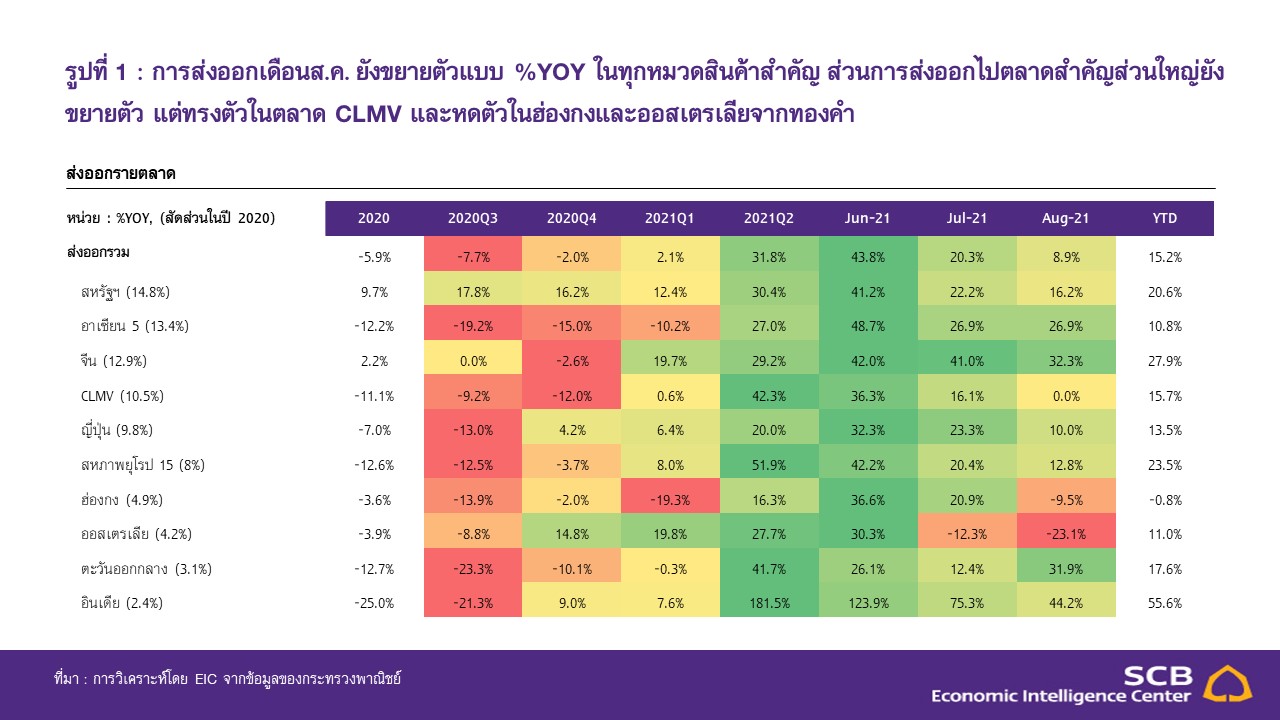
Regarding exports by market, Australia and Hong Kong saw declines, while the CLMV markets remained stable, and other major markets continued to grow.
- Exports to India continued to grow at a high rate of 44.2% YOY, marking seven consecutive months of growth, with key products including plastic pellets (92.6% YOY), chemicals (64% YOY), and automobiles and components (106.1% YOY).
- Exports to China grew by 32.3% YOY, with fresh, chilled, frozen, and dried fruits (163.8% YOY) being the most significant contributing factor. Other important products that saw growth included plastic pellets (32.3% YOY), cassava products (68% YOY), and rubber (108.1% YOY).
- Exports to CLMV remained stable at -0.03% YOY, with exports to Cambodia and Laos growing by 28.5% YOY and 19.8% YOY, while exports to Myanmar and Vietnam declined by -6.3% YOY and -17.2% YOY, respectively, due to severe COVID-19 outbreaks in both countries and political issues in Myanmar.
- Exports to Hong Kong reversed to a decline of -9.5% YOY, primarily due to a significant drop in gold exports (-65.8% YOY) and phones (-44.5% YOY), while other important products that still saw growth included computers (13.4% YOY) and electrical circuit boards (15.6% YOY).
- Exports to Australia continued to decline for the second consecutive month at -23.1%, accelerating from the previous month’s -12.3%, with major export products experiencing declines, including air conditioners.
In August 2021, the import value grew by 47.9% YOY, accelerating from the previous month’s 45.9% YOY, with growth in all major import categories including fuel (81.8% YOY), driven by both a low base and rising prices compared to the previous year, capital goods (23.8% YOY), consumer goods (12.7% YOY), and vehicles and transport equipment (47.3% YOY). Meanwhile, the import of raw materials and semi-finished goods also grew by 65.7% YOY, and excluding gold, it would grow by 66.3% YOY. In the first eight months of 2021, imports grew by 31% YOY. The trade balance in August shifted to a deficit of -1,215.6 million USD, but the trade balance for the first eight months remained in surplus at 1,407 million USD.
* Implication
Although exports have shown good YOY growth, when compared to the previous month on a seasonally adjusted basis, exports decreased significantly by -9.1% MoM_sa due to several factors, including:
1) The substantial decline in gold exports, with gold exports in August dropping by -85.8% YOY. Excluding gold, the export value would increase from 8.9% YOY to 23.8% YOY, making gold a key factor in the significant drop in export figures for August compared to the previous month.
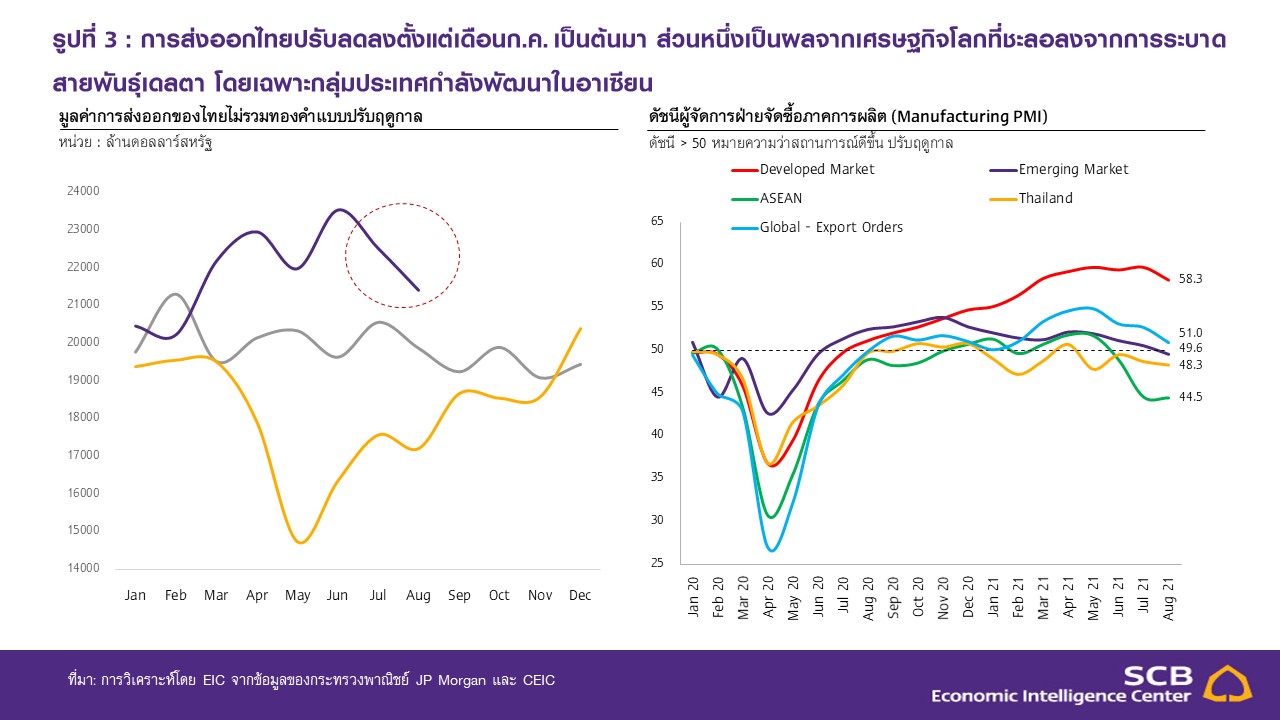
2) The impact of the Delta variant outbreak both domestically and globally, which has slowed the global economy and caused supply disruptions. This effect began to show signs in July and became more evident in August, as reflected in Thailand's exports excluding gold on a seasonally adjusted basis, which have been declining since July (see Figure 3 left). Figure 3 right illustrates the slowdown of the global economy due to the Delta variant COVID-19 outbreak, as reflected in the Global Manufacturing PMI Export Orders and Manufacturing PMI of various countries, especially in ASEAN developing countries, which have fallen below the 50 level recently.
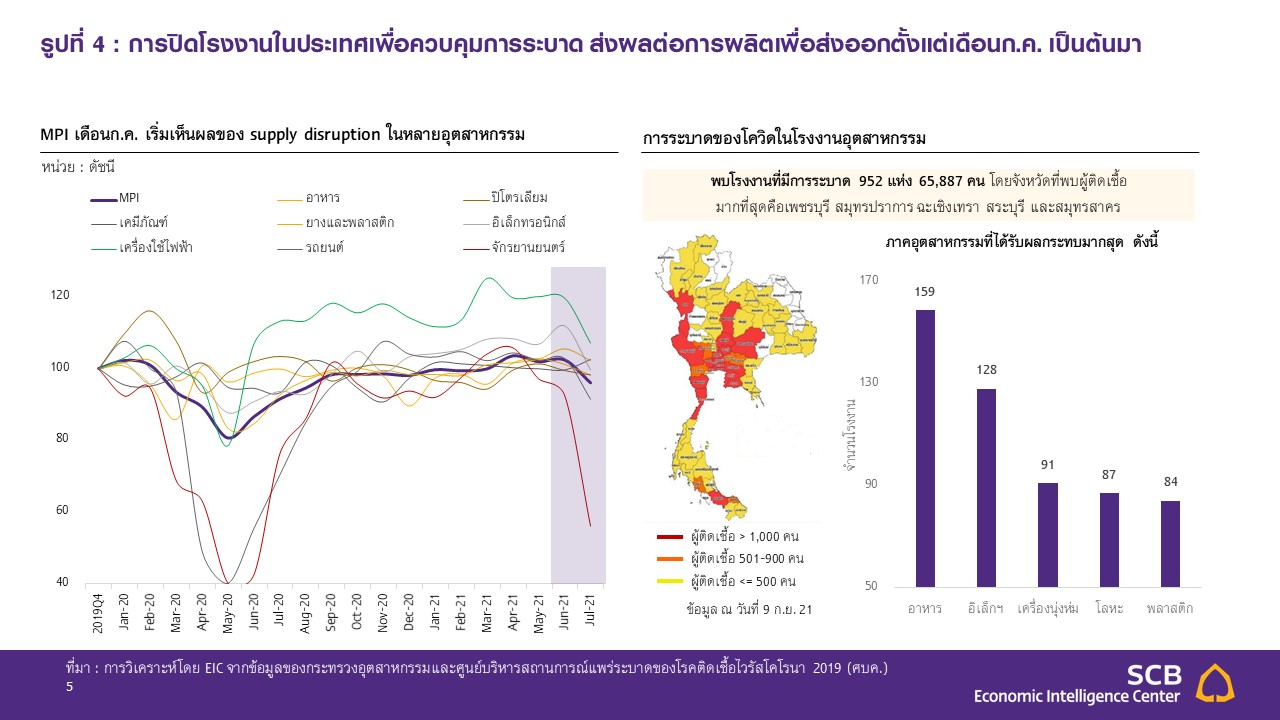
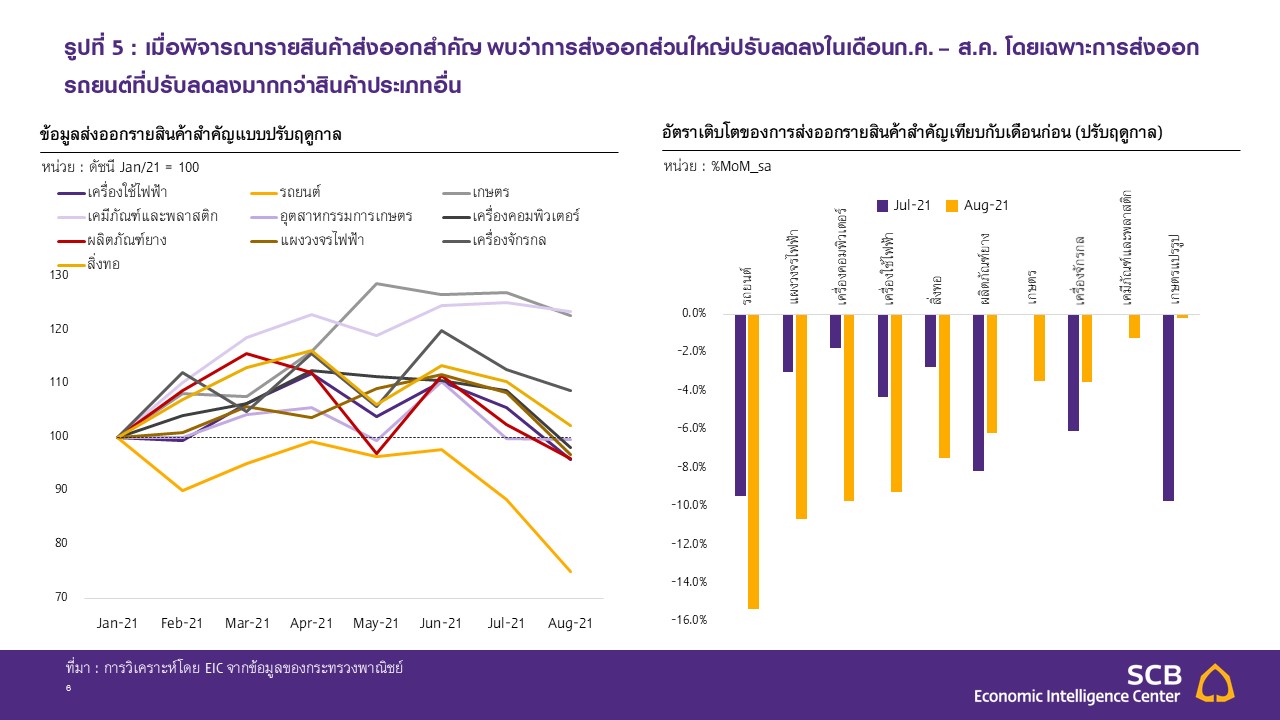
Additionally, Thailand's production for export has been affected by supply chain disruptions caused by factory closures in Thailand and production halts in partner countries within the same supply chain. Figure 4 shows that many factories have faced issues due to outbreaks in the country, along with the Industrial Production Index (MPI) in July, which has clearly declined in several industries, reflecting the supply chain disruption. If we consider the export figures of Thailand's major products (Figure 5), we can see that the export of most major products has been continuously declining since July, particularly in the automotive sector, which has seen a more significant decline than other products due to both the slowing global economy and supply chain disruptions, as mentioned, along with the chip shortage that has forced automotive companies to reduce production.
Consequently, EIC expects that for the remainder of the year, exports will likely stabilize or slow down, with growth rates decreasing from the previous period due to last year's elevated base, the downward trend in the global economy from renewed outbreaks in many countries, ongoing supply chain disruptions, and the increasing impact of chip shortages, especially in the production of electronics and automobiles. If the global and domestic outbreak situation improves, it will allow the manufacturing sector to resume operations, which will positively impact global trade and exports once again.
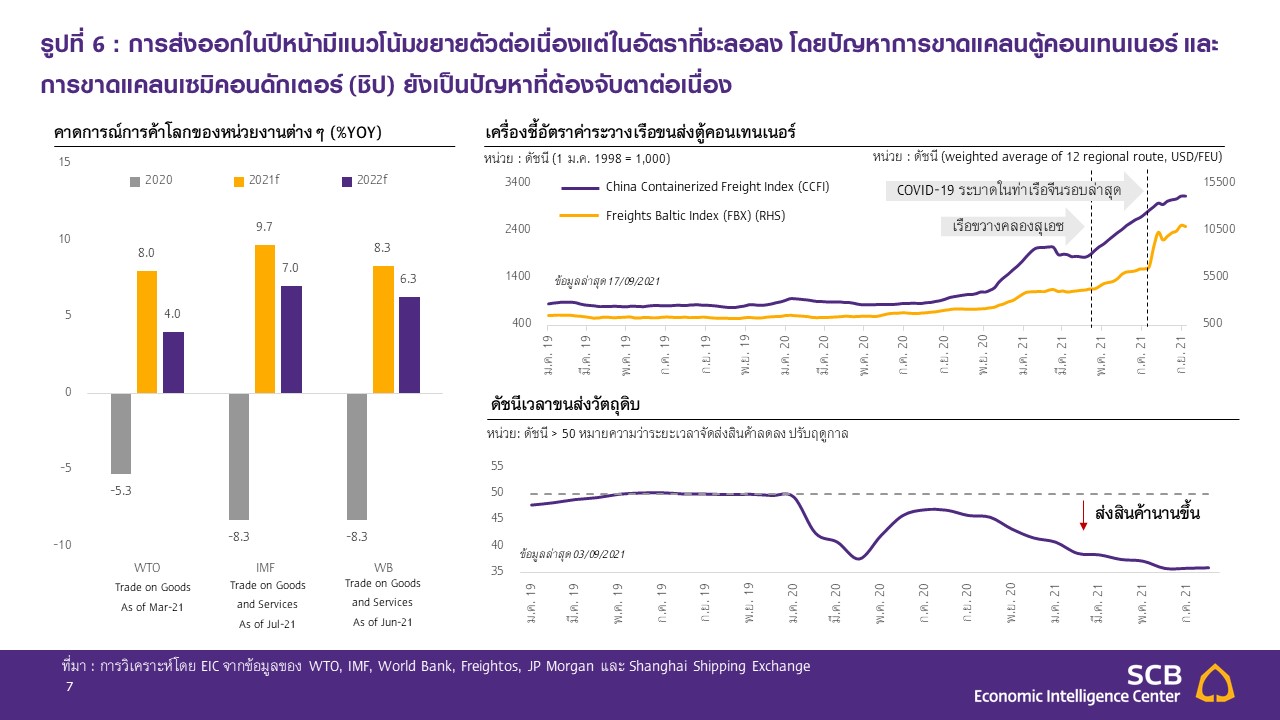
For 2022, exports are still expected to continue growing in line with the global economy at 4.7%, as the global economy is projected to continue expanding with progress in vaccination efforts, especially in developing economies, which will accelerate growth in line with developed economies, positively impacting Thailand's exports with an increasing number of recovering trading partners. However, the ongoing container shortage, which keeps shipping costs high, and the semiconductor (chip) shortage are likely to continue to pressure exporters next year.
Analysis from EIC website https://www.scbeic.com/th/detail/product/7826