Exploring the Thai Data Center Market: A Mega Trend Worth Watching
Analysis by SCB EIC
- The COVID-19 pandemic has been a significant catalyst for businesses to adopt technology more extensively, with the data center industry being one of the beneficiaries, supported by:
1. Changes in consumer behavior towards a new normal leading to increased reliance on online platforms for daily activities, resulting in a higher demand for data.
2. Digital transformation or the integration of technology into business operations at the organizational level, which is expanding rapidly. 3. Government agencies are likely to push for the development of a central cloud infrastructure project and support Thailand's position as a digital hub in ASEAN. - EIC estimates that the value of Thailand's data center market is expected to grow at a rate of 20% CAGR from 2020 to 2022, reaching approximately 32 billion baht. This growth will primarily come from the public cloud sector, which is anticipated to expand at a high rate of 24% CAGR, reaching 26 billion baht, as service users can save on IT equipment investments and have more flexibility in scaling their usage compared to colocation or private cloud models, which are expected to grow at 6% CAGR to 6 billion baht during the same period.
- However, the relatively high initial investment and competition from international players pose significant challenges for Thai operators. Therefore, operators should adapt to maintain growth rates and improve profitability in the future, such as:
1) Implementing modular data centers.
2) Focusing on public cloud services.
3) Collaborating with related businesses to create service synergies.
Continuously growing data centers are increasingly being designed and developed in the form of modular data centers, as this model can save costs, time, and provide flexibility for expansion. Data centers, which are responsible for receiving, storing, processing, and transmitting data, consist of three key components: 1) Site infrastructure capital, which includes the building where various systems are installed, such as electrical systems and air conditioning. Currently, investments in data center construction are shifting from traditional buildings that complete basic systems before installing servers and equipment to modular data centers (MDC), which are pre-fabricated units that operate independently. As demand increases, additional modules can be added, reducing construction delays and excessive initial investment, allowing for rapid expansion. 2) IT capital, which includes processing and data storage components such as storage devices, large processors, operating systems, racks, and internet connectivity equipment. 3) Human capital, which involves personnel managing and overseeing systems according to international standards set by institutions like the Uptime Institute, Telecommunications Industry Association (TIA), Building Industry Consulting Services International (BICSI), and International Organization for Standardization (ISO), as well as staff coordinating with clients and stakeholders.
In addition to building data centers for internal use, leasing services have created diverse business models for data center providers, offering options for businesses seeking data center services. Leasing can be divided into two forms: 1) Private cloud or colocation services, and 2) Public cloud services. The differences between private cloud (colocation) and public cloud services lie in the scope of service provided by the data center provider. In the case of private cloud (colocation), the provider supplies the space for basic equipment like racks and connectivity, while the service user invests in their own IT assets, such as servers and operating systems, paying monthly rent based on the space used. In contrast, public cloud providers supply all space and equipment, including IT assets, with users paying for services either through a subscription model or based on actual usage, allowing for flexibility in scaling usage as needed.
Public cloud services can be further categorized into three sub-types based on the level of service:
- Infrastructure as a Service (IaaS) refers to IT infrastructure services that support data storage and computer networking on the cloud, with charges based on actual usage. Examples of providers include Azure IaaS services, AWS EC2, Google Compute Engine, Rackspace, and INET.
- Platform as a Service (PaaS) refers to platforms for developing applications or software that operate on the cloud, with providers offering necessary tools for application development, such as web servers, databases, and development runtimes, with charges based on actual usage. Examples include AWS Elastic Beanstalk, Windows Azure, Google App Engine, Oracle Cloud, IBM Cloud, and Alibaba Cloud.
- Software as a Service (SaaS) refers to ready-to-use software services on the cloud, typically charged through a monthly or annual subscription model. Examples include Office365, Google Doc, Salesforce, Docusign, and Zoom applications.
However, when using public cloud services, users may have concerns about data security due to shared storage devices with other organizations, leading many to adopt hybrid cloud services, which combine private and public clouds. Hybrid clouds offer advantages in terms of lower initial investment compared to private clouds and can alleviate data security concerns, allowing users to store sensitive information on private clouds while keeping general data on public clouds.
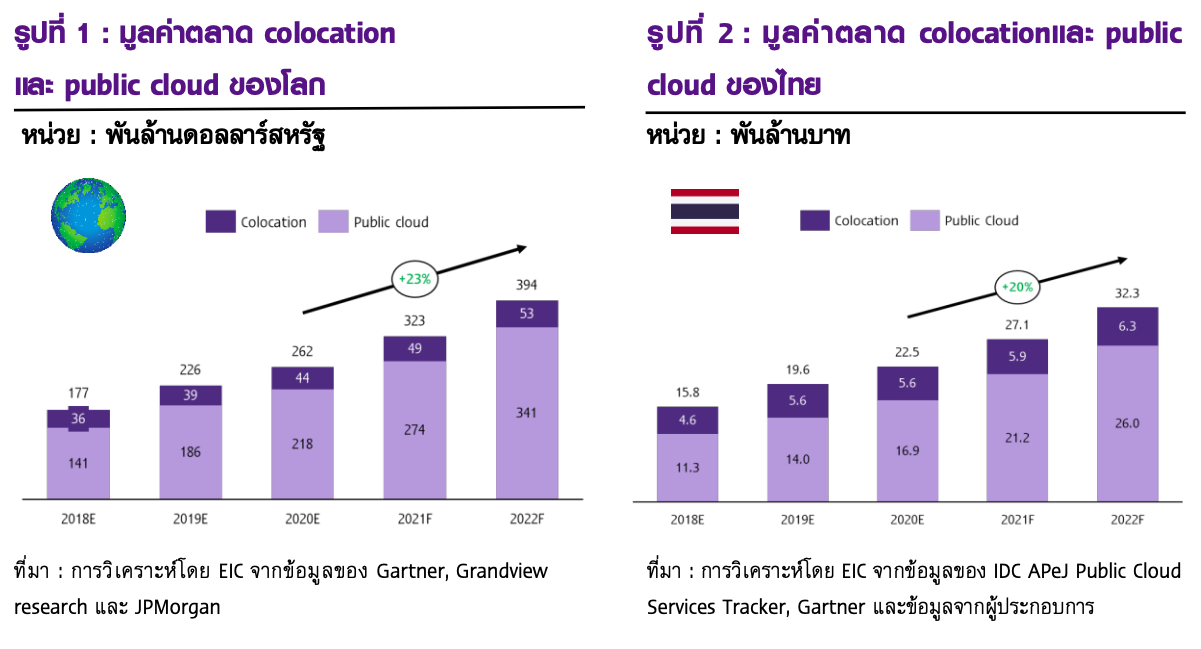
The global data center service market is expected to continue growing at around 23% CAGR from 2020 to 2022, driven by the rapidly expanding public cloud market, which effectively meets organizational needs under the new normal. The total value of the data center market in 2022 is projected to reach approximately $390 billion (around 12 trillion baht). Historically, the data center service market has seen an average growth rate of 22% CAGR from 2018 to 2020, supported by the continuous increase in data usage due to advancements in digital technology and the growing accessibility of smartphones and high-speed internet among consumers. This growth rate is expected to accelerate due to the COVID-19 pandemic, which has been a significant factor in organizations adopting cloud technology more extensively. This trend is likely to continue in the future, as cloud technology can help organizations reduce IT costs and enable employees to work from anywhere at any time through various software applications, such as customer relationship management (CRM) software, teleconferencing software, online document management, and e-signature solutions, based on data collected from leading research institutions on data center business trends.
Internationally, EIC estimates that the colocation market will grow at a slower rate than the overall data center market, projected to grow at around 8% CAGR to reach $52 billion from 2020 to 2022, due to pressure from some customers who may switch to public cloud services as part of their efforts to reduce operational costs. Meanwhile, the public cloud market is expected to grow significantly at 25% CAGR, reaching $340 billion by 2022.
The value of Thailand's data center service market is expected to grow at a slower rate than the global market, with projections of a 20% CAGR increase from 2020 to 2022, reaching around 32 billion baht. This marks an acceleration from the average growth rate of approximately 19% CAGR from 2018 to 2020. The colocation market is expected to grow at around 6% CAGR to reach 6.3 billion baht by 2022, which is lower than the global market (8% CAGR) due to Thailand's economic conditions during 2021-2022, which are expected to recover more slowly than the global economy due to the impact of the new wave of COVID-19. This has led some businesses to delay IT asset investments or shift towards public cloud usage due to lower initial investment costs. Meanwhile, Thailand's public cloud market is expected to grow close to the global market (25% CAGR), projected to expand at around 24% CAGR to reach 26 billion baht in 2022 due to increased cloud technology adoption within organizations.
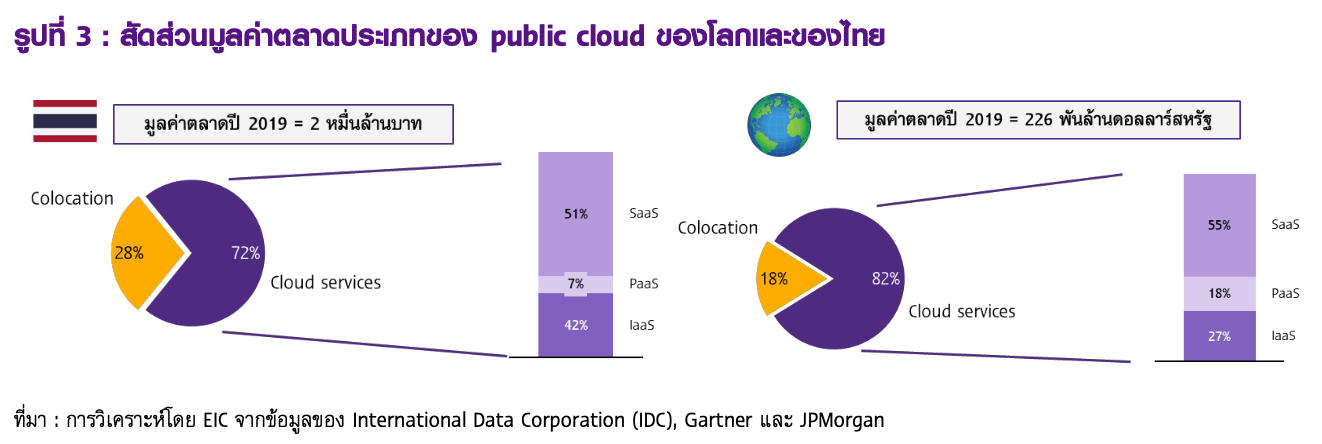
Additionally, in 2019, the proportion of the data center market value showed that the public cloud accounted for 72%, which is still lower than the global market proportion of around 80%, indicating significant opportunities for the expansion of Thailand's public cloud market in the future. This aligns with the market direction, where public cloud growth rates are expected to surpass colocation. Currently, over 93% of public cloud services are IaaS and SaaS, while the market value of PaaS accounts for only 7%. EIC anticipates that two main groups of Thai providers, namely IaaS providers (mostly the same as colocation providers) and SaaS providers (mostly startup companies developing cloud-based software), will be crucial drivers for Thailand's data center and cloud business in the future. Although the PaaS market is expected to grow alongside the public cloud market, most providers in Thailand are still large foreign technology companies such as Amazon, Google, Microsoft, and Alibaba.
The growth of both colocation and public cloud is supported by three factors driving data demand from consumers, businesses, and government agencies:
1) Consumer sector: Data usage is expected to continue growing alongside the expansion of Cloud Gaming, Over-the-top platforms (OTT), social media, and e-commerce. This growth reflects the changing consumer behavior towards increased reliance on online platforms for daily activities, as evidenced by the average mobile data usage in Thailand, which has grown at an average of 38% CAGR (1H2019-1H2021) to reach 20.3 GB per number per month in the first half of 2021. Similarly, the number of fixed broadband internet users in Thailand grew by about 14% YOY, reaching 11 million in 2020.
2) Business sector: The COVID-19 pandemic has accelerated businesses' adoption of technology for operations (digital transformation), including Artificial Intelligence (AI), Big Data analytics, automation systems, and cloud computing. This will significantly increase data usage in businesses. The Digital Economy Promotion Agency (DEPA) estimates that the market value of big data analytics in Thailand is expected to grow at 12% CAGR (2020-2022) to around 19 billion baht in 2022. Additionally, foreign research forecasts indicate that the global market value of SaaS Customer Relationship Management (CRM) and Enterprise Resource Planning (ERP) operating on the cloud is expected to grow at average rates of 14% CAGR and 17% CAGR, respectively, from 2021 to 2025.
3) Government sector: The government has projects to develop a central cloud infrastructure system (Government Data Center and Cloud Service: GDCC) to support the storage of government data in a fully digital system, including initiatives to position Thailand as a digital hub in ASEAN by providing tax incentives (BOI) to data center providers.
While the data center business shows promising growth, there are significant challenges to monitor, including high initial investment requirements and competition from international players. The nature of the business requires substantial infrastructure investment to support server and equipment operations, resulting in high initial capital and fixed costs due to investments in building construction, systems, racks, maintenance staff, and servers for customer service. According to accounting systems, it takes time to amortize all expenses, impacting the profitability of service providers in the early stages of business operations, as occupancy rates are still relatively low. Increased competition from international providers is another factor to watch, potentially leading to market share competition through diverse service offerings that meet varying customer needs, trust in user experience and recognized expertise, and price competition due to larger companies with higher investment budgets. Notable foreign providers planning to expand in Thailand include STT-GDC in partnership with Fraser, Huawei, NTT, Supernap, Tencent Cloud, and KT Corporation.
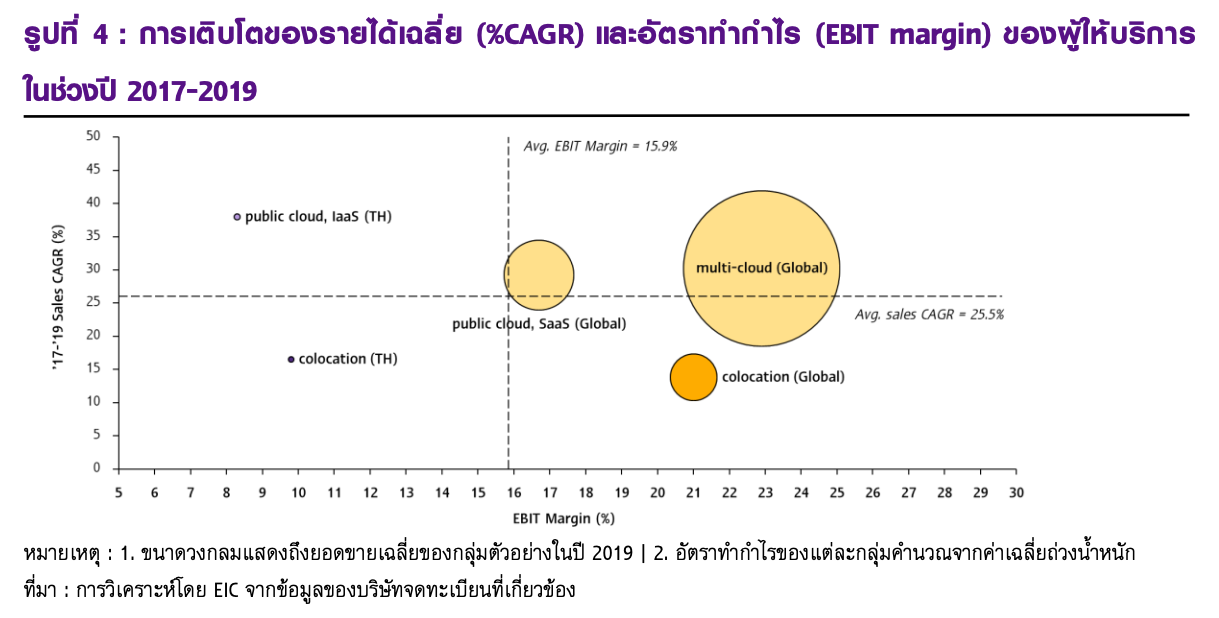
Regarding the performance of Thai data center providers over the past three years (2017-2019), there has been continuous growth. However, compared to global providers, Thai providers' profit margins remain lower. A study of a sample of 20 data center providers (both Thai and foreign) found that from 2017 to 2019, the average revenue growth of the group was 25% CAGR, indicating strong business expansion. Thai colocation providers experienced an average revenue growth of 16% CAGR, similar to foreign providers at around 14% CAGR, while Thai public cloud providers saw an average growth rate of about 38% CAGR, outperforming foreign SaaS and multi-cloud providers (covering IaaS, PaaS, and SaaS) at around 29% CAGR and 30% CAGR, respectively, due to the smaller revenue base of Thailand's cloud market. Additionally, in the past 3-4 years, digital technology has played a more significant role in Thailand. Furthermore, the revenue of both Thai and foreign public cloud providers has grown better than colocation, aligning with the overall market conditions. However, in terms of profit margins (EBIT margin), it was found that on average, Thai providers have lower profit margins than foreign providers. Thai colocation providers have an EBIT margin of about 10%, lower than foreign providers at 22%, while Thai public cloud providers have an EBIT margin of 8%, lower than foreign SaaS and multi-cloud providers at 17% and 23%, respectively, due to economies of scale, where global players have advantages in higher revenue bases, allowing for better cost management under a high fixed cost structure.
In the future, EIC expects that the revenue and profit margins of Thai providers will gradually improve as the market expands and economies of scale improve from a larger revenue base. This is especially true for public cloud providers, where the market is experiencing high growth, while colocation providers may face pressure from some users switching to public cloud services, resulting in slower growth rates. Increased competition from international providers will be a critical factor to watch in the medium term.
EIC presents three adaptation strategies for operators to prepare for increasing competition in the future:
1. Implementing modular data centers will help reduce initial investment costs and improve cost management due to the flexibility in expanding service areas.
2. Increasing focus on public cloud services to cater to the growing public cloud market in the future. Additionally, public cloud services offer better profit margins per rack than colocation.
3. Business collaborations to enhance options and create service synergies, such as partnering with System Integrators (SI) that provide cyber security solutions to increase customer confidence in using public cloud services, as well as collaborating with foreign providers to offer platform as a service (PaaS), which currently has few Thai operators.
The growth of the data center business also benefits other businesses in the supply chain, with EIC identifying:
1) IT equipment manufacturers
2) Construction contractors
3) Connectivity service providers as three groups significantly benefiting from this growth.
1. IT equipment manufacturers directly benefit from the production and distribution of IT equipment, which is a core component of data centers, such as hard disks, switches, routers, and cables. Gartner, a leading global technology research firm, estimates that global spending on data center systems and equipment will grow by about 8% YOY in 2021, reaching approximately $237 billion.
2. Construction contractors benefit not only from the increased demand for data center construction but also from the complexity of constructing and installing mechanical and electrical (M&E) systems in data centers, which require specialized expertise to ensure efficient operation according to standards. This results in higher profit margins for data center construction contractors compared to general contractors. Studies show that data center construction contractors have an average EBIT margin of around 20%, higher than general contractors, which typically range from 5% to 10%.
3. System integrators act as intermediaries connecting IT equipment and software manufacturers with users through various roles, including IT equipment distribution, software installation, consulting, and system management, ensuring that data center and cloud computing usage effectively meets user needs. EIC expects that system integrators, often collaborating with foreign IT companies like CISCO, Oracle, IBM, and Salesforce, will significantly benefit from the growth of the data center business, particularly in the cloud service solutions and cyber security sectors, which are growing rapidly alongside the expansion of public cloud usage in organizations.
In summary, the data center business is another future-oriented industry worth watching, with a strong growth trajectory driven by increasing data usage demands from three sectors: consumers, businesses, and government agencies, which positively impacts service providers in terms of revenue growth and improved profit margins. However, challenges related to high initial investment costs and competition from foreign companies necessitate that operators adapt to these factors moving forward.
Analysis by >>> https://www.scbeic.com/th/detail/product/7756
Author: Olan Ueawithayasuporn ([email protected])
Analyst
Economic Intelligence Center (EIC)
Siam Commercial Bank Public Company Limited
EIC Online: www.scbeic.com
Line: @scbeic